
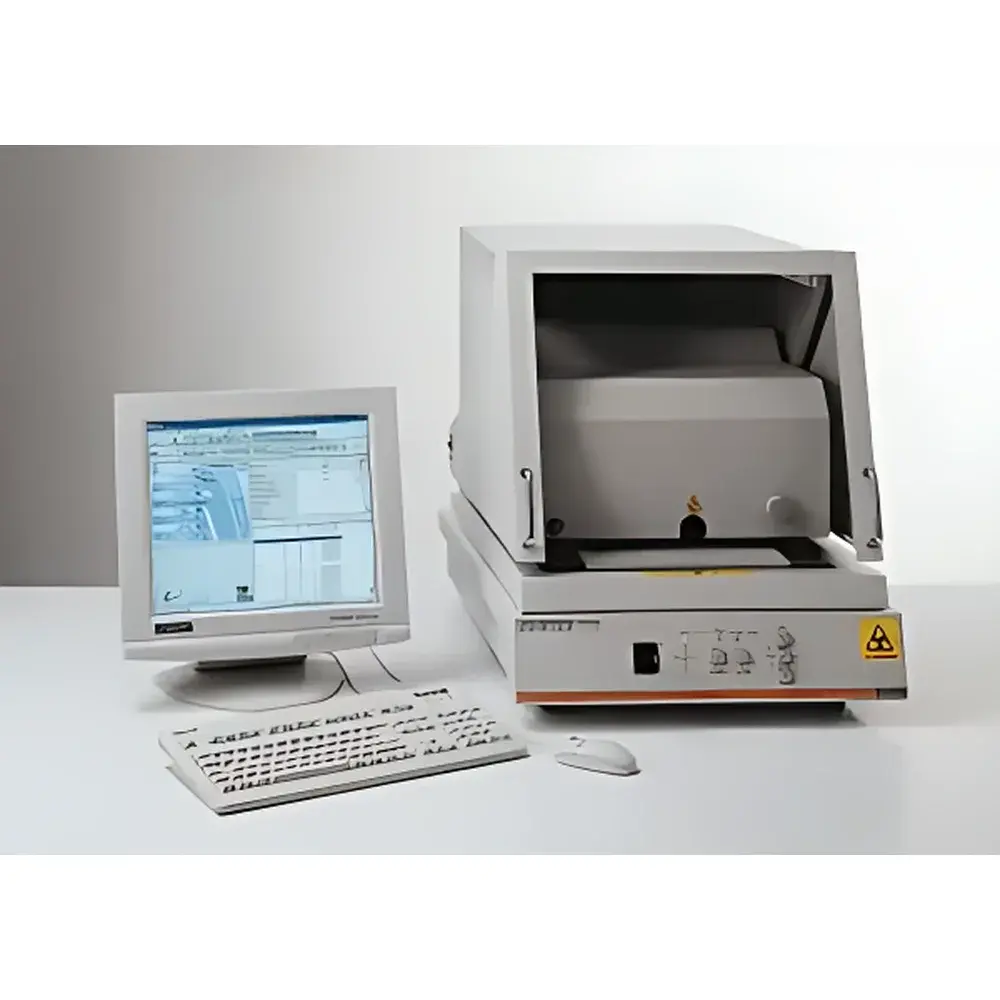
Fischer XDL-B Series X-Ray Fluorescence Coating Thickness Analyzer
| Brand | Fischer |
|---|---|
| Origin | Germany |
| Model | XDL-B Series |
| Measurement Principle | Energy-Dispersive X-Ray Fluorescence (ED-XRF) |
| Standards Compliance | DIN 50987, ISO 3497, ASTM B568 |
| X-ray Tube Voltage | Adjustable up to 50 kV |
| Collimator Options | 0.3 mm Ø standard |
| Measurement Chamber Dimensions (H×W×D) | 650 × 570 × 740 mm |
| Chamber Internal Dimensions (H×W×D) | 300 × 460 × 500 mm |
| Mass | ~105 kg |
| Viewing System | Integrated color CCD camera with real-time zoom and focus control |
| Distance Control Method | DCM (Distance Correction Method) for automated spectral intensity compensation across 3 fixed source-to-sample distances (standard: mid-position) |
| Sample Height Adjustment | Fixed-height X-ray head with removable support plate for oversized parts |
| Interface | RS-232, Ethernet-ready for remote command control |
| Software Platform | Native Win32 application for Windows 2000/XP |
| Language Support | English, German, French, Italian, Spanish, Chinese |
| Reporting & SPC | Embedded statistical engine with SPC charts, probability plots, histogram analysis, and customizable report generation including annotated sample images |
Overview
The Fischer XDL-B Series X-Ray Fluorescence Coating Thickness Analyzer is a precision benchtop ED-XRF system engineered for non-destructive, quantitative measurement of metallic coating thicknesses and elemental composition on complex industrial substrates. Operating on the fundamental principle of energy-dispersive X-ray fluorescence, the instrument irradiates the sample surface with a focused primary X-ray beam; characteristic secondary (fluorescent) X-rays emitted from constituent elements are spectrally resolved by a silicon drift detector (SDD) to determine both layer thickness and alloy composition simultaneously. Designed in strict accordance with international metrological standards—including DIN 50987 (German standard for XRF coating measurement), ISO 3497 (metallic coatings – measurement of coating thickness – X-ray spectrometric methods), and ASTM B568 (standard test method for coating thickness by X-ray spectroscopy)—the XDL-B delivers traceable, repeatable results suitable for quality assurance in electroplating, PCB manufacturing, automotive finishing, and aerospace component verification.
Key Features
- DCM (Distance Correction Method): Compensates automatically for spectral intensity variations caused by changes in source-to-sample distance—critical for measuring recessed features such as microwave cavity interiors, threaded fasteners, or stepped substrates without manual recalibration.
- Multi-layer capability: Supports quantitative analysis of single-, double-, and triple-layer systems—including cases where an alloy layer resides either as the outermost or intermediate layer.
- Advanced alloy analysis: Quantifies up to four elemental constituents within binary or ternary alloys; includes dedicated calibration routines for karat gold analysis and electrolyte monitoring (up to two cationic species in plating baths).
- High-resolution optical viewing: Integrated color CCD camera enables real-time imaging with digital zoom, autofocus, and overlay of calibrated crosshairs aligned precisely with the X-ray beam footprint—visualized dynamically based on selected collimator and working distance.
- Modular collimation: Standard 0.3 mm circular aperture; optional slotted (0.05 × 0.3 mm), 0.1 mm, 0.2 mm, or 0.4 × 0.4 mm square collimators available to optimize spatial resolution and signal-to-noise ratio for micro-feature analysis.
- Robust mechanical architecture: Fixed-source geometry with three pre-set source-to-sample distances (low/mid/high); removable support plate accommodates oversized or irregularly shaped components up to 300 mm height.
Sample Compatibility & Compliance
The XDL-B accommodates a broad range of conductive and non-conductive substrates—including steel, aluminum, copper, plastics, and ceramics—provided surface geometry permits stable positioning within the measurement chamber. Its top-down irradiation geometry and DCM algorithm ensure reliable performance on curved, sloped, or recessed surfaces where conventional fixed-distance systems fail. All measurement protocols and calibration data structures comply with GLP/GMP documentation requirements. Audit trails, user access levels (via password-protected menu restrictions), and timestamped result logs support regulatory readiness under FDA 21 CFR Part 11 when integrated into validated laboratory environments. Full traceability is maintained through embedded reference to certified calibration standards (e.g., NIST-traceable multilayer foils) and adherence to ISO/IEC 17025–aligned uncertainty estimation practices.
Software & Data Management
Running natively on Windows 2000/XP platforms, the XDL-B’s Win32 software provides a fully graphical, context-sensitive interface with integrated online help. Spectral libraries are extensible to elements from titanium (Ti, Z=22) through uranium (U, Z=92), enabling custom method development for emerging plating chemistries. The “Application Toolbox”—comprising pre-configured parameter sets stored on removable media and matched physical calibration standards—streamlines method deployment across production shifts or laboratories. Reports embed annotated sample images, spectral overlays, and quantitative tables; export formats include CSV, XML, and PDF. Statistical process control (SPC) tools generate X-bar/R charts, capability indices (Cp/Cpk), probability plots, and histograms—all compliant with AIAG SPC guidelines. Remote operation is supported via RS-232 serial commands or network-based TCP/IP control, facilitating integration into automated test cells or centralized QA dashboards.
Applications
- Quality control of decorative and functional electroplated layers (e.g., Ni/Cr, Cu/Ni/Cr, Sn, Zn, Au, Ag) on automotive trim, connectors, and consumer electronics.
- Thickness verification of immersion silver, ENIG (electroless nickel immersion gold), and OSP (organic solderability preservative) on printed circuit boards.
- In-process monitoring of electroplating bath composition via direct analysis of anode dissolution products or bath samples.
- Failure analysis of delamination, interdiffusion, or oxidation at coating-substrate interfaces using depth-resolved spectral deconvolution.
- Compliance testing for RoHS, REACH, and ELV directives by quantifying restricted substances (e.g., Pb, Cd, Cr⁶⁺, Hg) beneath surface finishes.
FAQ
What standards does the XDL-B comply with for coating thickness measurement?
The system conforms to DIN 50987, ISO 3497, and ASTM B568—internationally recognized standards governing XRF-based thickness determination.
Can the XDL-B measure coatings on non-flat or recessed surfaces?
Yes. Its DCM algorithm compensates for variable source-to-sample distances, enabling accurate measurements on curved, stepped, or deeply recessed geometries such as waveguide cavities or threaded components.
Is remote operation supported?
Yes—via RS-232 serial interface or network-enabled command protocols, allowing integration into factory automation systems or centralized QA networks.
What collimator options are available beyond the standard 0.3 mm aperture?
Optional configurations include slotted (0.05 × 0.3 mm), 0.1 mm, 0.2 mm, and 0.4 × 0.4 mm square apertures—each optimized for specific spatial resolution and detection sensitivity trade-offs.
Does the software support multi-language operation?
Yes—interface languages include English, German, French, Italian, Spanish, and Chinese, configurable per user session.
How is calibration maintained across different operators or shifts?
Calibration integrity is preserved through encrypted, version-controlled method files and hardware-matched reference standards; user-level permissions restrict access to critical calibration parameters.



