
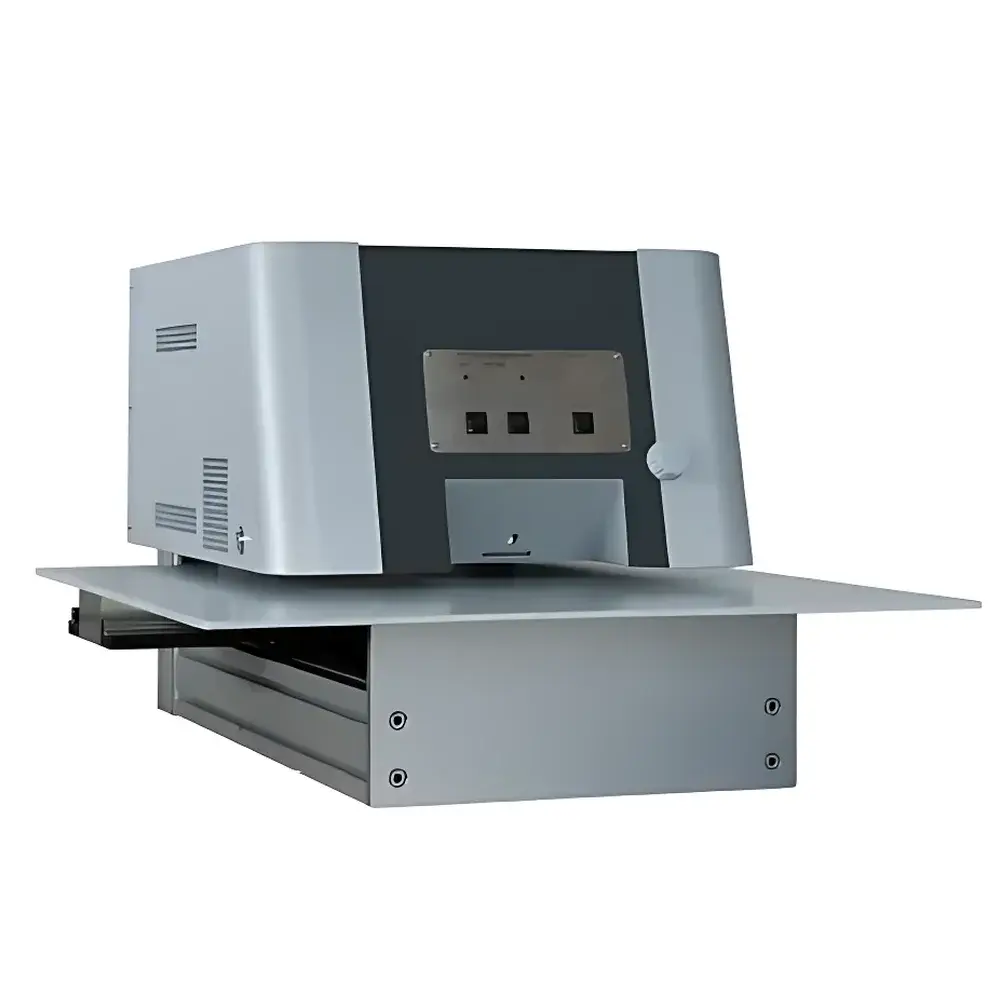
FISCHERSCOPE X-RAY XDLM-PCB 220 X-ray Fluorescence Thickness Analyzer
| Brand | Fischer |
|---|---|
| Origin | Germany |
| Model | XDLM-PCB 220 |
| X-ray Tube | Tungsten anode microfocus tube with beryllium window |
| Tube Voltage | 3 adjustable high-voltage settings (up to 50 kV) |
| Detector | Proportional counter detector |
| Collimators | Motorized, multiple interchangeable apertures |
| Primary Filters | 3 motorized basic filters |
| Sample Stage | Motorized XYZ stage with programmable XY positioning and pop-up function |
| Optical Alignment | High-resolution color camera + laser pointer for precise targeting |
| Measurement Geometry | Horizontal sample chamber with bottom-access gap for large PCBs |
| Analysis Method | Fundamental Parameters (FP) quantification without calibration standards |
| Compliance | Designed for ISO 3497, ASTM B568, IPC-4552A, and RoHS/WEEE screening workflows |
Overview
The FISCHERSCOPE X-RAY XDLM-PCB 220 is a benchtop energy-dispersive X-ray fluorescence (EDXRF) analyzer engineered specifically for non-destructive thickness measurement and elemental composition analysis of metallic coatings on printed circuit boards (PCBs). It operates on the physical principle of characteristic X-ray emission: when a focused primary X-ray beam excites atoms in the sample, each element emits secondary (fluorescent) X-rays at discrete energies unique to its atomic structure. By spectrally resolving these emissions using a proportional counter detector and applying fundamental parameters (FP) algorithms, the instrument calculates coating thicknesses—down to sub-micrometer levels—and quantifies elemental mass fractions without reliance on matrix-matched reference standards. Its design prioritizes robustness, long-term stability, and operational simplicity in high-volume electronics manufacturing and quality assurance environments.
Key Features
- Microfocus tungsten X-ray tube with beryllium exit window, delivering high photon flux and spatial resolution for fine-feature PCB analysis
- Three-step selectable tube voltage (up to 50 kV), enabling optimal excitation across a broad elemental range—from chlorine (Cl, Z=17) to tin (Sn, Z=50) and beyond
- Motorized collimator turret offering multiple aperture sizes (e.g., 0.1 mm, 0.2 mm, 0.5 mm) to match measurement area requirements and maximize signal-to-noise ratio
- Three-position motorized primary filter wheel, supporting tailored spectral optimization for specific coating-substrate combinations (e.g., Ni/Cu, Au/Ni/Cu, Sn/Pb)
- High-precision motorized XYZ stage with programmable XY travel (±50 mm), integrated pop-up lift mechanism, and repeatable positioning accuracy ≤ ±1 µm
- Real-time optical guidance system comprising a high-resolution color CMOS camera and coaxial laser pointer for rapid, unambiguous target alignment—even on densely populated PCBs
- Horizontal sample chamber architecture with bottom clearance gap (≥30 mm height), facilitating direct placement and measurement of oversized or panel-mounted PCB assemblies
Sample Compatibility & Compliance
The XDLM-PCB 220 accommodates rigid and flexible PCB substrates up to 300 × 300 mm in footprint and 30 mm in maximum thickness. It supports single-layer, multi-layer, and alloy-coated systems—including ENIG (electroless nickel immersion gold), ENEPIG, HASL (hot air solder leveling), OSP (organic solderability preservative), and immersion silver/tin. The instrument complies with international metrological and regulatory frameworks governing coating verification: ISO 3497 (metallic coatings — measurement of coating thickness — X-ray spectrometric methods), ASTM B568 (standard test method for measurement of coating thicknesses by X-ray spectroscopy), and IPC-4552A (qualification and performance specification for electroless nickel/immersion gold plating on printed wiring boards). Its FP-based quantification engine meets GLP/GMP traceability requirements when paired with audit-ready software logging and user access controls.
Software & Data Management
Operating under FISCHER’s WinFTM® v8 platform, the XDLM-PCB 220 provides intuitive workflow-driven measurement sequencing, automated report generation (PDF/CSV), and full spectral data archiving. The software implements FDA 21 CFR Part 11–compliant electronic signatures, audit trail functionality, and role-based user permissions. Measurement programs—including stage coordinates, tube parameters, collimation/filter selection, and FP calculation models—are saved as reusable templates. Spectral overlays, peak deconvolution tools, and real-time background subtraction support method development and troubleshooting. All raw spectra and processed results are timestamped, user-annotated, and exportable for SPC integration or external statistical analysis.
Applications
- Thickness verification of immersion gold (0.05–0.2 µm), electroless nickel (2–8 µm), and immersion tin (0.8–1.5 µm) layers on PCB pads and vias
- Quantitative analysis of Pb content in lead-free HASL finishes per JEDEC J-STD-006 and RoHS Directive Annex II limits
- Verification of Cu thickness in outer-layer etch-back processes and inner-layer foil lamination
- Multi-layer stack analysis (e.g., Au/Ni/Cu/Sn) using iterative FP modeling and interlayer absorption correction
- In-process QA during PCB surface finish lines, particularly where rapid turnaround and minimal operator training are critical
- Failure analysis support—detecting contamination (e.g., Cl, Br), incomplete plating, or intermetallic diffusion zones via elemental mapping
FAQ
Does the XDLM-PCB 220 require certified reference standards for routine operation?
No. Its fundamental parameters (FP) algorithm eliminates dependency on physical calibration standards for most common PCB coating systems, reducing cost-of-ownership and method development time.
Can it measure coatings on curved or irregular PCB surfaces?
It is optimized for flat, rigid substrates. For non-planar geometries, measurement uncertainty increases; optional height-sensing Z-axis compensation may be configured upon request.
Is the instrument compliant with ISO/IEC 17025 laboratory accreditation requirements?
Yes—when operated with documented SOPs, regular performance verification (e.g., using check standards traceable to NIST SRMs), and full software audit trails enabled.
What maintenance intervals are recommended for the X-ray tube and detector?
The microfocus tungsten tube has a typical service life exceeding 15,000 operating hours; the proportional counter requires no scheduled replacement but benefits from annual sensitivity verification using certified reference foils.
Can measurement data be integrated into MES or ERP systems?
Yes—WinFTM® supports ODBC-compliant database export and configurable XML/JSON API endpoints for enterprise system interoperability.



