
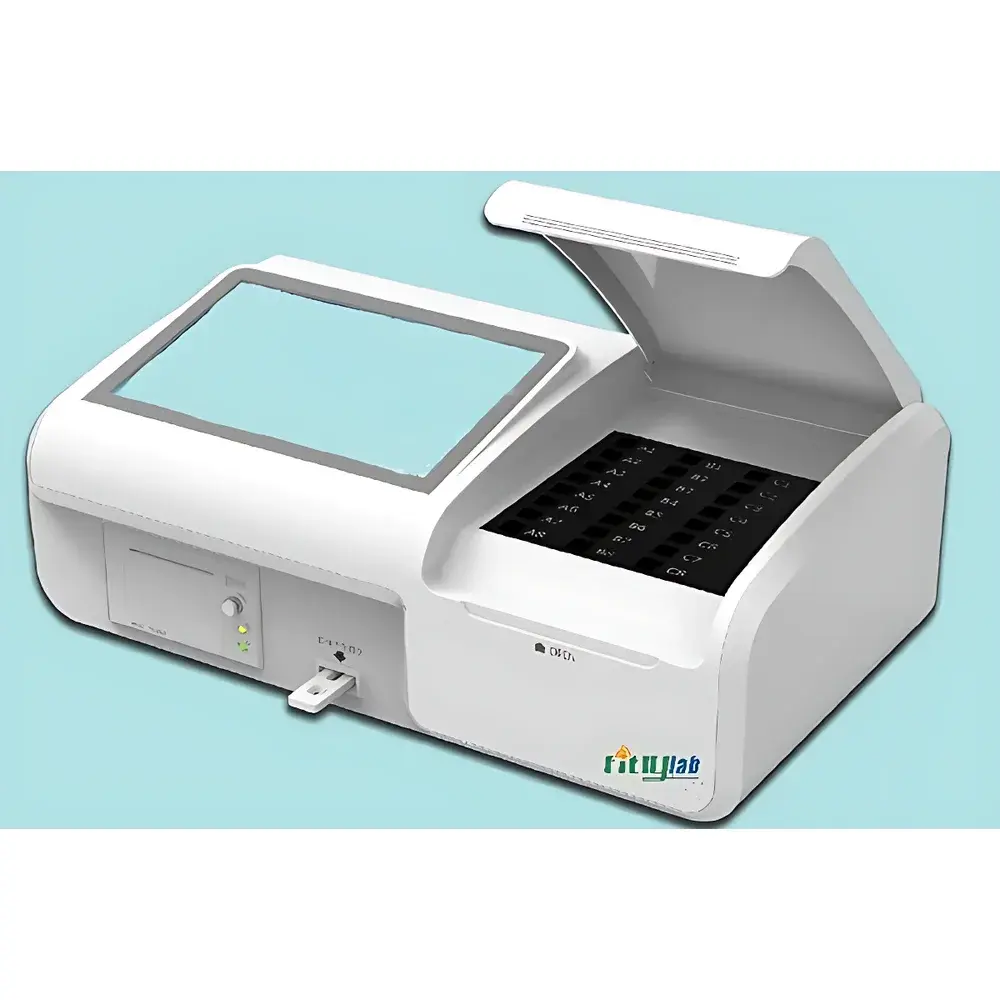
Fitlylab FITLY-9616 Food Safety Comprehensive Analyzer
| Brand | Fitlylab |
|---|---|
| Origin | Shenzhen, China |
| Manufacturer Type | Authorized Distributor |
| Country of Origin | China |
| Model | FITLY-9616 |
| Function Type | Multi-analyte (Simultaneous Detection of 30+ Food Contaminants & Additives) |
| Sample Compatibility | Liquid, Solid, Semi-solid Extracts (Homogenized or Centrifuged) |
| Wavelength Range | 410–900 nm (Fixed LED Sources at 410, 536, 595, 620 nm) |
| Detection Channels | 16-Channel Photometric Array |
| Photometric Repeatability | ≤ ±1% T |
| Immunoassay Detection Mode | Single-Channel CCD-Based Lateral Flow Reader (3-Megapixel, 2048×1536 Resolution, Reflective T/C Quantification) |
| T/C Accuracy | ≤ ±0.1 T/C |
| T/C Precision (CV) | ≤ 5% |
| Stability | ≤ 0.1 T/C over 10 min |
| Assay Time | <10 s per lateral flow strip |
| Data Export Format | Excel (.xlsx) |
| Connectivity | USB 2.0, Wi-Fi 802.11 b/g/n, Bluetooth 4.2, 10/100 Mbps Ethernet |
| Onboard Storage | 32 GB SSD |
| RAM | 4 GB |
| CPU | Dual-core 1.6 GHz |
| Display | 10.2-inch Full-color Capacitive Touchscreen |
| Weight | ≤ 3.0 kg |
Overview
The Fitlylab FITLY-9616 Food Safety Comprehensive Analyzer is a field-deployable, dual-mode analytical platform engineered for regulatory-grade screening and semi-quantitative quantification of foodborne hazards in resource-constrained or mobile environments. It integrates two complementary detection technologies: (1) a 16-channel visible-range spectrophotometer operating across 410–900 nm with four fixed-wavelength LED sources (410, 536, 595, 620 nm), optimized for colorimetric assays based on enzymatic inhibition, chromogenic reactions, or complexometric binding; and (2) a high-resolution CCD-based lateral flow immunoassay reader capable of precise reflectance-based T-line/C-line (T/C) ratio quantification for rapid immunochromatographic tests. The instrument complies with fundamental performance requirements outlined in ISO 17025:2017 (Clause 5.9 — Method Validation), ASTM E2912–22 (Standard Guide for Rapid Screening Methods for Food Contaminants), and China’s GB/T 5009 series for food safety testing protocols. Its architecture supports method-specific calibration curves, blank subtraction, and multi-point standardization—enabling traceable results suitable for preliminary compliance assessment prior to confirmatory LC-MS/MS or HPLC analysis.
Key Features
- Dual-technology integration: Simultaneous operation of photometric and lateral flow modalities without hardware reconfiguration
- 16 independent optical channels with real-time dark-current compensation and auto-zeroing at system startup
- Calibration traceability: Preloaded NIST-traceable absorbance standards for 410/536/595/620 nm wavelengths; user-definable calibration curves stored per assay protocol
- Robust embedded computing: Dual-core 1.6 GHz processor, 4 GB RAM, and 32 GB SSD ensure responsive UI navigation and local data buffering during offline operation
- Regulatory-ready data governance: Automatic timestamping, operator ID logging, method version control, and immutable result archives compliant with GLP documentation practices
- Field-hardened portability: Weighing ≤3.0 kg with integrated battery support (optional), shock-absorbing chassis, and IP52-rated enclosure for transport and roadside deployment
- Expandable assay library: Firmware-upgradable test protocols via USB or OTA; validated methods preloaded for >30 analytes including organophosphate pesticides, aflatoxin B1, melamine, lead, mercury, formaldehyde, nitrite, and peroxide value
Sample Compatibility & Compliance
The FITLY-9616 accepts homogenized extracts, centrifuged supernatants, or clarified filtrates from diverse matrices—including raw produce, meat, dairy, edible oils, grains, condiments, and processed foods. Sample preparation follows AOAC Official Method guidelines or GB 5009 national standards where applicable. All onboard assays are validated against reference materials certified by CNAS-accredited laboratories (e.g., CRM 8200 series for heavy metals, CRM 8100 for mycotoxins). The system meets the instrumental performance criteria specified in USP Analytical Instrument Qualification for Category C instruments (computerized systems with audit trail), and supports 21 CFR Part 11-compliant electronic signatures when deployed with optional authentication modules.
Software & Data Management
The analyzer runs FitlyOS v4.2—a Linux-based, menu-driven interface designed for non-specialist operators. Software modules include: (1) Assay Wizard for guided sample loading and parameter selection; (2) Batch Manager for multi-sample queueing and parallel processing; (3) Report Generator supporting PDF and Excel export with embedded chromatograms (for lateral flow scans) and calibration plots; (4) Audit Log Viewer with filterable entries by date, user, or assay type; and (5) Cloud Sync Agent enabling encrypted upload to FitlyCloud (AWS-hosted, SOC 2 Type II certified). All data files retain original metadata: acquisition time, ambient temperature/humidity (via onboard sensors), instrument serial number, and firmware revision.
Applications
- Routine surveillance by municipal food and drug administration teams conducting unannounced inspections at wet markets, school canteens, and catering facilities
- On-site verification of supplier declarations in cold-chain logistics hubs and wholesale distribution centers
- Pre-harvest pesticide residue screening in agricultural cooperatives using leaf dip or fruit peel extract protocols
- Quality assurance labs in beverage manufacturers performing daily checks for sulfites, benzoic acid, or total acidity
- Teaching laboratories for food science curricula demonstrating principles of enzyme-linked immunosorbent assays (ELISA), competitive inhibition kinetics, and Beer–Lambert law applications
- Emergency response units deploying mobile food safety labs during mass gathering events or post-disaster relief operations
FAQ
Does the FITLY-9616 require external calibration standards for routine use?
No—factory-installed wavelength and photometric calibrations are retained across power cycles. However, daily verification using supplied neutral density filters and reference strips is recommended per ISO/IEC 17025 internal quality control requirements.
Can third-party lateral flow strips be used with the CCD reader module?
Yes, provided they conform to standard 5-mm lateral flow cassette dimensions and utilize colloidal gold or dye-labeled conjugates. Users must configure line positions and T/C thresholds manually within the assay editor.
Is method validation documentation available for each preloaded assay?
Yes—each validated method includes a summary report detailing limit of detection (LOD), limit of quantitation (LOQ), recovery rates (85–115%), and inter-day precision (RSD ≤8%) generated under CNAS-accredited conditions.
How is data integrity ensured during wireless transmission?
All Wi-Fi and Bluetooth transfers employ TLS 1.2 encryption; locally stored datasets are SHA-256 hashed and digitally signed upon export to prevent tampering.
What maintenance procedures are required for long-term photometric stability?
Annual verification of LED intensity drift and detector dark current is advised. No optical alignment or lamp replacement is needed—the solid-state光源 design ensures >50,000-hour operational lifetime.
Related Products






