
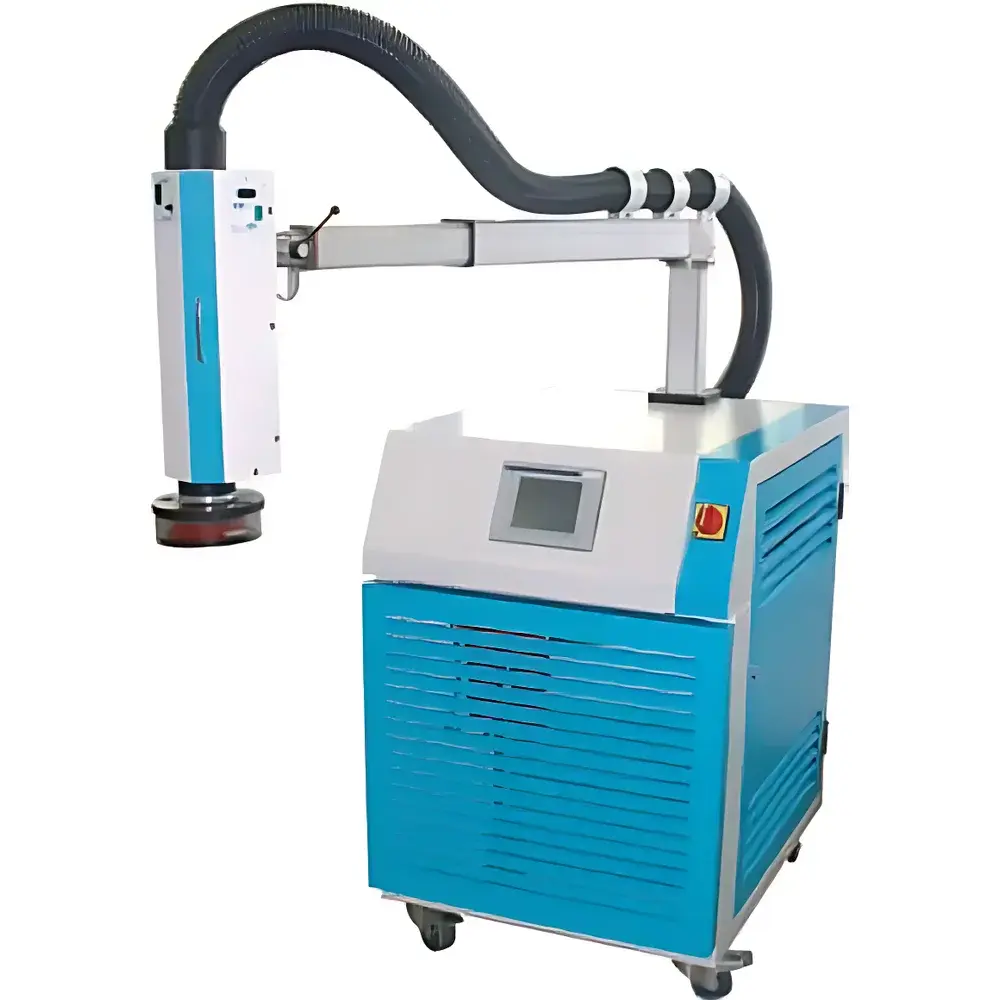
Froilabo Dragon High-Speed Thermal Shock System with Integrated Airflow Control
| Brand | Froilabo |
|---|---|
| Origin | France |
| Model | Dragon |
| Temperature Range | −80 °C to +225 °C |
| Temperature Transition Speed | <10 s (−55 °C ↔ +125 °C) |
| Accuracy | ±1.0 °C (calibrated) |
| Setpoint Resolution | 0.1 °C |
| Airflow Output | 5–20 SCFM (2.4–9.4 L/s, continuous) |
| Power Supply | 200–250 VAC, 50/60 Hz, 20 A, single-phase |
| Noise Level | <49 dBA (average) |
| Compliance | CE certified, CFC-free, GLP/GMP-ready interface support |
Overview
The Froilabo Dragon High-Speed Thermal Shock System is an engineered thermal management platform designed for precision environmental stress testing in semiconductor R&D, reliability engineering, and advanced materials qualification laboratories. Unlike conventional thermal chambers, the Dragon employs a closed-loop, variable-speed compressor architecture coupled with active airflow regulation—enabling rapid, repeatable, and highly controllable thermal transitions without reliance on cryogenic consumables (e.g., LN₂ or CO₂). Its core principle centers on forced convection using conditioned dry air, delivered via a dynamically regulated pneumatic path with integrated inline temperature sensing at the nozzle outlet. This architecture supports both steady-state thermal conditioning and high-fidelity thermal shock profiling—including ramp-and-soak, step transitions, and multi-zone cycling—across a broad operational envelope of −80 °C to +225 °C. The system is explicitly validated for wafer-level, package-level, and board-level device testing under JEDEC JESD22-A104 (Thermal Cycling), JESD22-A106 (Thermal Shock), and MIL-STD-883 Method 1010.8 protocols.
Key Features
- Sub-10-second thermal transition between −55 °C and +125 °C, verified per ASTM E1545 and IEC 60068-2-14 test criteria
- Zero-frost operation enabled by built-in desiccant air dryer and dew point control (≤+10 °C dew point at inlet)
- Integrated dual-touchscreen interface: one on main console, one on articulated airflow nozzle for localized parameter adjustment
- Variable-speed compressor optimized for low-noise operation (50% versus legacy thermal shock systems
- Modular nozzle design with tool-free, quick-swap adapters (5.5″, 5.7″, and 7″ internal diameters) for flexible DUT access and spatial integration
- Full electrical isolation and ESD-safe casters for safe deployment in cleanroom and benchtop environments
- Real-time temperature feedback from T-type, K-type, and RTD sensors—both embedded in the nozzle and externally configurable
Sample Compatibility & Compliance
The Dragon accommodates diverse sample geometries—from bare die and 300-mm wafers to populated PCBAs and automotive ECUs—via its extendable articulating arm (max extension: 139.7 cm) and height-adjustable base (standard: 70.6–131.6 cm; extended: 85.9–146.9 cm). Its tempered borosilicate viewing window (optional thermal shield) permits optical monitoring without thermal interruption. All airflow pathways meet ISO 8573-1 Class 2 particulate and oil contamination standards (≤0.10 ppm oil weight, ≤5 μm particle filtration). The system complies with CE marking requirements under the EU Machinery Directive 2006/42/EC and Electromagnetic Compatibility Directive 2014/30/EU. It supports audit-ready data integrity through timestamped, user-accessible logging to USB or SSD storage—fully traceable per FDA 21 CFR Part 11 and ISO/IEC 17025 documentation workflows.
Software & Data Management
The Dragon operates natively via Froilabo’s ACS (Automated Conditioning Suite) software—a modular, scriptable environment supporting Python-based test sequence definition, real-time waveform visualization, and automated pass/fail reporting. ACS provides native drivers for IEEE-488 (GPIB), RS-232, LAN (TCP/IP), and USB-TMC interfaces, enabling seamless integration into existing ATE platforms (e.g., Keysight PathWave, NI TestStand). All temperature profiles are stored with full metadata—including operator ID, calibration certificate reference, ambient condition logs, and sensor validation timestamps. Export formats include CSV, XML, and PDF reports compliant with GLP and GMP record retention policies. Remote monitoring and alarm notification (email/SNMP) are supported via optional Ethernet gateway configuration.
Applications
- Qualification of SiC and GaN power modules under accelerated thermal stress (JEDEC JEP180)
- Failure analysis of solder joint fatigue in automotive ADAS controllers
- Pre-burn-in thermal screening of MEMS accelerometers and pressure sensors
- Material coefficient-of-thermal-expansion (CTE) characterization via controlled thermal strain mapping
- Validation of conformal coating performance under cyclic thermal-humidity exposure (combined with external humidity modules)
- Process development for reflow profile optimization in advanced packaging (e.g., fan-out wafer-level packaging)
FAQ
Does the Dragon require liquid nitrogen or carbon dioxide for low-temperature operation?
No. The system uses a proprietary two-stage refrigeration cycle with environmentally compliant refrigerants (R-513A/R-1234yf blend), eliminating dependency on cryogens.
Can the Dragon be integrated into an automated test cell with PLC-level control?
Yes. Standard digital I/O, analog voltage outputs (0–10 V), and Modbus TCP support enable direct interfacing with industrial PLCs and MES systems.
What is the recommended compressed air specification for optimal performance?
Clean, dry air (CDA) at 90–110 PSIG (6.2–7.6 bar), 15–30 SCFM, with inlet temperature 15–25 °C and dew point ≤+10 °C. Filtration must meet ISO 8573-1 Class 2 for particles and oil.
Is calibration traceable to national standards?
Each unit ships with a UKAS-accredited calibration certificate (NIST-traceable reference standards), valid for 12 months under normal operating conditions.
How is temperature uniformity maintained across the airflow stream?
Uniformity is ensured by laminar flow optimization within the nozzle manifold, real-time feedback from three-point sensor array (center + dual offset), and adaptive PID tuning based on load-dependent thermal mass estimation.
Related Products



