
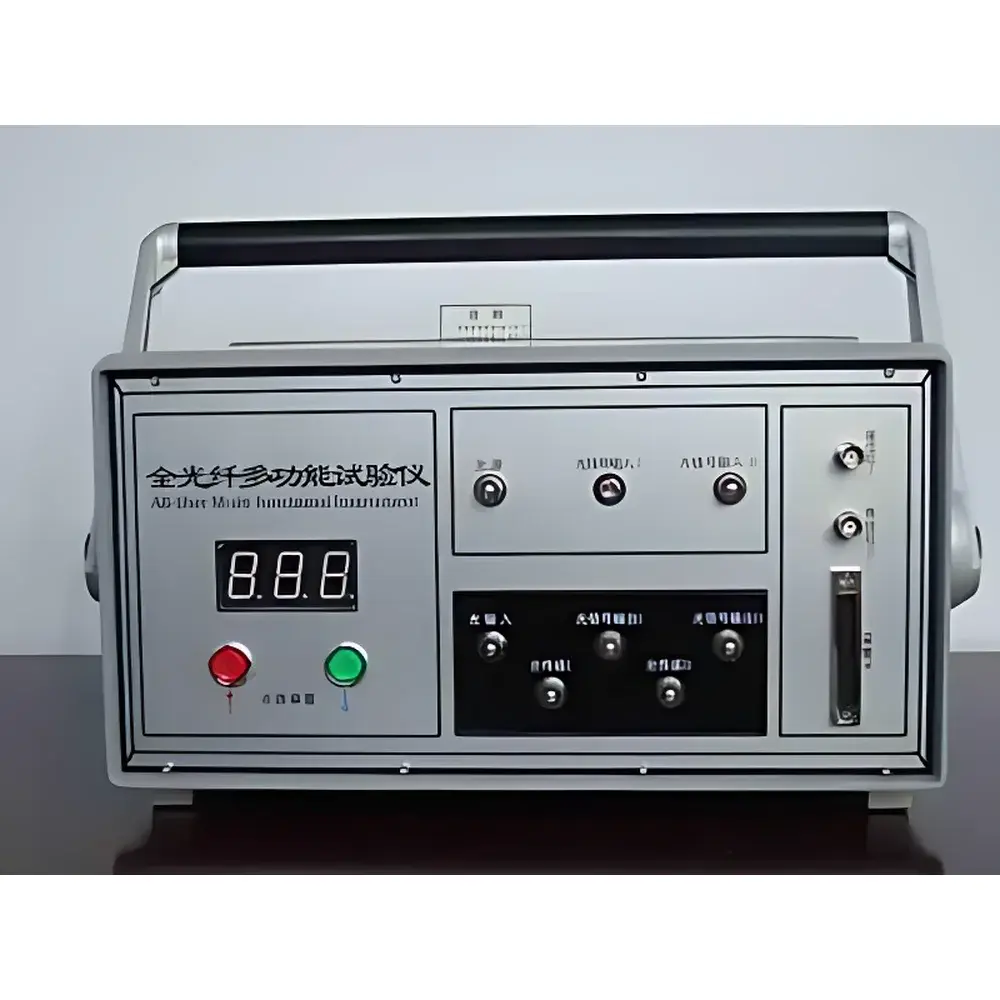
Fudan University Multi-Function Fiber-Optic Interferometric Teaching System
| Origin | Shanghai, China |
|---|---|
| Manufacturer Type | Authorized Distributor |
| Origin Category | Domestic (PRC) |
| Model | FOFI-3 |
| Pricing | Available Upon Request |
Overview
The Fudan University Multi-Function Fiber-Optic Interferometric Teaching System is an advanced educational platform engineered for undergraduate and graduate-level instruction in photonics, optical sensing, and interferometric measurement principles. At its core, the system implements full-fiber white-light interferometry—a precision technique that leverages broadband light sources and path-length-dependent coherence to resolve phase shifts with sub-micron spatial resolution and nanosecond temporal fidelity. Unlike conventional laser-based interferometers (e.g., Michelson, Fabry–Pérot, or Mach–Zehnder configurations), this system eliminates free-space alignment constraints and environmental sensitivity by integrating all optical paths within single-mode fiber components. It serves as a pedagogical bridge between fundamental wave optics theory and modern applications in distributed fiber sensing, optical communications, and dynamic physical parameter measurement—including vibration, strain, acoustic pressure, and group velocity dispersion in optical media.
Key Features
- Modular, shared-host architecture enabling rapid reconfiguration for >20 distinct experiments without hardware duplication
- Integrated broadband white-light source with stabilized spectral output (450–850 nm) and low-coherence length (<20 µm)
- Dual-channel high-speed data acquisition (16-bit, 1 MS/s per channel) synchronized with LabVIEW-based real-time signal processing software
- Comprehensive accessory set including calibrated vibration shaker (5–2 kHz range), acoustic emitters, fiber-coupled photodetectors, and polarization-maintaining components
- Support for both intensity- and phase-demodulated detection schemes, facilitating comparative study of interferometric demodulation methods
- Self-contained optical power amplification, analog signal conditioning, and impedance-matched I/O interfaces for seamless integration with standard oscilloscopes and function generators
Sample Compatibility & Compliance
The system is designed exclusively for use with standard single-mode telecom fiber (G.652.D, 125 µm cladding, 8.2 µm core) and compatible passive components (FC/APC connectors, 50/50 and 90/10 couplers, collimators). All optical modules comply with IEC 61300-2-4 (fiber optic connector durability) and IEC 61280-4-1 (optical power measurement accuracy) standards. Software architecture supports audit-trail logging and user-access control—enabling alignment with GLP-compliant laboratory practices where required for academic accreditation. While not intended for clinical or industrial certification, experimental protocols align with foundational principles referenced in ISO/IEC 17025 Annex A.3 (measurement uncertainty estimation) and ASTM E2877-13 (optical fiber sensor calibration guidelines).
Software & Data Management
The system ships with a custom LabVIEW-based application suite developed under NI LabVIEW 2020 SP1 runtime environment. The software provides synchronized acquisition, time-domain waveform visualization, FFT-based spectral analysis, Hilbert transform for envelope detection, and phase-unwrapping algorithms optimized for low-SNR interferograms. Raw data exports to CSV, TDMS, and HDF5 formats; metadata tagging includes timestamp, experiment ID, module configuration, and environmental notes. Version-controlled software updates are delivered via secure academic license portal. The platform supports third-party integration through TCP/IP and VISA APIs, allowing interoperability with MATLAB, Python (via PyVISA), or custom C++ applications for advanced algorithm development.
Applications
This teaching system enables rigorous exploration across eight structured experimental domains:
- Fiber-optic audio transmission and demodulation (including bidirectional voice-over-fiber telephony)
- Laser external modulation and coherent demodulation using acousto-optic modulators
- Direct measurement of light propagation velocity and effective refractive index in optical fiber
- Fiber length determination via time-of-flight and interferometric fringe counting
- Point-wise strain and dynamic displacement sensing using fiber Bragg grating (FBG)-free interferometric interrogation
- Full-fiber sonar simulation and underwater acoustic wave characterization
- Vibration mode analysis, resonance mapping, and modal frequency identification up to 2 kHz
- White-light interferometric profilometry and surface topography reconstruction
Each experiment integrates theoretical derivation, hands-on setup, error analysis, and validation against analytical models—supporting curriculum requirements for physics, electrical engineering, and optical science programs.
FAQ
Is the system suitable for research-grade measurements beyond classroom use?
Yes—the interferometric architecture and calibrated components support repeatable measurements at laboratory-grade uncertainty levels (±0.5% for relative phase shift, ±2% for absolute group delay), making it appropriate for preliminary prototyping and method validation.
Does the system include documentation for curriculum integration?
Yes—comprehensive instructor manuals, student lab guides, theoretical background primers, and assessment rubrics are provided in English, aligned with ABET and EUR-ACE learning outcomes.
Can additional modules be added post-purchase?
Yes—the open mechanical and electrical interface design allows integration of third-party sensors, custom fiber coils, or wavelength-tunable sources using standardized FC/APC and SMA connectors.
What computing requirements are needed to run the software?
A Windows 10/11 PC with ≥8 GB RAM, Intel i5-8th gen or equivalent, and two USB 3.0 ports is recommended. NI LabVIEW Runtime Engine is included and does not require a separate license.
Is technical support available internationally?
Yes—remote diagnostics, video-assisted troubleshooting, and annual software maintenance are included for institutional purchasers under multi-year academic support agreements.




