
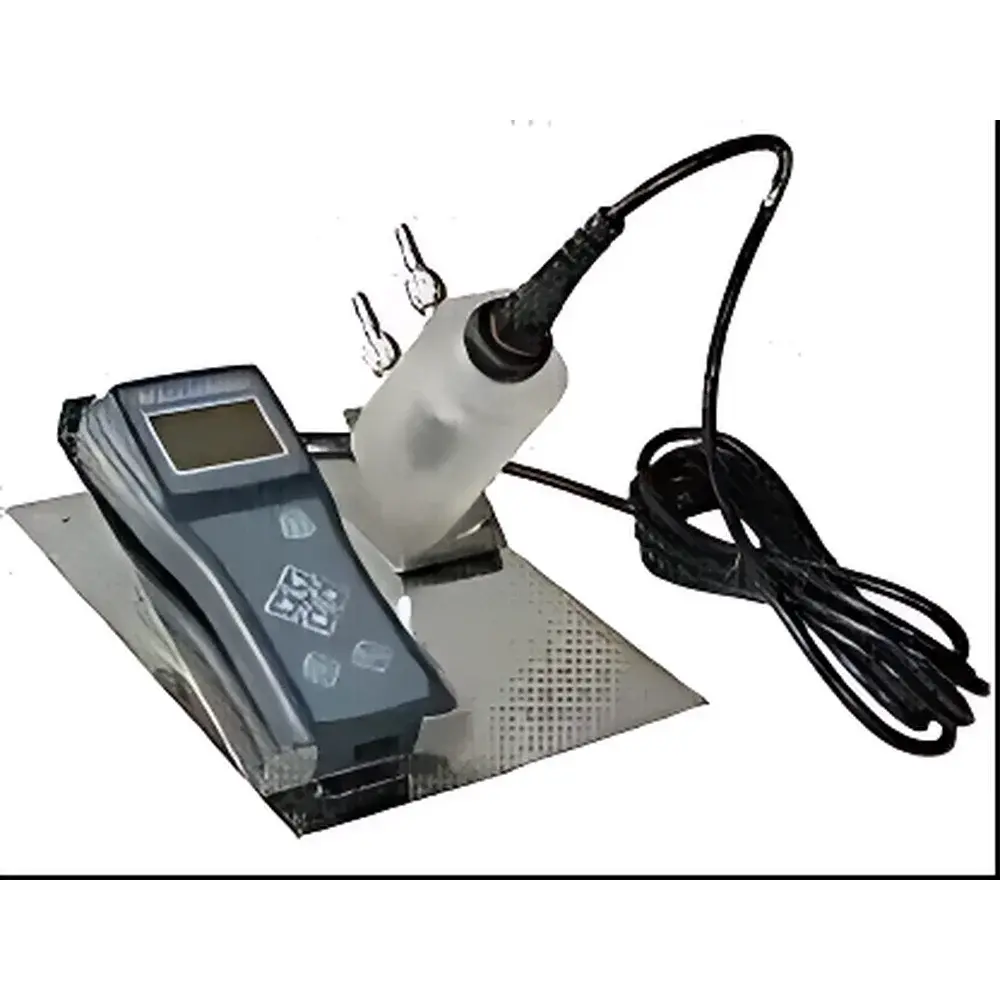
HDY-2110 Portable Dissolved Oxygen Monitor
| Origin | Beijing, China |
|---|---|
| Manufacturer Type | Authorized Distributor |
| Origin Category | Domestic (China-made) |
| Model | HDY-2110 |
| Price Range | USD 2,800–4,200 |
| Instrument Type | Portable |
| Measurement Principle | Electrochemical Clark-type Polarographic Sensor |
| Measurement Range | 0–200 µg/L |
| Accuracy | ±1.5×10⁻²/4 h |
| Repeatability | ±0.5% FS |
| Detection Limit | 0–200 µg/L |
| Basic Error | ±3.0% FS |
| Response Time | ≤30 s to 98% FS at 25 °C |
| Temperature Resolution | 0.1 °C |
| Temperature Accuracy | ±0.5 °C |
| Operating Temp. | 5–55 °C |
| Storage Temp. | −25–55 °C (electrode ≥0 °C) |
| Relative Humidity | ≤85% RH |
| Sample Temp. Range | 5–60 °C |
| Max. Suspended Solids | ≤5 µm (no colloids or oils) |
| Power | AC 220 V ±10%, 50 Hz / USB-powered rechargeable Li-ion battery (60 h continuous operation) |
| Interface | RS232 |
| Dimensions | 180 × 50 × 25 mm |
| Weight | 0.5 kg |
| IP Rating | IP55 |
| Calibration Modes | Faraday-based zero calibration & air-saturation calibration |
Overview
The HDY-2110 Portable Dissolved Oxygen Monitor is an electrochemical field instrument engineered for high-fidelity, real-time measurement of dissolved oxygen (DO) concentration in aqueous environmental and process samples. It employs a Clark-type polarographic sensor—comprising a noble metal cathode (typically gold or platinum), silver/silver chloride reference electrode, and oxygen-permeable polytetrafluoroethylene (PTFE) membrane—to generate a diffusion-limited reduction current proportional to the partial pressure of molecular oxygen. This principle ensures stable, drift-free operation without zero-point calibration requirements—a critical advantage for unattended or remote deployments. The device implements auto-ranging across four decades (0–200 µg/L to 0–2000 mg/L), enabling seamless transition between trace-level (ppb) and high-concentration (ppm) applications—from groundwater monitoring and wastewater effluent compliance to aquaculture management and bioreactor control. Its embedded 32-bit ARM architecture delivers deterministic sampling intervals, low-latency signal processing, and firmware-upgradable functionality compliant with evolving regulatory data integrity expectations.
Key Features
- True portable form factor: 180 × 50 × 25 mm, 0.5 kg mass—optimized for handheld field use and rapid site-to-site deployment.
- IP55-rated enclosure: Dust-resistant and protected against low-pressure water jets—suitable for outdoor ambient exposure, rain-prone environments, and humid industrial zones.
- Dual calibration methodology: Faraday-based zero calibration (eliminates chemical reagents and manual zeroing) and air-saturation calibration (traceable to atmospheric O₂ partial pressure at local barometric conditions).
- Integrated rechargeable lithium-ion battery: Supports up to 60 hours of continuous operation; on-device battery status indicator displays remaining capacity and charge/discharge phase.
- High-contrast 128 × 64 monochrome LCD with adjustable backlight: Full Chinese-language menu interface—designed for intuitive navigation by field technicians with minimal training.
- Modular electrode design: Compatible with both flow-through cell and immersion-style probes; robust mechanical construction minimizes membrane damage during handling and reduces maintenance frequency.
- Temperature compensation: Built-in thermistor (±0.5 °C accuracy, 0.1 °C resolution) enables automatic correction per ASTM D888 and ISO 5814 standards.
Sample Compatibility & Compliance
The HDY-2110 is validated for use with natural waters, treated effluents, surface runoff, and process streams meeting defined physical constraints: sample temperature between 5 °C and 60 °C; suspended solids ≤5 µm; absence of colloidal matter, oils, or greases that could foul the sensor membrane. It complies with key international method frameworks including EPA Method 360.1 (for wastewater DO determination), ISO 5814:2012 (electrochemical probe method), and ASTM D888-22 (standard test methods for dissolved oxygen in water). While not certified for GLP/GMP-regulated clinical or pharmaceutical manufacturing, its data logging architecture—including time-stamped point storage and optional continuous recording—supports audit-ready documentation under ISO/IEC 17025-accredited environmental testing laboratories.
Software & Data Management
Data output is accessible via RS232 serial interface, supporting direct connection to Windows-based PCs for real-time telemetry and synchronized display using vendor-supplied terminal software. Logged measurements include timestamp, DO value, temperature reading, and sensor status flags (e.g., membrane integrity, electrolyte level). All stored records are non-volatile and retain integrity during power interruption. Though native cloud synchronization is not implemented, exported CSV files conform to FAIR data principles (Findable, Accessible, Interoperable, Reusable) and integrate seamlessly into LIMS platforms or Excel-based QA/QC workflows. Firmware updates are delivered via UART bootloader—ensuring long-term adaptability without hardware replacement.
Applications
- Regulatory environmental monitoring: Surface water quality assessment (e.g., river, lake, estuary surveys per national water quality standards).
- Municipal and industrial wastewater treatment: Aeration basin optimization, effluent compliance verification (e.g., discharge permits requiring DO ≥2 mg/L).
- Aquaculture and fisheries management: Real-time pond DO profiling to prevent hypoxia-induced mortality.
- Drinking water distribution system surveillance: Residual oxygen mapping to assess pipe wall biofilm activity and corrosion risk.
- Educational and research fieldwork: Undergraduate hydrology labs, ecological impact studies, and citizen science initiatives requiring rugged, low-cost instrumentation.
FAQ
Does the HDY-2110 require daily zero calibration?
No—its Faraday-based zero calibration eliminates the need for routine zero-point adjustment; only periodic air-saturation verification is recommended every 7–14 days depending on usage intensity.
Can the instrument measure DO in seawater?
Yes, provided salinity compensation is applied manually using the built-in temperature-compensated saturation table; however, dedicated marine-grade electrodes with integrated salinity sensors are recommended for long-term marine deployments.
Is the RS232 interface compatible with modern laptops lacking serial ports?
Yes—USB-to-RS232 adapters (FTDI chipset-based) are fully supported; driver installation is required on Windows systems.
What is the expected service life of the polarographic membrane?
Under typical freshwater field use, the PTFE membrane maintains performance for 6–12 months; replacement kits include membrane, electrolyte, and O-ring components.
Does the device meet FDA 21 CFR Part 11 requirements?
No—it does not implement electronic signatures, audit trails, or role-based access control; it is intended for environmental field use, not regulated pharmaceutical or clinical applications.
Related Products







