
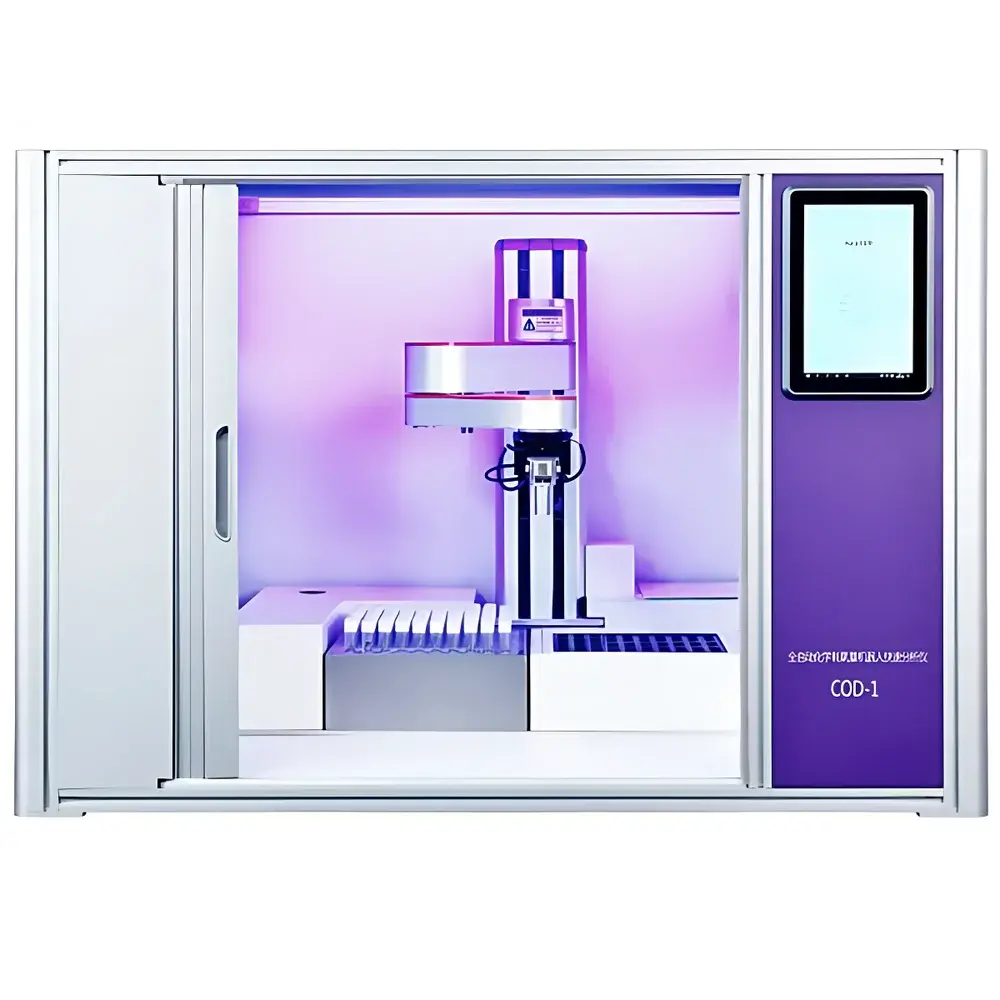
Fumi COD-1 Automated Chemical Oxygen Demand Analyzer
| Brand | Fumi |
|---|---|
| Origin | Shanghai, China |
| Model | COD-1 |
| Instrument Type | Laboratory Benchtop Analyzer |
| Sample Capacity | 100 positions |
| Digestion Temperature | 165 °C ±0.1 °C |
| Digestion Time | 15 min (configurable) |
| Cooling Endpoint | 60 °C (pre-mix) and 20 °C (pre-measurement) |
| Optical Wavelengths | 440 nm, 600 nm, 680 nm |
| Spectral Bandwidth | ≤10 nm |
| Absorbance Range | 0–3 A |
| Digestion Tube Dimensions | 16 mm × 100 mm (standard), optional 16 mm × 120 mm |
| Operating Environment | 10–30 °C |
| Power Supply | 220 V, 50 Hz |
| Power Consumption | 1280 W |
| Dimensions (W×D×H) | 940 mm × 680 mm × 885 mm |
| Weight | 80 kg |
| Remote Control | Yes |
| LIMS Integration | Network-enabled output |
| Mobile App Support | Yes |
| Built-in Imaging System | Yes |
| Compliance Standard | HJ/T 399–2007 |
Overview
The Fumi COD-1 Automated Chemical Oxygen Demand Analyzer is a fully integrated benchtop system engineered for high-throughput, standardized COD determination in environmental and wastewater laboratories. It implements the rapid digestion–spectrophotometric method specified in China’s HJ/T 399–2007 standard—equivalent in principle to ASTM D1252 (Method B) and ISO 15705:2002—by combining precise graphite-block thermal digestion, robotic sample handling, multi-wavelength absorbance measurement, and automated thermal management. Unlike manual or semi-automated COD workflows, the COD-1 eliminates operator-dependent variability in tube handling, timing, cooling, mixing, and photometric reading. Its core architecture integrates a 100-position sample carousel, a temperature-stabilized graphite digestion block (±0.1 °C control at 165 °C), an embedded vision module for tube position verification and cap integrity check, and a dual-beam spectrophotometer with three fixed-wavelength LEDs (440 nm, 600 nm, 680 nm) to enable turbidity-corrected quantification via dual-reference subtraction. The system is designed for reproducible, auditable, and GLP-aligned operation in regulated environments where traceability and procedural consistency are essential.
Key Features
- Fully autonomous workflow: Robotic arm handles all physical operations—including tube uncapping, sample aspiration, digestion transfer, post-digestion cooling, vortex-like inversion mixing (5 s per tube), and spectrophotometric positioning—without manual intervention.
- Thermal precision engineering: Graphite digestion block maintains 165 °C within ±0.1 °C over full 100-tube capacity; real-time temperature monitoring ensures compliance with HJ/T 399–2007 digestion protocol requirements.
- Turbidity-resolved photometry: Simultaneous measurement at 440 nm (COD-specific chromophore), 600 nm, and 680 nm enables automatic baseline correction for suspended solids interference, improving accuracy in turbid or colored samples.
- Integrated imaging verification: Onboard camera captures tube orientation, cap status, and liquid meniscus before and after digestion—supporting root-cause analysis during QA/QC review and audit readiness.
- Modular digestion tube compatibility: Supports standard 16 mm × 100 mm pre-filled COD reagent vials (e.g., commercial Cr(VI)-based digestants); optional 16 mm × 120 mm configuration accommodates alternative reagent formulations.
- Regulatory-ready software architecture: Embedded Windows 10 OS supports user-level access control, electronic signatures, audit trail logging (per FDA 21 CFR Part 11 principles), and timestamped event records for every mechanical and optical step.
Sample Compatibility & Compliance
The COD-1 accepts aqueous samples conforming to HJ/T 399–2007 scope: domestic sewage, industrial effluents, surface water, and treated wastewater. It is validated for use with commercially available sealed COD digestion vials containing 5 mL of acidic dichromate reagent. Sample volume is precisely dispensed via calibrated pipette integration (not included) prior to instrument loading. The analyzer operates across two calibrated ranges: low-range (15–150 mg/L COD) and high-range (100–1000 mg/L COD), with linearity verified per ISO/IEC 17025 calibration protocols. All thermal, optical, and robotic subsystems undergo factory calibration traceable to NIM (National Institute of Metrology, China). While HJ/T 399–2007 is its primary reference, method equivalence to EPA Method 410.4 and ISO 15705 has been demonstrated in interlaboratory validation studies under controlled matrix conditions.
Software & Data Management
The COD-1 runs proprietary Fumi Analytical Suite v3.x on Windows 10, featuring a touchscreen-native interface with multilingual support (English, Chinese, Spanish). Software modules include method editor (for custom digestion time/temperature profiles), calibration manager (with curve fitting using quadratic or linear regression), QC dashboard (control charts for blanks, standards, duplicates), and LIMS connector supporting ASTM E1384-compliant HL7 and CSV export. Raw absorbance values, thermal logs, robotic motion timestamps, and image thumbnails are stored in encrypted SQLite databases with configurable retention policies. Network output enables direct integration with enterprise laboratory information management systems (LIMS) or cloud-based data warehouses. Remote diagnostics and firmware updates are supported via secure HTTPS channel; mobile app (iOS/Android) provides real-time run status, alert push notifications, and historical report preview.
Applications
- Environmental monitoring labs conducting routine compliance testing against municipal discharge permits (e.g., GB 8978–1996, local wastewater ordinances).
- Water treatment plants performing daily influent/effluent COD profiling to optimize biological reactor loading and chemical dosing.
- Industrial QA/QC departments verifying pretreatment efficiency for electroplating, food processing, or pharmaceutical manufacturing effluents.
- Research institutions studying organic load dynamics in constructed wetlands, anaerobic digesters, or bioremediation columns.
- Educational laboratories delivering standardized COD training with minimized hands-on exposure to hazardous digestion reagents.
FAQ
Does the COD-1 require external pipetting hardware?
No—the instrument accepts pre-dispensed samples in standard COD vials; users must prepare samples externally using calibrated pipettes or liquid handlers prior to loading.
Can the digestion temperature and time be modified beyond 165 °C and 15 minutes?
Yes—method editor allows user-defined profiles; however, deviations from HJ/T 399–2007 parameters require full re-validation per ISO/IEC 17025 clause 5.4.2.
Is the spectrophotometer calibrated automatically?
Yes—daily self-calibration uses built-in neutral density filters and LED intensity monitoring; full wavelength verification is performed during annual service.
What data security measures are implemented for audit compliance?
All user actions, instrument events, and measurement results are logged with immutable timestamps, user IDs, and digital signatures; audit trails cannot be edited or deleted.
How is turbidity correction mathematically applied?
Absorbance at 600 nm and 680 nm is averaged and subtracted from the 440 nm signal to yield turbidity-compensated COD absorbance, following the algorithm defined in HJ/T 399–2007 Annex A.
Related Products







