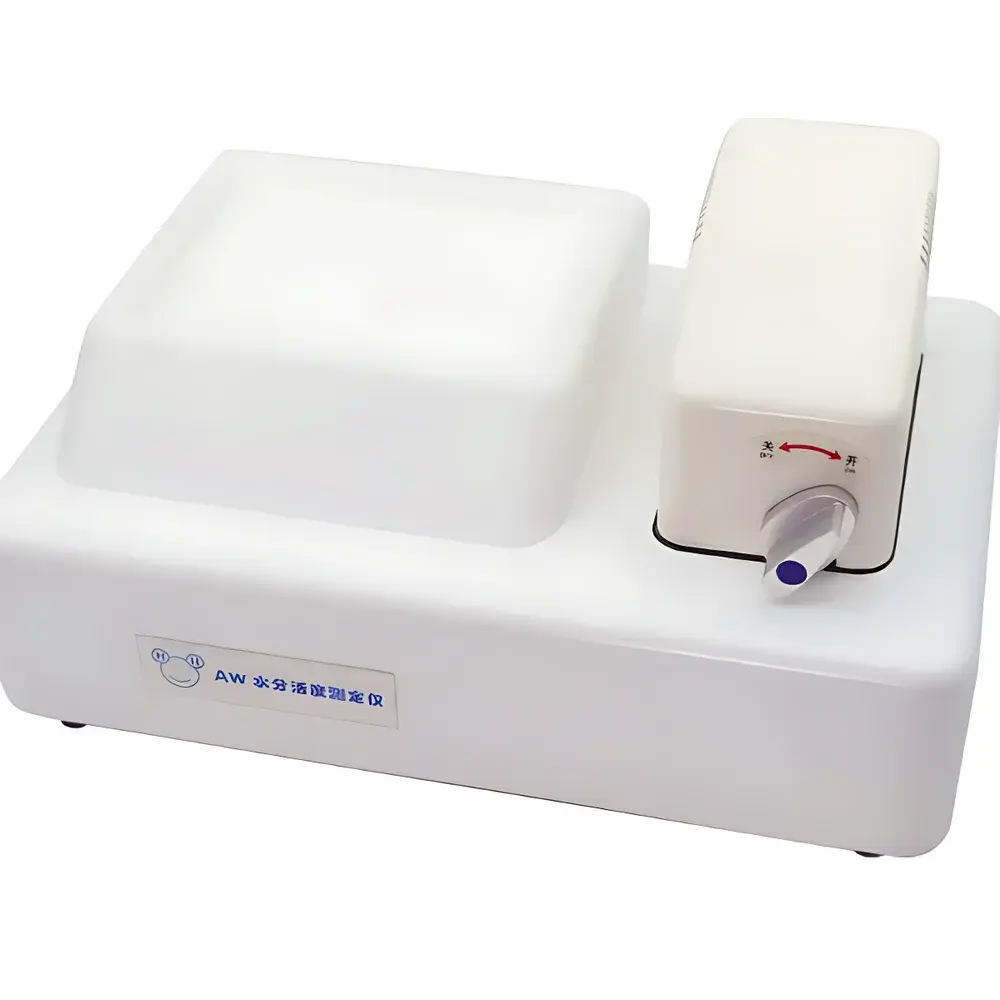
Future-Spectrum AW3000T Water Activity Analyzer with Mirror Condensation Dew Point Sensor
| Brand | Future-Spectrum |
|---|---|
| Origin | Shanghai, China |
| Model | AW3000T |
| Measurement Range | 0.030–1.000 aw |
| Operating Environment | Ambient Temperature |
| Instrument Type | Benchtop Laboratory Analyzer |
| Net Weight | ~4.7 kg |
| Sensor Type | Mirror Condensation Dew Point Sensor |
| Accuracy | ±0.005 aw at 25 °C |
| Resolution | 0.0001 aw |
| Temperature Control | Peltier-controlled, Setpoint 25 °C |
| Temperature Resolution | 0.01 °C |
| Calibration | Multi-point, up to 20 standard solutions |
| Software Compatibility | Windows & Linux |
| Interface Language | Chinese GUI |
| User Access Control | Hierarchical operator permissions |
| Report Customization | Configurable print templates |
| Sample Pre-heating | Integrated |
| Sample Temperature Monitoring | IR-based non-contact sensor |
Overview
The Future-Spectrum AW3000T Water Activity Analyzer is a benchtop laboratory instrument engineered for high-precision, traceable measurement of water activity (aw) in solid and semi-solid matrices using the mirror condensation dew point principle. This method relies on thermodynamic equilibrium: within a sealed sample chamber, the instrument cools a polished, temperature-controlled mirror surface until condensation forms—detected optically—thereby identifying the dew point temperature. From this, the equilibrium vapor pressure of the sample is calculated and normalized against the saturated vapor pressure of pure water at the same temperature, yielding aw = p/p0. As a fundamental thermodynamic parameter—not merely a moisture content proxy—water activity directly reflects the energy state of water molecules available for microbial metabolism, enzymatic reactions, and chemical degradation. The AW3000T’s dew point sensor architecture delivers superior accuracy and long-term stability compared to capacitance or chilled-mirror alternatives, particularly in low-aw regimes (<0.30) where microbial inhibition and shelf-life prediction are most critical.
Key Features
- Mirror condensation dew point sensor with real-time optical condensation detection—ensures high reproducibility and minimal drift over extended operation.
- Peltier-based active temperature control maintains precise 25 °C chamber setpoint (±0.01 °C resolution), eliminating ambient dependency and enabling strict compliance with ISO 21807, AOAC 975.30, and USP <1112>.
- Non-contact infrared temperature sensor continuously monitors sample surface temperature during equilibration—critical for correcting thermal gradients and validating true thermodynamic equilibrium.
- Multi-point calibration capability supporting up to 20 certified reference standards (e.g., saturated salt solutions per ISO 21807 Annex B), allowing full-range validation from 0.030 to 1.000 aw.
- Configurable user access levels (administrator, technician, operator) with audit-trail–capable session logging—designed to support GLP/GMP environments and FDA 21 CFR Part 11 readiness when paired with validated software workflows.
- Integrated sample pre-heating function reduces equilibration time for viscous or low-permeability matrices (e.g., chocolate, dried fruit pastes, hydrocolloid gels).
Sample Compatibility & Compliance
The AW3000T accommodates a broad spectrum of food-grade materials—including powders (milk, spices), granules (cereals, coffee), semi-solids (cheese, meat products), and low-moisture confections—without requiring grinding or dilution. Its sealed chamber design minimizes cross-contamination and volatile loss. Regulatory alignment includes adherence to ISO 21807:2022 (Food microbiology—Determination of water activity), AOAC Official Method 975.30, and harmonized pharmacopeial chapters (USP <1112>, Ph. Eur. 2.2.36). When operated under documented SOPs—including daily verification with two-point calibration standards—the system supports HACCP prerequisite programs, shelf-life modeling (per ICMSF guidelines), and packaging barrier performance assessment per ASTM F1249.
Software & Data Management
The AW3000T runs native firmware compatible with Windows and Linux host systems, presenting a fully localized Chinese graphical interface optimized for QC laboratory workflows. All measurement data—including raw dew point curves, temperature logs, calibration history, and operator metadata—are timestamped and exportable in CSV or PDF formats. Report templates are customizable to include company headers, test IDs, environmental conditions, and pass/fail thresholds aligned with internal specifications or regulatory limits (e.g., aw ≤ 0.85 for non-potentially hazardous foods per FDA Food Code). Audit trails record user logins, parameter changes, and calibration events—enabling retrospective review for internal audits or regulatory inspections.
Applications
- Microbial safety assessment: Correlating measured aw with known growth boundaries for pathogens (e.g., Staphylococcus aureus inhibition at ≤0.86 aw, xerophilic molds at ≤0.65 aw) per Beuchat (1981) and ICMSF models.
- Shelf-life prediction: Inputting aw into Arrhenius-based kinetic models for lipid oxidation, Maillard browning, or enzymatic browning in intermediate-moisture foods.
- Formulation optimization: Quantifying water migration between multi-phase components (e.g., filling vs. crust in baked goods) to prevent texture deterioration.
- Package integrity validation: Measuring post-packaging aw shifts to verify moisture barrier efficacy of laminated films or desiccant-lined pouches.
- GMP documentation: Supporting batch release testing for dietary supplements, nutraceuticals, and topical pharmaceuticals where water activity governs chemical stability and preservative efficacy.
FAQ
What is the fundamental difference between moisture content and water activity?
Moisture content quantifies total water mass per unit sample mass (e.g., % w/w), whereas water activity measures the *thermodynamic availability* of that water—defined as the ratio of the sample’s equilibrium vapor pressure to that of pure water at identical temperature. Two samples with identical moisture content may exhibit vastly different aw values due to matrix binding effects.
Why does the AW3000T use a mirror condensation dew point sensor instead of a capacitance sensor?
Dew point sensors provide absolute, physics-based measurement traceable to thermodynamic standards, with minimal matrix interference and superior accuracy below 0.40 aw. Capacitance sensors require frequent recalibration and suffer from hysteresis and coating drift in high-fat or high-sugar applications.
Is the AW3000T compliant with FDA 21 CFR Part 11 requirements?
The hardware and firmware support Part 11–aligned practices—including electronic signatures, audit trails, and role-based access—when deployed within a validated IT environment and supported by appropriate procedural controls (SOPs, change management, backup protocols).
How frequently should calibration be performed?
A minimum two-point verification (e.g., 0.11 aw and 0.75 aw standards) is recommended before each analytical session. Full multi-point calibration is required after sensor maintenance, firmware updates, or if verification fails beyond ±0.005 aw.
Can the AW3000T measure samples at temperatures other than 25 °C?
The instrument is optimized for isothermal measurement at 25 °C per international standards. While the Peltier system allows limited deviation, non-standard temperatures invalidate comparability with published microbial growth charts and regulatory thresholds, which are all referenced to 25 °C equilibrium conditions.
Related Products