
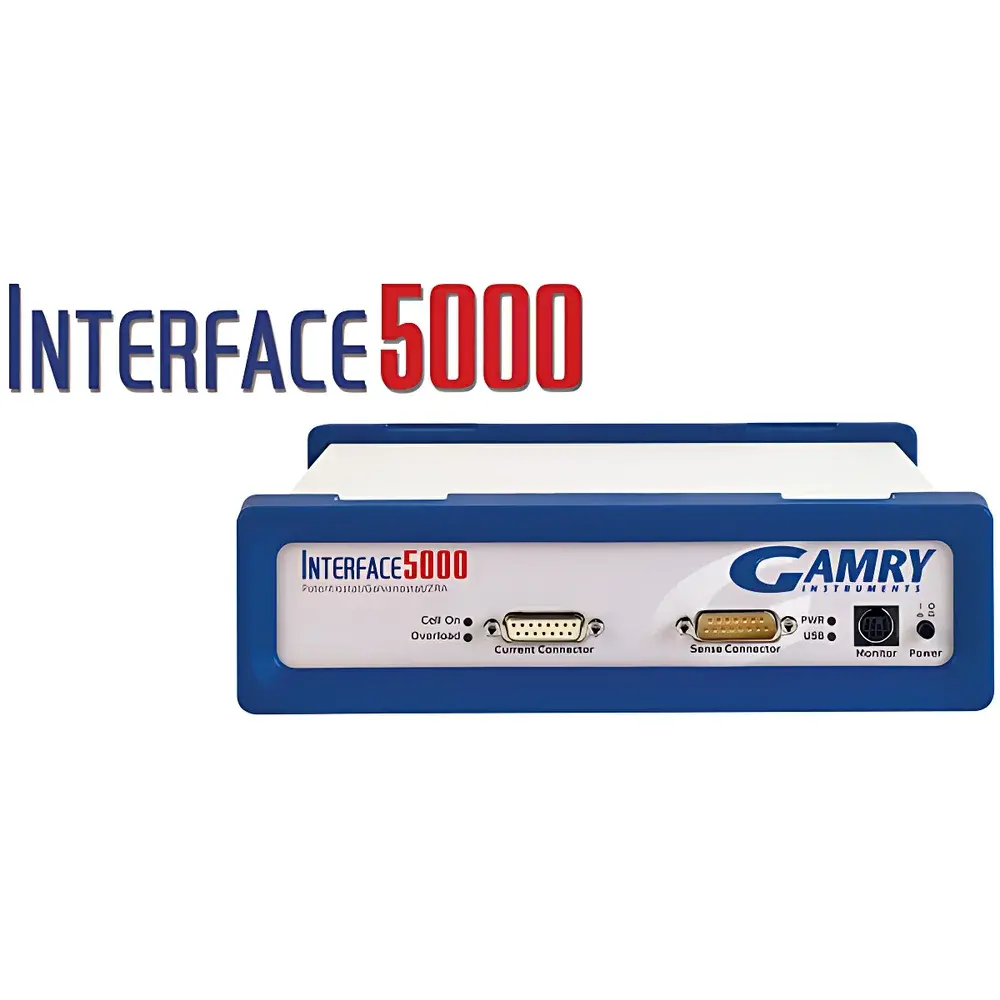
Gamry Interface 5000 Electrochemical Workstation
| Brand | Gamry |
|---|---|
| Origin | USA |
| Model | Interface 5000 |
| Current Range | ±5 A |
| Current Resolution | < 20 pA |
| Potential Accuracy | 1 µV |
| Potentiostatic Range | ±6 V |
| EIS Frequency Range | 10 µHz – 1 MHz |
Overview
The Gamry Interface 5000 Electrochemical Workstation is a research-grade potentiostat/galvanostat/zero-resistance ammeter (ZRA) engineered for high-fidelity electrochemical characterization in energy storage and conversion systems. It operates on a precision analog front-end architecture with dual electrometer circuitry—enabling simultaneous, independent measurement of full-cell voltage and individual half-cell potentials (anode and cathode) in battery or fuel cell configurations. This capability is essential for decoupling interfacial kinetics, identifying rate-limiting electrodes, and validating reference electrode placement in three-electrode or pseudo-reference setups. Its floating ground design ensures electrical isolation from earth ground, permitting safe and accurate measurements on grounded working electrodes, multi-electrode arrays immersed in shared electrolytes, or integrated systems such as high-pressure autoclaves or in-situ TEM cells. The instrument supports both single-channel and scalable multi-channel configurations—up to eight independent channels can be synchronized via shared timing and data acquisition infrastructure without compromising resolution, bandwidth, or compliance voltage.
Key Features
- Dual electrometer architecture for concurrent full-cell and half-cell potential monitoring—critical for battery degradation analysis and electrode-specific impedance spectroscopy (EIS)
- Floating ground topology compliant with ASTM G59, G102, and ISO 9223 standards for corrosion testing under grounded or galvanically coupled conditions
- Eight programmable current ranges (50 µA to 5 A), each selectable with three gain settings (1×, 10×, 100×), delivering optimal signal-to-noise ratio across orders-of-magnitude current dynamics
- Ultra-low current detection limit (< 20 pA) and 1 µV potential resolution—validated per ASTM E2004 for low-current voltammetry and passive film characterization
- Broad EIS frequency coverage (10 µHz to 1 MHz) with phase accuracy < 0.1° and magnitude error < 0.1%—suitable for modeling solid-electrolyte interphases (SEI), charge-transfer resistance, and diffusion-controlled processes
- Integrated hardware support for real-time ZRA operation, enabling precise current distribution mapping in multi-electrode corrosion studies or electroplating uniformity assessment
Sample Compatibility & Compliance
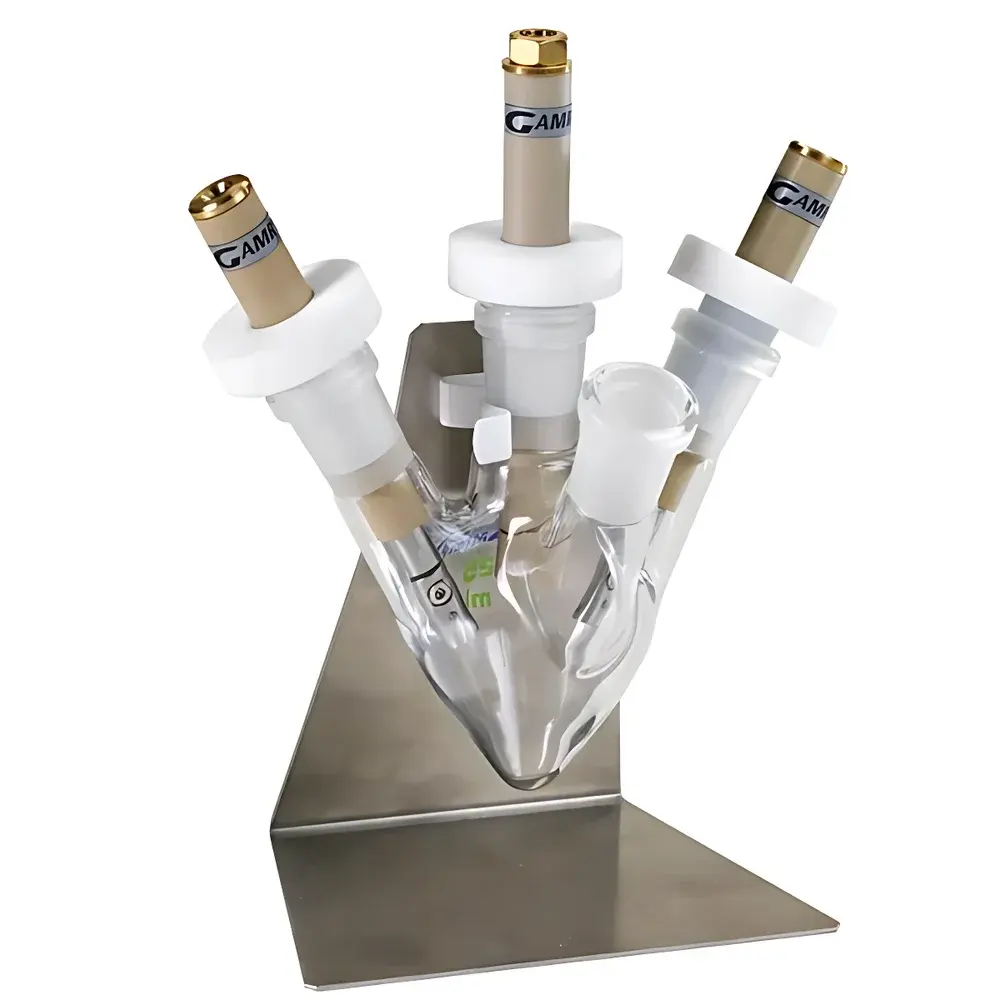
The Interface 5000 accommodates diverse electrochemical configurations: two-electrode, three-electrode, rotating disk electrode (RDE), scanning electrochemical microscopy (SECM) probes, and segmented or stacked electrode assemblies. Its ±6 V compliance voltage and ±5 A output support high-power battery cycling, rapid charge/discharge protocols, and pulsed electrodeposition. For regulatory environments, the system complies with FDA 21 CFR Part 11 requirements when used with Gamry’s Framework software featuring audit trail, electronic signatures, and user-access controls—making it suitable for GLP/GMP-aligned battery qualification, corrosion inhibitor validation, and sensor calibration workflows. All hardware meets IEC 61010-1 safety standards for laboratory use, including protection against overvoltage, overcurrent, and thermal runaway during extended impedance sweeps or galvanostatic holds.
Software & Data Management
Controlled exclusively via Gamry’s Framework software—a Windows-based platform certified for ISO/IEC 17025-compliant laboratories—the Interface 5000 provides scriptable experiment sequencing, real-time FFT-based noise filtering, and automated Kramers-Kronig validation for EIS data integrity. Raw data are stored in open-format .DTA files with embedded metadata (timestamp, operator ID, instrument serial, calibration history), ensuring traceability and third-party interoperability (e.g., with MATLAB, Python, or Thermo Scientific Avantage). Batch processing tools enable statistical comparison of multiple EIS spectra, Tafel slope derivation, and equivalent circuit fitting using distributed element models (e.g., constant phase elements, Warburg diffusion). Audit logs record all parameter modifications, file exports, and user logins—fully satisfying GLP documentation requirements.
Applications
- Li-ion, Na-ion, and solid-state battery development: anode/cathode half-cell balancing, SEI growth kinetics, and cycle-life impedance evolution
- Proton exchange membrane (PEM) and alkaline fuel cell catalyst evaluation under variable humidity and backpressure
- Supercapacitor electrode material screening via cyclic voltammetry, galvanostatic charge/discharge, and frequency-dependent capacitance profiling
- Corrosion science: electrochemical noise analysis (ENA), localized corrosion mapping, and in-situ monitoring of rebar in concrete or marine coatings
- Electroanalytical sensor development: amperometric detection limits, mediator kinetics, and fouling resistance quantification
- Electrodeposition process optimization: current efficiency, throwing power, and nucleation overpotential determination
FAQ
Can the Interface 5000 measure individual electrode potentials in a full-cell battery without physical disassembly?
Yes—its dual electrometer design enables simultaneous measurement of working and counter electrode potentials versus a stable reference, provided the reference is placed in proximity to each electrode or embedded within the cell stack.
Is the instrument compatible with glovebox-integrated testing environments?
Yes—multi-channel configurations allow one channel to reside inside an argon-filled glovebox while others operate externally, all synchronized via Ethernet-connected Framework software.
Does the system support real-time data streaming to external DAQ systems or LabVIEW?
Yes—Framework exposes a TCP/IP API and includes LabVIEW drivers for bidirectional communication, enabling integration with custom control loops or hybrid in-situ characterization rigs.
How is calibration traceability maintained for regulatory submissions?
Gamry provides NIST-traceable calibration certificates for voltage, current, and impedance modules, updated annually; calibration events are automatically logged in Framework’s audit trail.
What safety protections prevent damage during high-current battery testing?
Hardware-enforced current/voltage limits, thermal shutdown sensors, and automatic compliance voltage rollover protect both the instrument and DUT during transient overloads or short-circuit events.





