
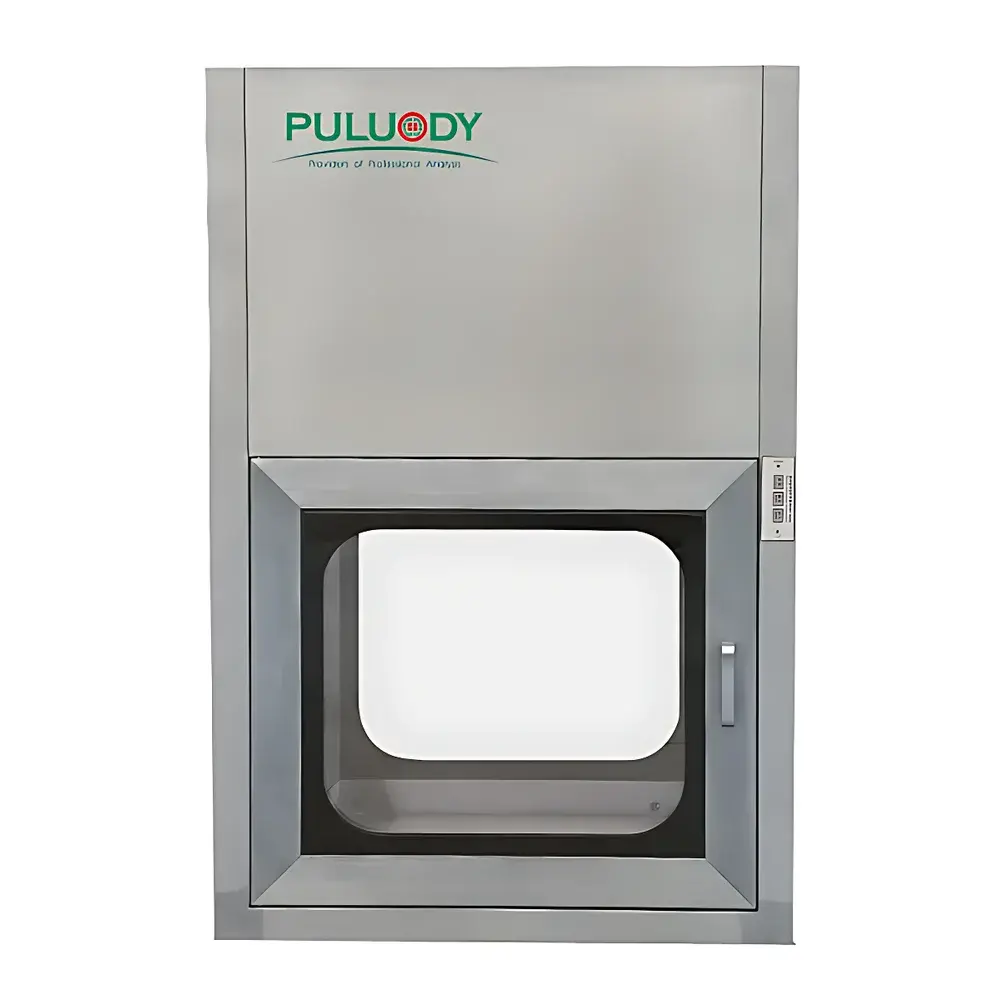
PULUODY PSD-PF100-1A-0.5 Electronic-Grade Sample Vial Decontamination Chamber
| Brand | PULUODY |
|---|---|
| Origin | Shaanxi, China |
| Model | PSD-PF100-1A-0.5 |
| Dimensions | 360 × 450 × 580 mm |
| Cleanroom Class | ISO Class 4 (10-class) & ISO Class 5 (100-class) |
| Air Velocity | 0.25 m/s |
| Vibration Amplitude | ≤3 µm |
| Noise Level | ≤67 dB(A) |
| Lighting | Fluorescent Lamp |
| Sterilization | UV-C Lamp (254 nm) |
| Operating Temperature | 10–30 °C |
| Relative Humidity | ≤75% RH |
| Power Supply | AC 220 V ±10%, 50 Hz ±1 Hz |
| Construction | Powder-coated steel frame with 304 stainless steel work surface |
| Optional Accessories | High-purity nitrogen inlet with inline filter, articulated nitrogen delivery hose, motorized bidirectional sample rotation stage |
Overview
The PULUODY PSD-PF100-1A-0.5 Electronic-Grade Sample Vial Decontamination Chamber is an engineered solution designed to mitigate particulate contamination risk during the transfer of pharmaceutical and microelectronics sampling vessels into controlled environments. It functions as a pre-entry decontamination airlock—specifically for vials, syringes, and small-volume containers used in insoluble particle testing per USP , , and ISO 11171. The chamber employs laminar airflow generated by a dual-stage filtration system (pre-filter + H14 HEPA), delivering ISO Class 4 (10-class) or ISO Class 5 (100-class) conditions within the working zone. Unlike generic clean benches, this unit integrates vibration-damped structural design (≤3 µm amplitude), calibrated airflow velocity (0.25 m/s), and UV-C germicidal irradiation (254 nm) to address both airborne particles and surface bioburden—critical for QC labs supporting parenteral drug manufacturing, semiconductor chemical analysis, and high-purity solvent handling.
Key Features
- ISO-compliant laminar flow architecture with H14 HEPA filtration (≥99.995% @ 0.1 µm) and G4 pre-filter for extended filter life
- Stainless steel 304 work surface resistant to corrosion from solvents, acids, and cleaning agents commonly used in pharmaceutical QC
- Vibration-isolated steel chassis with powder-coated finish ensures mechanical stability during sensitive particle counting workflows
- Integrated UV-C lamp (254 nm) with safety interlock—automatically deactivates when door is opened per IEC 62471 photobiological safety requirements
- Dual airflow configuration support: vertical downflow (standard) and horizontal crossflow (optional)—validated via smoke visualization per ISO 14644-3
- Modular nitrogen purge interface with 0.01 µm inline particulate filter and flexible articulated delivery arm for targeted vial neck and interior surface blow-down
- Optional motorized bidirectional rotation stage (±180°, programmable dwell time) enables uniform exposure of vial surfaces to airflow and UV irradiation
Sample Compatibility & Compliance
The PSD-PF100-1A-0.5 accommodates standard pharmaceutical sampling formats including 2R, 5R, 10R, and 20R glass vials (ISO 8362-1), Luer-lock syringes, and low-particulate plastic containers up to 150 mm height. Its internal dimensions (W360 × D450 × H580 mm) permit simultaneous processing of up to six 10R vials with adequate spacing for unimpeded laminar flow. The unit complies with key regulatory expectations for particle control infrastructure: it supports ALCOA+ data integrity principles when integrated with validated rotation and UV exposure logs; meets mechanical and electrical safety standards per IEC 61010-1; and facilitates audit readiness for FDA inspections under 21 CFR Part 211 (Subpart J – Production and Process Controls) and EU GMP Annex 1 (2022 revision) requirements for grade A/B environment preparation.
Software & Data Management
While the base model operates via manual controls (airflow on/off, UV timer, lighting), the optional digital controller module provides timestamped operational logging—including UV exposure duration, nitrogen purge cycle count, and door open/close events. All logs are exportable via USB to CSV format and support traceability for GLP/GMP documentation. The system architecture allows integration with laboratory information management systems (LIMS) via RS-485 Modbus RTU protocol for centralized monitoring of environmental parameters. Audit trails comply with 21 CFR Part 11 requirements when paired with user authentication and electronic signature modules (sold separately).
Applications
- Pre-analysis decontamination of vials prior to insoluble particle testing using light obscuration (e.g., HIAC, MET ONE) or membrane filtration methods
- Handling of high-value reference standards and certified reference materials (CRMs) requiring ultra-low background particulate levels
- Preparation of sampling containers for elemental impurity analysis (ICP-MS) where metallic particulates compromise detection limits
- Supporting cleanroom gowning protocols in Grade A/B environments by eliminating carry-in contamination from external sampling sites
- Microelectronics fab QC labs processing photoresist, etchants, and CMP slurries where sub-5 µm silica or metal contaminants affect yield
FAQ
What ISO cleanroom classes does this chamber achieve?
It delivers verified ISO Class 4 (10-class) performance at the work surface under vertical downflow mode and ISO Class 5 (100-class) under horizontal crossflow configuration—validated per ISO 14644-1:2015 Annex B.
Can the unit be used for sterile vial handling?
No—it is not a biological safety cabinet nor a sterile isolator. UV irradiation and HEPA filtration reduce bioburden and particles but do not guarantee sterility; it is intended for particulate control only.
Is nitrogen purge mandatory for operation?
No. Nitrogen purge is an optional enhancement for oxygen-sensitive or moisture-sensitive samples; ambient air mode remains fully functional with HEPA-filtered laminar flow.
Does the chamber require annual certification?
Yes. Per ISO 14644-3 and pharmaceutical quality systems, annual performance qualification (PQ) is recommended—including airflow velocity mapping, particle count verification, UV intensity measurement, and vibration assessment.
What maintenance intervals apply to the filters?
Pre-filters should be replaced every 3–6 months depending on ambient dust load; H14 HEPA filters require replacement every 18–24 months or after 7,500 operating hours—validated via differential pressure monitoring.





