
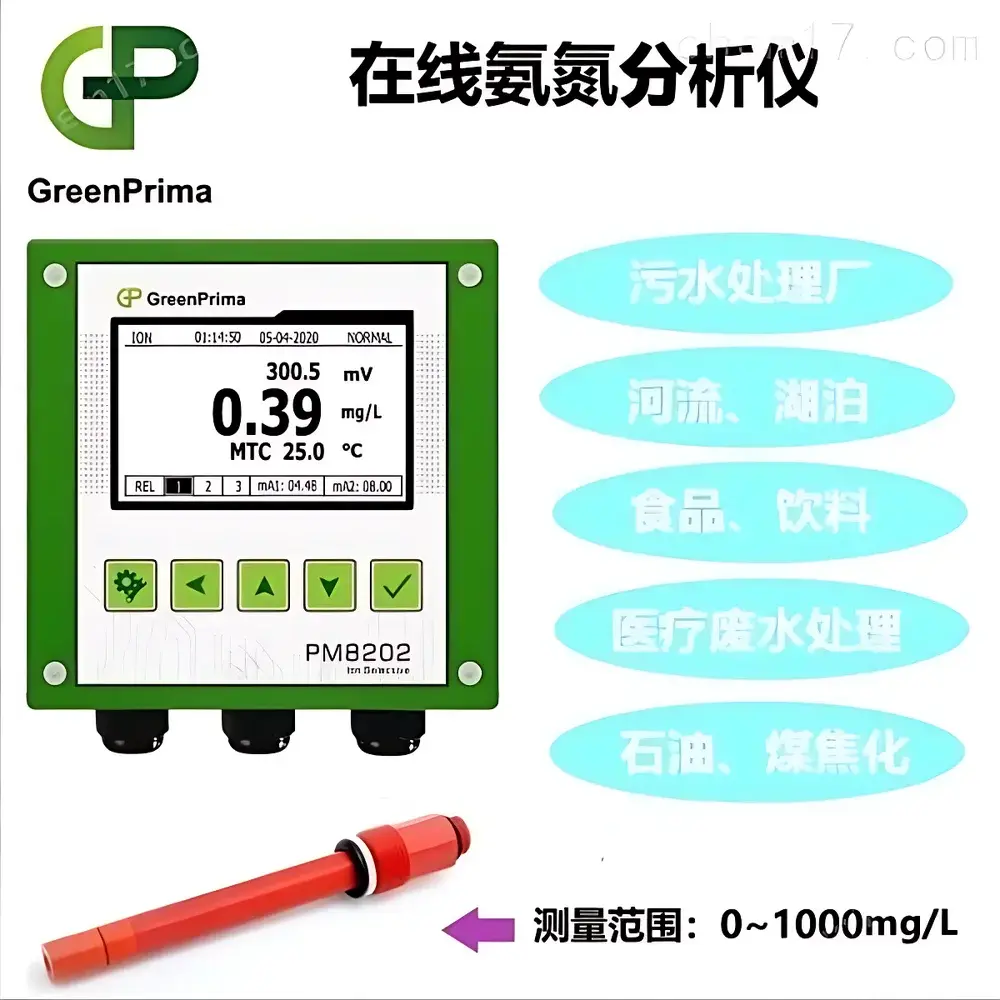
GreenPrima PM8202I Online Ammonia Nitrogen Analyzer
| Brand | GreenPrima |
|---|---|
| Origin | United Kingdom |
| Manufacturer Type | Manufacturer |
| Origin Category | Imported |
| Model | PM8202I |
| Instrument Type | Online |
| Measurement Principle | Ion-Selective Electrode (ISE) Method |
| Measurement Range | 0.00–20,000 ppm |
| Accuracy | ±0.01 / ±0.1 / ±1 ppm (dependent on range) |
| Resolution | 0.01 / 0.1 / 1 ppm |
| Temperature Compensation | –10 to 130 °C (manual/automatic, NTC30K or PT1000) |
| Operating Temperature | –10 to 70.0 °C |
| Storage Temperature | –20 to 70.0 °C |
| Display | Backlit dot-matrix LCD |
| Languages | English & Chinese |
| Data Storage | 600,000 records |
| Power Supply | 90–260 VAC, 50/60 Hz or optional 24 VDC |
| Output | Two isolated 4–20 mA outputs (max. loop resistance 500 Ω, accuracy 0.1% FS) |
| Communication | RS485 Modbus RTU |
| Cleaning Cycle | 0.1–1000 h adjustable |
| cleaning duration | 1–1000 s adjustable |
| Alarm Outputs | Two independent Hi/Lo relay outputs (5 A / 250 VAC / 30 VDC) |
| Enclosure Rating | IP65 |
| Mounting Options | Wall-mounted, pipe-mounted, panel-mounted |
| Dimensions (W×H×D) | 144 × 144 × 108 mm |
| Cutout Size | 138 × 138 mm |
| Weight | 0.87 kg |
Overview
The GreenPrima PM8202I Online Ammonia Nitrogen Analyzer is an industrial-grade, continuous-monitoring instrument engineered for real-time quantification of ammonia nitrogen (NH₃–N) in aqueous matrices using potentiometric ion-selective electrode (ISE) technology. Based on the Nernst equation response of a solid-state ammonium-selective membrane, the system delivers stable, interference-resistant measurements across a wide dynamic range—from trace-level process control to high-concentration effluent monitoring. Designed for unattended operation in demanding municipal and industrial environments, the analyzer integrates a robust controller with the Bsens730 ammonia-specific ISE sensor, enabling direct measurement without reagents, distillation, or colorimetric chemistry. Its architecture supports long-term deployment in raw water intake, secondary clarifier effluent, activated sludge return lines, and cooling tower recirculation systems—where rapid detection of ammonia spikes is critical for biological treatment integrity and regulatory compliance.
Key Features
- IP65-rated sealed enclosure with corrosion-resistant housing, suitable for humid, dusty, or splash-prone installation sites;
- Intuitive dual-language (English/Chinese) graphical interface on backlit dot-matrix LCD, displaying real-time NH₃–N concentration, temperature, timestamp, relay status, and diagnostic flags;
- Multi-range resolution and accuracy configuration: 0.01 ppm (±0.01 ppm), 0.1 ppm (±0.1 ppm), or 1 ppm (±1 ppm), automatically or manually selected based on application requirements;
- Integrated temperature compensation using either NTC30K thermistor or PT1000 RTD input, supporting accurate measurement across –10 to 130 °C sample temperatures;
- Two fully isolated 4–20 mA analog outputs configurable for NH₃–N concentration and/or temperature, compliant with 0.1% full-scale linearity and 500 Ω maximum loop load;
- RS485 Modbus RTU communication port for seamless integration into SCADA, DCS, or PLC-based automation infrastructures;
- Programmable cleaning cycle (0.1–1000 hours) and cleaning duration (1–1000 seconds) to mitigate fouling in suspended-solids-rich streams;
- Dual independent relay outputs with user-defined high/low alarm thresholds, hysteresis adjustment, and fail-safe state logic (5 A @ 250 VAC / 30 VDC);
- Password-protected configuration mode prevents unauthorized parameter modification, supporting operational accountability under GLP/GMP-aligned workflows.
Sample Compatibility & Compliance
The PM8202I is validated for use in potable water, wastewater (primary, secondary, and tertiary), industrial process water (e.g., food & beverage, pharmaceutical cooling loops), and aquaculture recirculation systems. It operates effectively within pH 4–11 and conductivity ranges typical of municipal and industrial influents (up to 20 mS/cm). While not a photometric or spectrophotometric method, the ISE-based approach aligns with ASTM D1426–15 (Standard Test Methods for Nitrogen in Water) for ion-selective determination and supports data traceability required by ISO/IEC 17025-accredited laboratories. The device’s data logging (600,000 entries with timestamp) and audit-ready configuration history meet foundational expectations for regulatory reporting under EU Urban Wastewater Treatment Directive (91/271/EEC) and U.S. EPA Clean Water Act discharge monitoring protocols.
Software & Data Management
Data acquisition and configuration are managed locally via the front-panel interface; no proprietary PC software is required for routine operation. All logged values—including concentration, temperature, calibration timestamps, cleaning events, and alarm activations—are time-stamped and stored non-volatile memory with power-fail resilience. Export is supported via Modbus polling to external historian systems (e.g., Ignition, Siemens Desigo, or Wonderware). The unit maintains full calibration history (date, standard values, slope/mV offset, R²) and supports up to three-point calibration using certified NH₄⁺ standards (e.g., 1, 10, and 100 ppm NH₃–N). While not natively 21 CFR Part 11-compliant, its password protection, immutable event logs, and deterministic output behavior facilitate validation in regulated environments when deployed within validated IT infrastructure.
Applications
- Continuous monitoring of ammonia nitrogen at wastewater treatment plant influent, bioreactor zones, and final effluent discharge points;
- Real-time feedback control of nitrification/denitrification processes in activated sludge and MBR systems;
- Early warning detection of ammonia breakthrough in granular activated carbon (GAC) or ion exchange polishing units;
- Compliance tracking for NPDES permits and local discharge limits (e.g., < 1–5 mg/L NH₃–N depending on receiving water classification);
- Process optimization in industrial cooling towers to prevent microbiologically influenced corrosion (MIC) linked to elevated NH₃;
- Monitoring in recirculating aquaculture systems (RAS) where sub-ppm ammonia shifts impact fish health and biofilter loading.
FAQ
What measurement principle does the PM8202I employ?
It uses a solid-contact ammonium-selective ion-selective electrode (ISE) operating on the Nernstian potentiometric principle, eliminating the need for reagents or optical components.
Is field calibration required, and how often?
Yes—routine calibration is essential for long-term accuracy. Typical intervals range from daily (in highly variable or fouling-prone streams) to weekly (in stable, low-turbidity applications), using traceable NH₄⁺ standard solutions.
Can the analyzer operate in high-salinity seawater or brackish water?
While functional, performance may degrade above 35,000 µS/cm due to ionic strength effects on ISE selectivity; use of ionic strength adjusters or matrix-matched calibration is recommended.
Does it support automatic temperature compensation?
Yes—integrated NTC30K or PT1000 inputs enable real-time, automatic temperature correction across the full –10 to 130 °C range.
What mounting options are available?
The unit supports wall-mounting, pipe-clamp mounting (with optional bracket), and panel-cutout installation (138 × 138 mm opening).
Is remote configuration possible via Modbus?
Modbus RTU enables read-only access to live measurements and status registers; configuration changes require local interface interaction for security and traceability.
Related Products







