
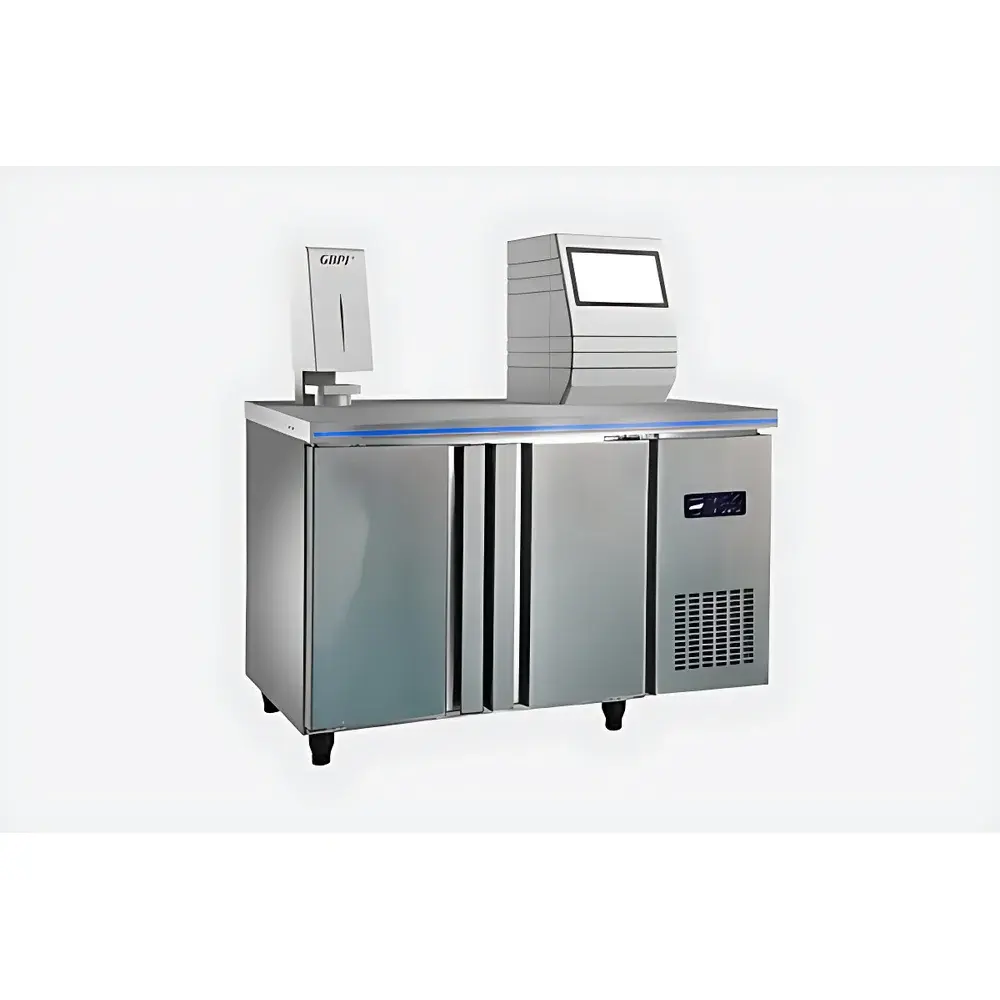
GBPI GB-KF30010Y Aerosol Filtration Efficiency Tester for Medical Masks
| Brand | GBPI |
|---|---|
| Origin | Guangdong, China |
| Manufacturer Type | Manufacturer |
| Country of Origin | China |
| Model | GB-KF30010Y |
| Instrument Type | Aerosol Filtration Efficiency Tester |
| Filtration Efficiency Range | 0–99.999% |
| Aerosol Flow Rate | 10–100 L/min (Accuracy Class 2.5) |
| Sampling Frequency | 1–9999 times/min (adjustable) |
| Test Aerosol Concentration | 20–30 mg/m³ |
| Count Median Diameter (CMD) | NaCl aerosol (0.075 ± 0.02) µm |
| Geometric Standard Deviation (GSD) | NaCl ≤ 1.86 |
| Dynamic Concentration Range | 0.001–100 mg/m³ (±1% accuracy) |
| Differential Pressure Sensor Range | 0–500 Pa |
| Dimensions | 460 mm × 525 mm × 1430 mm |
| Power Supply | AC 220 V, 50 Hz |
| Environmental Control | Temperature 25 °C ± 5 °C, Relative Humidity 30 %RH ± 10 %RH |
Overview
The GBPI GB-KF30010Y Aerosol Filtration Efficiency Tester is a precision-engineered system designed to quantify the particle filtration efficiency (PFE) of medical masks, surgical masks, respirators, and protective textiles under standardized airflow conditions. It operates on the principle of controlled aerosol challenge and real-time differential concentration measurement—comparing upstream and downstream particle number or mass concentrations using calibrated optical particle counters and high-sensitivity PM2.5 sensors. The system complies with internationally recognized test protocols including ISO 16900-1:2016 (respiratory protective devices), ASTM F2299/F2101 (bacterial filtration efficiency), and critical Chinese national standards such as GB/T 32610–2016 (daily protective masks), GB 2626–2006 (respiratory protective equipment), GB 19082–2009 (medical protective clothing), GB 19083–2010 (medical surgical masks), GB 24539–2009 (chemical protective clothing), and YY 0469–2011 (surgical masks). Its dual-aerosol capability—supporting both sodium chloride (NaCl) and paraffin oil aerosols—enables evaluation across hydrophilic and hydrophobic challenge conditions, essential for regulatory validation of barrier performance.
Key Features
- Cold-generation dual aerosol system: Independent NaCl and oil aerosol generators produce stable, monodisperse challenge particles without thermal degradation; solution refilling is accessible and tool-free.
- Integrated electrostatic neutralizer: Ensures consistent charge state distribution (Boltzmann equilibrium) prior to filter challenge, eliminating electrostatic enhancement artifacts in PFE measurements.
- Full containment design: Sealed aerosol pathway with negative-pressure exhaust and HEPA-filtered exhaust ensures operator safety and prevents environmental contamination during high-concentration testing.
- Dual-sensor concentration monitoring: High-accuracy PM2.5 mass sensor + laser particle counter (0.3–10 µm channel resolution) enable simultaneous gravimetric and number-based efficiency calculation per ISO 16900-3.
- Pneumatic clamping fixture with mechanical interlock: Ensures repeatable mask mounting pressure (±2 kPa) and automatic shutdown if seal integrity is compromised.
- Environmental monitoring suite: Integrated temperature and relative humidity sensors continuously log ambient conditions (25 °C ± 5 °C, 30 %RH ± 10 %RH) to meet standard-compliant conditioning requirements.
- Modular flow control: Precision glass rotameter and vacuum pump deliver stable, laminar airflow from 10 to 100 L/min at ±2.5% full-scale accuracy per ISO 5167.
Sample Compatibility & Compliance
The GB-KF30010Y accommodates flat-sheet specimens (up to 100 mm × 100 mm) and three-dimensional mask forms (including cup, fold-flat, and duckbill styles) via adjustable fixture geometry. It supports standardized test substrates per ASTM F2100 (medical face masks), EN 14683 (European medical masks), and FDA guidance for surgical mask evaluation. All hardware and software workflows are engineered to support audit-ready documentation for GLP and GMP environments. Data acquisition meets FDA 21 CFR Part 11 requirements for electronic records and signatures when deployed with validated software configuration and user access controls. Calibration traceability follows ISO/IEC 17025 principles, with documented uncertainty budgets for flow, pressure, and concentration measurements.
Software & Data Management
The system includes dedicated Windows-based control software with intuitive GUI for method setup, real-time parameter visualization, and automated reporting. Test protocols are preconfigured for GB/T 32610, GB 2626, YY 0469, and custom methods. Software automatically calculates filtration efficiency (%) as (1 − Cdown/Cup) × 100, where Cup and Cdown represent upstream and downstream mass or particle concentrations. All raw data—including time-stamped flow rate, differential pressure, temperature, RH, and particle counts per size bin—are stored in encrypted CSV and PDF formats. Audit trails record user login, method changes, calibration events, and result exports. Export options include Excel-compatible tables, graphical trend plots (efficiency vs. time, pressure drop vs. flow), and certificate-of-analysis templates compliant with CNAS-CL01 and ILAC-MRA frameworks.
Applications
- Regulatory compliance testing for Class I/II medical masks submitted to NMPA, FDA, or EU Notified Bodies.
- R&D validation of novel filter media (e.g., electret nonwovens, nanofiber composites, antimicrobial coatings).
- Quality control in mask manufacturing lines—batch release testing per AQL sampling plans.
- Comparative analysis of filtration vs. breathability trade-offs (ΔP @ 85 L/min).
- Accelerated aging studies assessing PFE retention after simulated wear, humidity exposure, or laundering cycles.
- Support for ISO 10993 biocompatibility testing by quantifying particulate shedding from mask materials.
FAQ
What aerosol types does the GB-KF30010Y support?
It supports both sodium chloride (NaCl) and paraffin oil aerosols, generated independently via cold nebulization to meet salt- and oil-particulate test requirements per GB 2626 and EN 149.
Is the system compliant with ISO 16900 series standards?
Yes—the instrument architecture, aerosol generation, sampling methodology, and data processing align with ISO 16900-1 (test principles), ISO 16900-2 (equipment specifications), and ISO 16900-3 (efficiency calculation).
Can the system be used for bacterial filtration efficiency (BFE) testing?
While optimized for particulate filtration, it may be adapted for BFE when paired with biological aerosol generators and viable particle counters—subject to additional biosafety certification and lab validation per ASTM F2101.
Does the software support multi-user permissions and electronic signatures?
Yes—role-based access control (administrator, operator, reviewer), electronic signature capture, and full 21 CFR Part 11 audit trail functionality are available with proper installation qualification (IQ) and operational qualification (OQ).
What maintenance intervals are recommended for the aerosol generators and sensors?
NaCl/oil reservoirs require cleaning after every 50 test cycles; PM2.5 sensor zero calibration is advised daily, and full span calibration every 30 days using NIST-traceable reference aerosols.







