
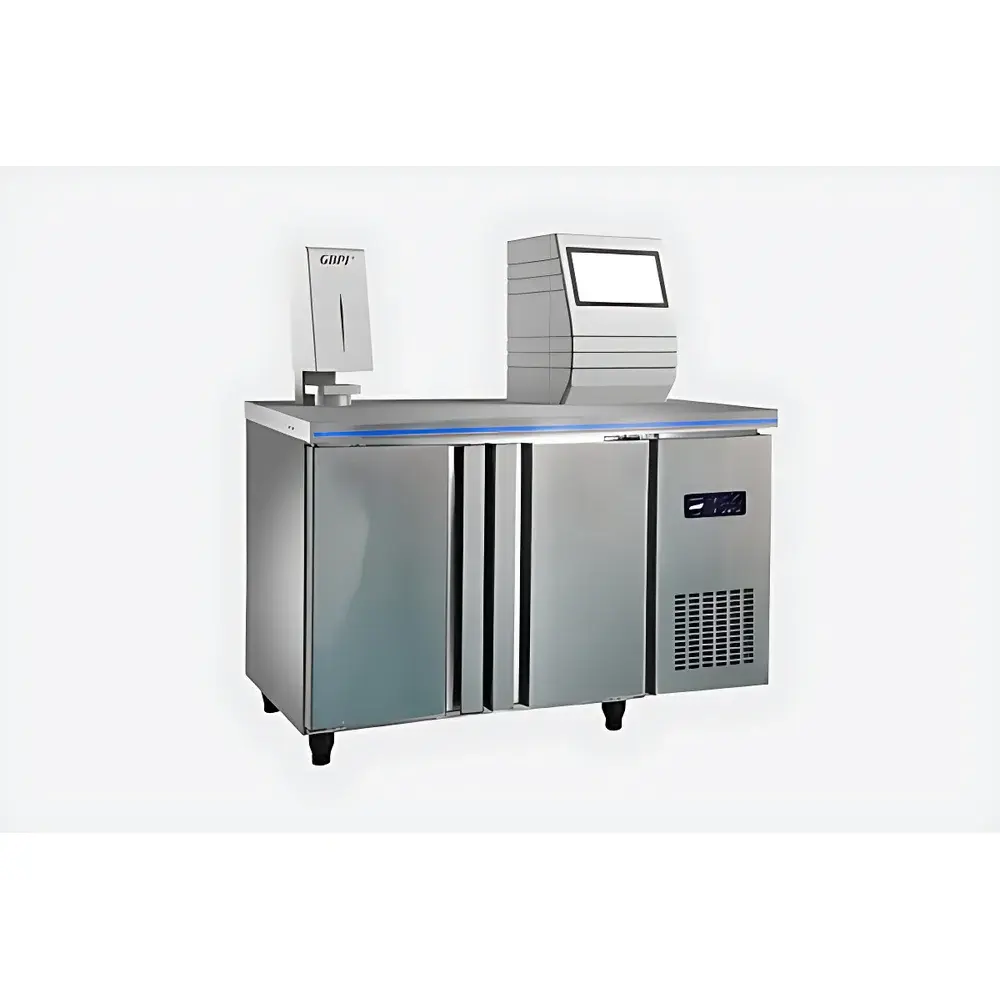
GBPI GB-KF30020 Aerosol Filtration Efficiency Tester for Respiratory Protective Devices
| Brand | GBPI |
|---|---|
| Origin | Guangdong, China |
| Manufacturer Type | Manufacturer |
| Product Category | Domestic |
| Model | GB-KF30020 |
| Instrument Type | Aerosol Filtration Efficiency Tester |
| Filtration Efficiency Range | 0–99.999% |
| Aerosol Flow Rate | 10–100 L/min (Accuracy Class 2.5) |
| Sampling Frequency | 1–9999 times/min (adjustable) |
| Test Aerosol Concentration | 20–30 mg/m³ |
| Count Median Diameter (CMD) | NaCl aerosol (0.075 ± 0.02) µm |
| Geometric Standard Deviation (GSD) | NaCl ≤ 1.86 |
| Dynamic Concentration Range | 0.001–100 mg/m³ (±1% accuracy) |
| Differential Pressure Sensor Range | 0–500 Pa |
| Dimensions | 460 mm × 525 mm × 1430 mm |
| Power Supply | AC 220 V, 50 Hz |
| Environmental Requirements | 25 °C ± 5 °C, 30 %RH ± 10 %RH |
Overview
The GBPI GB-KF30020 Aerosol Filtration Efficiency Tester is a purpose-built, regulatory-compliant instrumentation platform engineered for quantitative evaluation of particulate filtration efficiency (PFE) in respiratory protective devices—including surgical masks, N95/KN95 respirators, medical face masks, and protective textiles. It operates on the principle of controlled aerosol challenge testing under constant airflow conditions, adhering to internationally recognized test methodologies grounded in aerosol science and respiratory protection standards. The system generates monodisperse or narrowly distributed polydisperse aerosols using calibrated salt (NaCl) and oil-based generators, delivering stable particle clouds at defined mass concentrations and aerodynamic size distributions. Filtration performance is determined by real-time comparative measurement of upstream and downstream aerosol concentrations—typically via high-sensitivity PM2.5 optical sensors and laser particle counters—enabling precise calculation of fractional filtration efficiency across the critical submicron range (0.075–0.185 µm CMD). Designed for laboratory-grade repeatability and traceable metrology, the GB-KF30020 supports both static and dynamic filtration resistance assessment, including differential pressure drop measurement across the test specimen under standardized flow rates.
Key Features
- Cold-generation dual-aerosol system: Independent NaCl and oil aerosol generators ensure compliance with both hydrophilic and hydrophobic challenge requirements per GB 2626-2006 and EN 149:2001+A1:2009.
- Integrated electrostatic neutralization stage: Removes residual charge from generated aerosols to minimize electrostatic attraction artifacts and improve measurement fidelity for nonwoven filter media.
- Full containment architecture: Leak-tight aerosol pathway design with sealed viewing windows and negative-pressure exhaust safeguards operator exposure during operation.
- Automated differential pressure monitoring: High-resolution 0–500 Pa sensor enables concurrent determination of filter resistance (ΔP) at regulated flow rates (10–100 L/min), supporting breathability assessments per ISO 16900-1.
- Environmental conditioning module: Built-in temperature and humidity sensors maintain and log ambient conditions (25 °C ± 5 °C, 30 %RH ± 10 %RH), satisfying preconditioning requirements outlined in GB/T 32610-2016 and YY 0469-2011.
- Modular sensor suite: Combines calibrated glass rotor flowmeters, vacuum pump assembly, laser particle counter (0.3–10 µm detection range), and NIST-traceable PM2.5 optical density sensors for multi-point aerosol quantification.
- Computer-controlled operation: Dedicated Windows-based software automates test sequencing, data acquisition, PFE computation (E = [1 − Cdown/Cup] × 100%), statistical reporting, and audit-ready export (CSV, PDF, XML).
Sample Compatibility & Compliance
The GB-KF30020 accommodates flat, circular specimens up to Ø100 mm—including layered nonwovens, melt-blown polypropylene, electrospun nanofibers, and coated fabrics—secured via pneumatic clamping with force-limiting safety interlocks. It meets the physical and procedural specifications of multiple national and industry standards: GB/T 32610-2016 (Daily Protective Masks), GB 2626-2006 (Respiratory Protection—Non-powered Air-purifying Particulate Respirators), GB 19082-2009 (Medical Disposable Protective Clothing), GB 19083-2010 (Medical Protective Masks), GB 24539-2009 (Chemical Protective Clothing), and YY 0469-2011 (Surgical Masks). While not certified to ISO 16900 series or ASTM F2299/F2101 by default, its operational parameters and calibration traceability align with the foundational aerosol physics underpinning those standards. All firmware and data handling protocols support GLP-aligned documentation practices, including user authentication, electronic signatures, and time-stamped audit trails compliant with FDA 21 CFR Part 11 principles.
Software & Data Management
The proprietary GBPI TestSuite v3.2 software provides full lifecycle control—from method setup (flow rate, sampling interval, aerosol type, dwell time) to real-time visualization of concentration decay curves and ΔP trends. Raw sensor outputs are timestamped at 100 Hz and stored in an encrypted local database with version-controlled backups. Each test report includes metadata (operator ID, calibration certificate numbers, environmental logs), raw concentration waveforms, calculated PFE values with standard deviation (n ≥ 3), and graphical overlays comparing results against pass/fail thresholds. Export formats include ISO/IEC 17025-compatible PDF reports with digital signature fields, CSV files for LIMS integration, and XML schemas compatible with enterprise QA systems. Software validation documentation (IQ/OQ/PQ protocols) is available upon request for GMP-regulated laboratories.
Applications
This instrument serves as a core testing asset in regulatory and R&D laboratories evaluating filtration integrity, material degradation under cyclic loading, and performance consistency across production batches. Primary use cases include: verification of PFE claims for CE-marked or NMPA-registered masks; comparative analysis of novel electret-charged media versus mechanical filtration layers; accelerated aging studies assessing electrostatic decay after humidity exposure; validation of sterilization effects on filtration performance; and benchmarking of reusable textile masks against single-use benchmarks. It is routinely deployed in National Institutes for Food and Drug Control (NIFDC), provincial CDCs, occupational safety institutes, textile certification bodies (e.g., CNAS-accredited labs), and Tier-1 medical device OEMs conducting internal QC prior to third-party conformity assessment.
FAQ
Does the GB-KF30020 comply with ISO 16900-3 for aerosol generation and measurement?
It implements equivalent aerosol generation stability and sizing controls per GB 2626-2006 Annex B, but formal ISO 16900-3 conformance requires additional third-party verification of generator GSD and CMD uncertainty budgets.
Can the system test pleated respirators without flattening?
No—it requires planar specimens mounted in the standard fixture; 3D form factors must be sectioned or evaluated via alternative whole-mask test rigs.
Is calibration traceable to NIST or equivalent national metrology institutes?
Flow meters and pressure sensors are calibrated against CNAS-accredited reference standards; optional NIST-traceable calibration certificates are available for an additional fee.
What maintenance intervals are recommended for the aerosol generators?
Salt generator solution reservoirs require cleaning every 50 hours of operation; oil generator nozzles demand ultrasonic cleaning every 200 hours to prevent clogging.
Does the software support multi-user role-based access control?
Yes—administrator, technician, and reviewer roles enforce segregation of duties for method editing, test execution, and report approval in accordance with 21 CFR Part 11 Annex 11 expectations.
Related Products







