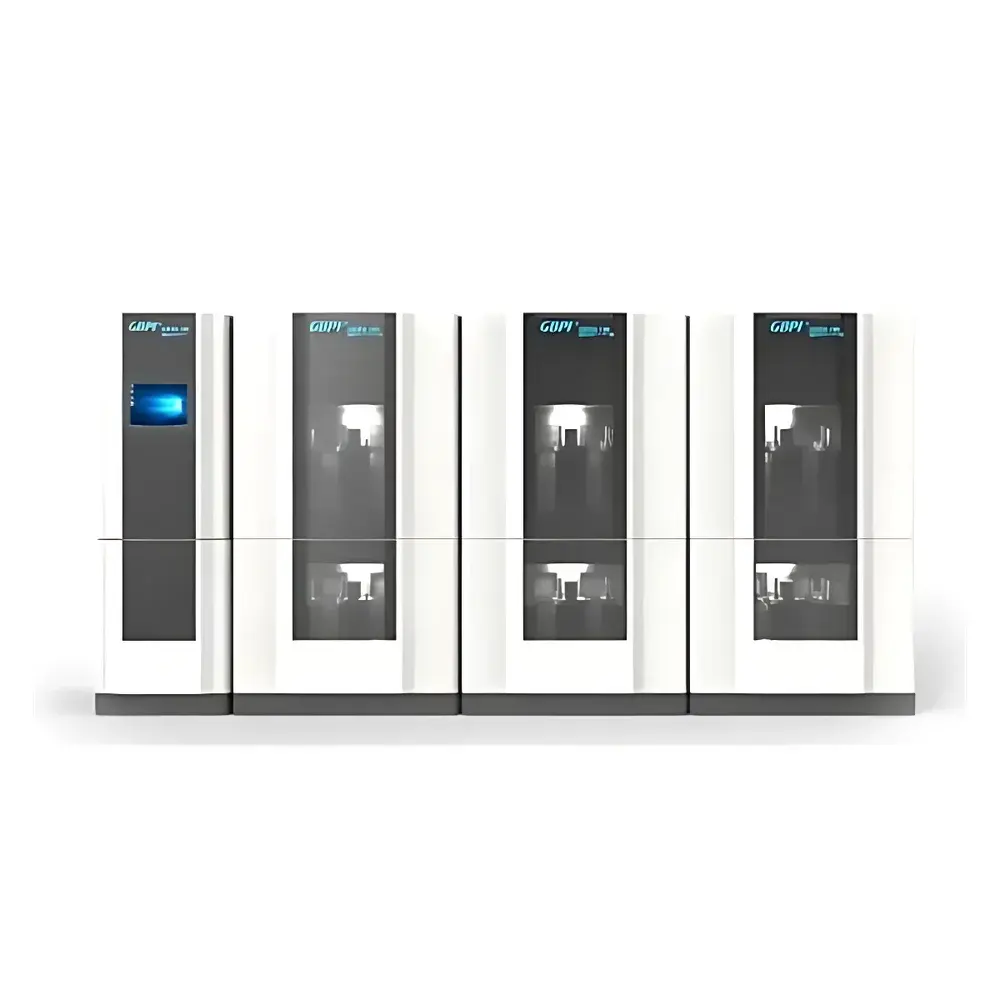
GBPI GBDA-180C Intelligent Composting Biodegradation Testing System
| Brand | GBPI |
|---|---|
| Origin | Guangdong, China |
| Manufacturer Type | OEM Manufacturer |
| Country of Origin | China |
| Model | GBDA-180C |
| Price Range | USD 112,000–252,000 (FOB Guangzhou) |
| Mass Measurement Resolution | ±0.01 g |
| Gas Flow Rate Range | 0.01–10 L/min |
| Reactor Volume | 500 mL |
| Maximum Number of Simultaneous Reactors | 18 |
| Temperature Control Range | Ambient to 80 °C |
| Temperature Control Accuracy | ±0.5 °C |
| CO₂ Detection Range | 0–10,000 ppm |
| CO₂ Detection Accuracy | ±40 ppm (0–3,000 ppm), ±2% FS (3,000–10,000 ppm) |
| O₂ Detection Range | 0–25% vol |
| O₂ Detection Accuracy | ±1% FS |
| Pressure Detection Range | 0–200 kPa |
| Pressure Detection Accuracy | ±1% FS |
| Gas Supply Pressure | 0.2–0.8 MPa |
| Power Supply | AC 220 V, 50 Hz |
| Total Power Consumption | 3,000 W |
| Dimensions (W×D×H) | 3600 × 810 × 1930 mm |
| Weight | 1,100 kg |
Overview
The GBPI GBDA-180C Intelligent Composting Biodegradation Testing System is a fully automated, multi-channel respirometric instrument engineered for standardized determination of ultimate aerobic biodegradability of organic materials under controlled composting conditions. It operates on the principle of dynamic headspace respirometry: test specimens—mixed with mature compost inoculum—are incubated in sealed, temperature-regulated reactors under continuous forced aeration. Microbial oxidation of organic carbon yields CO₂, H₂O, mineral salts, and microbial biomass; the system quantifies cumulative CO₂ evolution via high-stability non-dispersive infrared (NDIR) sensors, enabling calculation of percent biodegradation relative to theoretical CO₂ yield (ThCO₂). Designed in strict alignment with internationally harmonized test protocols—including ISO 14855-1, ASTM D5338, GB/T 19277.1, and ASTM D6400—the GBDA-180C delivers traceable, reproducible data required for regulatory compliance, certification (e.g., OK Compost INDUSTRIAL, TÜV Austria), and R&D validation of bio-based polymers, mulch films, food packaging, and other compostable materials.
Key Features
- Eighteen independent reaction channels, each equipped with dedicated mass-sensitive CO₂ sensing, precision gas flow control (0.01–10 L/min), and real-time O₂ monitoring—enabling parallel testing of samples, blanks, and reference controls without cross-contamination.
- PID-fuzzy logic temperature regulation (ambient to 80 °C, ±0.5 °C stability) across all chambers, ensuring adherence to thermophilic composting profiles mandated by ISO 14855-1.
- Integrated automatic stirring mechanism per reactor—programmable agitation frequency and duration—to maintain homogeneity of solid-phase matrix and prevent stratification or localized anaerobiosis.
- Onboard gas-tightness verification protocol: automated pressure decay test prior to assay initiation, confirming integrity of the closed-loop gas circuit per channel.
- Modular hardware architecture with field-replaceable sensor cartridges (CO₂, O₂, pressure), calibrated NDIR modules, and mass-flow controllers traceable to NIST standards—supporting routine in-house verification and metrological traceability.
- Role-based access control (administrator, operator, viewer) with encrypted login, configurable permission sets, and full audit trail logging compliant with FDA 21 CFR Part 11 and GLP/GMP documentation requirements.
Sample Compatibility & Compliance
The GBDA-180C accommodates solid, granular, or film-form test materials up to 500 mL reactor volume, compatible with standard inocula including mature compost, activated vermiculite, or defined microbial consortia. Its design satisfies the mechanical, environmental, and analytical requirements of ISO 14855-1 (determination of ultimate aerobic biodegradability under controlled composting conditions), ASTM D5338 (standard test method for determining aerobic biodegradation of plastic materials in municipal solid waste compost), GB/T 19277.1 (Chinese national standard equivalent to ISO 14855-1), and ASTM D6400 (specification for labeling of plastics designed to be aerobically composted). All gas measurement subsystems meet ISO/IEC 17025 calibration traceability criteria when operated with certified reference gases and validated calibration procedures.
Software & Data Management
The proprietary GBDA Control Suite provides a validated Windows-based platform supporting method definition, real-time multichannel parameter visualization (CO₂ evolution rate, O₂ depletion, temperature, pressure), and automated data reduction per ISO 14855-1 Annex B. Raw time-series datasets are stored in encrypted binary format with embedded metadata (user ID, timestamp, instrument serial, method version). The software implements full electronic audit trail functionality: every user action—including method edits, result overrides, report generation, and calibration events—is timestamped, user-attributed, and immutable. Reports export natively to PDF and Microsoft Excel formats, including calculated biodegradation curves, lag phase identification, plateau confirmation, and statistical summaries (mean ± SD, coefficient of variation). Data archives support long-term retention and retrieval for regulatory audits or interlaboratory comparison studies.
Applications
This system serves as a core analytical platform for polymer manufacturers validating compostability claims; third-party testing laboratories accredited to ISO/IEC 17025 conducting conformity assessments for EN 13432 or AS 5810 certification; academic and governmental research institutions investigating microbial degradation kinetics of novel biomaterials; and regulatory bodies verifying compliance with national composting directives (e.g., EU Directive 2019/904, California AB 1881). It is routinely deployed for testing polylactic acid (PLA), polyhydroxyalkanoates (PHA), starch-blends, cellulose derivatives, and oxo-degradable formulations—providing quantitative, standards-aligned evidence of carbon mineralization performance under simulated industrial composting conditions.
FAQ
What standards does the GBDA-180C directly support?
It is configured and validated for ISO 14855-1, ASTM D5338, GB/T 19277.1, ASTM D6400, and JIS K 6953.
Can blank correction and reference material testing be performed simultaneously with samples?
Yes—each of the 18 channels supports independent configuration as sample, blank, or reference (e.g., microcrystalline cellulose), enabling concurrent normalization and system suitability verification.
Is remote monitoring and data backup supported?
The system includes Ethernet connectivity and optional cloud synchronization; raw data and reports may be automatically archived to network drives or secure SFTP servers.
How is sensor accuracy maintained over extended operation?
Built-in zero-span calibration routines use certified span gases; users can perform daily zero checks and periodic multi-point calibrations using traceable standards—documentation is auto-recorded in the audit trail.
Does the system comply with FDA 21 CFR Part 11 requirements?
Yes—electronic signatures, role-based permissions, and immutable audit logs satisfy predicate rule requirements for regulated environments.
Related Products