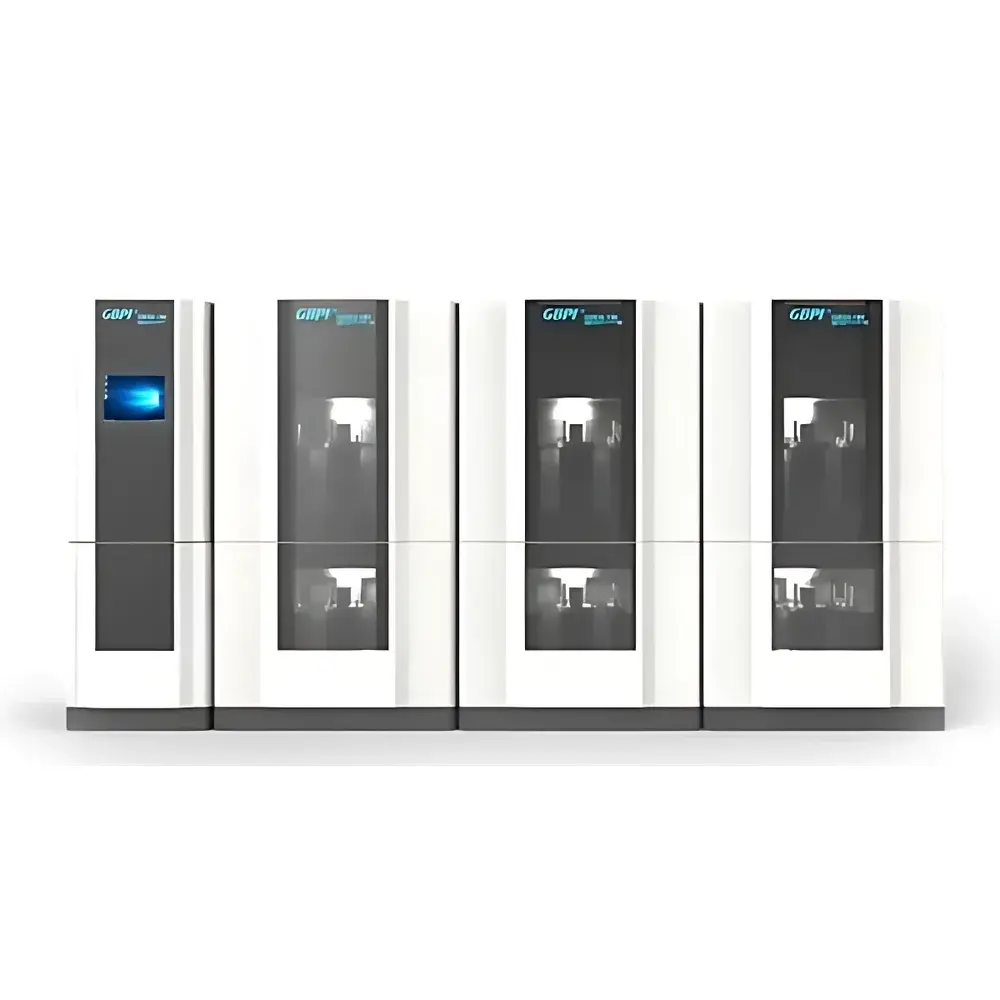
GBPI GBDA-180I Automated Composting Biodegradation Testing System
| Brand | GBPI |
|---|---|
| Origin | Guangdong, China |
| Manufacturer Type | Direct Manufacturer |
| Origin Category | Domestic (China) |
| Model | GBDA-180I |
| Price Range | USD 112,000 – 252,000 |
| Mass Measurement Resolution | ±0.01 g |
| Gas Flow Rate Range | 0.01–10 L/min |
| Reactor Volume | 500 mL |
| Maximum Number of Reactors per System | 18 |
| Temperature Control Range | Ambient to 80 °C |
| Temperature Control Accuracy | ±0.5 °C |
| CO₂ Detection Range | 0–10,000 ppm |
| CO₂ Detection Accuracy | ±40 ppm (0–3,000 ppm), ±2% FS (3,000–10,000 ppm) |
| O₂ Detection Range | 0–25% |
| O₂ Detection Accuracy | ±1% FS |
| Pressure Detection Range | 0–200 kPa |
| Pressure Detection Accuracy | ±1% FS |
| Air Supply Pressure | 0.2–0.8 MPa |
| Test Chamber Count | 18 |
| Chamber Volume | 3.5 L |
| Dimensions | 3600 × 810 × 1930 mm |
| Weight | 1100 kg |
| Power Consumption | 3000 W |
| Electrical Supply | AC 220 V, 50 Hz |
Overview
The GBPI GBDA-180I Automated Composting Biodegradation Testing System is a fully integrated, high-throughput instrument engineered for standardized determination of ultimate aerobic biodegradability of organic materials under controlled composting conditions. It operates on the principle of respirometric measurement—quantifying carbon dioxide (CO₂) evolved during microbial mineralization of test substrates in the presence of mature compost inoculum. The system complies with internationally recognized protocols including ISO 14855-1, ASTM D5338, ASTM D6400, JIS K 6953, and GB/T 19277.1. Each of its 18 independent reaction chambers maintains precise control over temperature, airflow, oxygen concentration, and pressure—enabling parallel, statistically robust evaluation of multiple samples and controls (e.g., reference cellulose, blanks, and test materials) within a single experimental run. The core measurement architecture integrates NDIR-based CO₂ sensors (imported OEM grade), electrochemical O₂ sensors, and thermal-mass-flow controllers calibrated to ±1.0% full scale, ensuring metrological traceability and inter-laboratory reproducibility.
Key Features
- 18 independently controlled reaction chambers (500 mL working volume each), enabling concurrent multi-sample assessment with full parameter autonomy per channel.
- PID-fuzzy logic temperature regulation across ambient to 80 °C, with stability maintained at ±0.5 °C—critical for simulating thermophilic composting phases.
- High-accuracy gas delivery: dual-range mass flow controllers (0.01–10 L/min) with real-time feedback and automatic leak detection via integrated pressure decay monitoring.
- Dual-gas sensing: simultaneous, continuous monitoring of CO₂ (0–10,000 ppm) and O₂ (0–25%) using factory-calibrated, long-life sensors; accuracy validated per ISO 14855 Annex B requirements.
- Onboard calibration verification system for CO₂ and O₂ sensors—eliminating need for external span gas during routine operation.
- Automated stirring mechanism with programmable frequency and duration per chamber to ensure homogeneous substrate-inoculum contact and prevent anaerobic microzones.
- Modular hardware design supports field-replaceable sensor modules, flow controllers, and reactor assemblies—minimizing downtime and facilitating ISO/IEC 17025-compliant maintenance logs.
Sample Compatibility & Compliance
The GBDA-180I accommodates solid and semi-solid organic test materials—including PLA, PHA, PBAT, starch blends, paper-based composites, and agricultural residues—provided they meet particle size specifications (≤20 µm for reference cellulose per ASTM D6400). All reactors are constructed from inert, autoclavable stainless steel with PTFE-sealed lids to prevent adsorption or catalytic interference. The system supports full compliance with regulatory frameworks requiring documented method validation: it meets GLP principles per OECD Series on Principles of Good Laboratory Practice, satisfies data integrity requirements of FDA 21 CFR Part 11 (via role-based access control, electronic signatures, and immutable audit trails), and aligns with ISO/IEC 17025:2017 clause 7.7 on measurement uncertainty management. Optional accessories—including certified reference materials (TLC-grade cellulose), pre-activated vermiculite inoculum, and TOC analyzers—enable full chain-of-custody alignment with ISO 14855-2 validation procedures.
Software & Data Management
The proprietary GBPI BioTrack™ software provides a validated, 21 CFR Part 11-compliant platform for method definition, real-time monitoring, raw data archiving, and report generation. Users configure test parameters—including incubation duration (up to 180 days), sampling intervals (1–60 min), temperature ramps, and gas flow profiles—via intuitive graphical interface. All operational events (method edits, user logins, calibration actions, alarm triggers) are permanently recorded in tamper-evident audit trails compliant with ALCOA+ principles. Data export supports CSV, PDF, and Microsoft Office formats; reports include calculated % biodegradation (relative to theoretical CO₂ yield), kinetic curves (e.g., DT₅₀), and statistical summaries (mean, SD, CV%). Role-based permissions enforce separation of duties: Administrators manage users and system configurations; Operators execute tests; Observers view historical data only. Software updates are digitally signed and version-controlled per IEC 62304 Class B medical device software standards.
Applications
The GBDA-180I serves as a primary analytical platform for R&D laboratories developing certified compostable polymers, quality control departments verifying conformance to EN 13432 or ASTM D6400, and third-party testing bodies accredited to ISO/IEC 17025. It supports regulatory submissions to certification bodies such as TÜV Austria (OK Compost INDUSTRIAL), DIN CERTCO, and BPI. Beyond polymer testing, the system enables comparative studies of enzymatic pretreatment efficacy on lignocellulosic feedstocks, optimization of co-composting ratios for mixed waste streams, and validation of novel inoculant formulations. Its modular architecture allows integration into larger environmental simulation suites—e.g., coupling with headspace GC-MS for volatile metabolite profiling or with online pH/conductivity probes for dynamic process monitoring.
FAQ
What international standards does the GBDA-180I validate against?
The system is configured and verified to meet ISO 14855-1, ASTM D5338, ASTM D6400, JIS K 6953, and GB/T 19277.1 for ultimate aerobic biodegradability in controlled composting environments.
Can the system operate unattended for extended periods?
Yes—designed for continuous 24/7 operation up to 180 days, with automated data logging, self-diagnostics, and alarm notifications via email or SNMP.
Is sensor recalibration required between tests?
No—built-in zero/span verification routines allow daily functional checks without external gases; full NIST-traceable recalibration is recommended annually or after sensor replacement.
How is data integrity ensured for regulatory submissions?
Through 21 CFR Part 11-compliant features: electronic signatures, role-based access, immutable audit trails, and encrypted database storage with backup retention policies.
What support is provided for method validation and laboratory accreditation?
GBPI offers GxP-aligned IQ/OQ/PQ documentation packages, on-site installation qualification, operator training certified to ISO/IEC 17025 competency criteria, and technical assistance for CNAS, UKAS, or A2LA accreditation audits.
Related Products