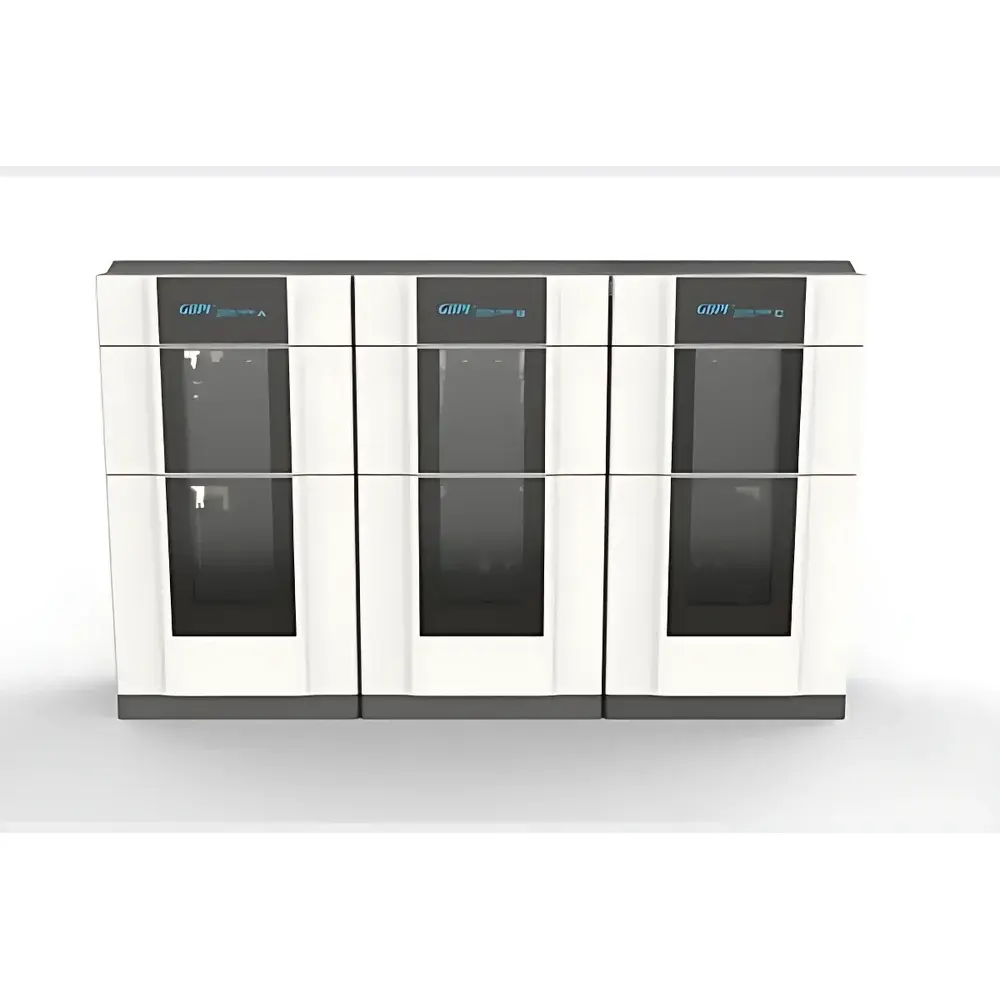
GBPI GBDA-180W Automated Composting Biodegradation Testing System
| Brand | GBPI |
|---|---|
| Origin | Guangdong, China |
| Manufacturer Type | Direct Manufacturer |
| Country of Origin | China |
| Model | GBDA-180W |
| Price Range | USD 70,000–112,000 (FOB Guangzhou) |
| Mass Resolution | ±0.01 g |
| Gas Flow Rate | 0.01–10 L/min |
| Reactor Volume | 500 mL |
| Maximum Number of Simultaneous Reactors | 18 |
| Temperature Range | Ambient to 80 °C (0.1 °C increment) |
| Temperature Control Accuracy | ≤ ±0.2 °C |
| Mass Detection Range | 0–4200 g |
| Power Supply | 200 V AC, 50/60 Hz |
| Max. Power Consumption | 3 kW |
| Dimensions (W×D×H) | 2700 × 560 × 1800 mm |
| Operating Environment | 5–40 °C, <60% RH |
Overview
The GBPI GBDA-180W Automated Composting Biodegradation Testing System is a fully integrated, multi-channel laboratory instrument engineered for standardized assessment of ultimate aerobic biodegradability under controlled composting conditions. It operates on the gravimetric principle—measuring cumulative CO2 evolution by continuous mass loss tracking of CO2-absorbing reagents (sodium hydroxide and soda lime) placed downstream of each reactor. This methodology aligns with internationally recognized respirometric protocols that quantify mineralization as the primary endpoint of biodegradation. The system is designed to replicate thermophilic-phase composting environments (typically 58 ± 2 °C), maintaining strict control over temperature, aeration rate, moisture content, and inoculum activity—key variables defined in ISO 14855-2:2007 and GB/T 19277.2–2013. Unlike single-vessel respirometers, the GBDA-180W supports parallel evaluation of up to 18 independent samples under identical environmental conditions, enabling statistically robust inter-material comparisons and accelerated method validation.
Key Features
- Eighteen independently monitored reaction channels, each equipped with precision load cells (±0.01 g resolution) and dedicated gas flow control (0.01–10 L/min range), ensuring high reproducibility across replicates.
- Water-jacketed temperature regulation system delivering stable thermal control from ambient to 80 °C at 0.1 °C increments, with real-time feedback loops achieving ≤ ±0.2 °C uniformity across all reactor zones.
- Modular reactor assembly: 500 mL borosilicate glass vessels compatible with standard compost inocula (e.g., mature compost extract), inert support media (vermiculite or quartz sand), and test materials in pellet, film, or particulate form.
- Dual-stage gas scrubbing per channel—comprising CO2-specific absorption (NaOH/soda lime) followed by NH3 removal (acidified boric acid or citric acid traps)—to eliminate interference from volatile nitrogenous metabolites.
- Industrial-grade PLC-based control architecture with Ethernet interface, supporting remote monitoring, alarm logging, and scheduled data export without host PC dependency.
- CE-compliant electrical design (EN 61000-6-2/6-4) and IP20-rated enclosure suitable for ISO Class 8 (100,000) cleanroom-adjacent laboratory environments.
Sample Compatibility & Compliance
The GBDA-180W accommodates a broad spectrum of solid organic substrates including polyhydroxyalkanoates (PHAs), polylactic acid (PLA), starch-blended films, mulch films containing pro-degradant additives, food-contact bioplastics (e.g., molded fiber trays), and lignocellulosic composites. All test configurations adhere strictly to the experimental design requirements of ISO 14855-2:2007 (determination of ultimate aerobic biodegradability under controlled composting conditions) and its national adoption GB/T 19277.2–2013. The system satisfies critical parameters for regulatory submission, including mandatory use of reference materials (microcrystalline cellulose), blank correction protocols, and minimum 90-day test duration capability. Data outputs are structured to support GLP-compliant audit trails, with timestamped mass readings, environmental logs, and user-access metadata retained for ≥10 years on internal SSD storage.
Software & Data Management
The included GBPI BioDecay Suite v3.2 provides ISO/IEC 17025-aligned data acquisition, visualization, and reporting functionality. It features role-based user authentication (admin/operator/auditor), electronic signature support compliant with FDA 21 CFR Part 11, and automatic generation of biodegradation curves (% CO2 evolved vs. time), lag-phase identification, and plateau detection algorithms. Raw mass data are stored in encrypted SQLite databases with SHA-256 checksum verification; export options include CSV, PDF (with embedded calibration certificates), and XML formats compatible with LIMS integration (ASTM E1578-18). Audit logs record every parameter change, calibration event, and report generation—including operator ID, timestamp, and reason-for-change fields.
Applications
- Regulatory testing for compliance with EU Directive 2019/904 (Single-Use Plastics), EN 13432:2000, and ASTM D6400/D6868 certification pathways.
- Formulation development and comparative screening of biopolymer blends, compatibilizers, and bio-based fillers under simulated industrial composting conditions.
- Quality assurance of commercial compostable packaging—validating batch-to-batch consistency in mineralization kinetics and final degradation extent.
- Research into microbial community dynamics via coupling with off-gas GC-MS or FTIR analysis (optional gas sampling port integration).
- Method transfer studies between laboratory-scale systems and pilot-scale compost reactors (e.g., OECD 301 series correlation).
FAQ
What standards does the GBDA-180W directly support?
ISO 14855-2:2007, GB/T 19277.2–2013, and EN 13432 Annex E for disintegration and biodegradation validation.
Can the system operate unattended for extended durations?
Yes—designed for continuous 24/7 operation up to 180 days with automated data logging, low-reagent alerts, and thermal fault shutdown protocols.
Is third-party calibration certification available?
GBPI provides NIST-traceable mass calibration (certified to ISO/IEC 17025) and temperature mapping reports upon request, with optional annual recalibration service contracts.
How is moisture content maintained during long-term tests?
Each reactor includes integrated humidity sensors and programmable condensate reflux modules; users define target % moisture (typically 50–60% w/w) and the system adjusts water addition via peristaltic dosing pumps.
Does the system meet cybersecurity requirements for networked labs?
Firmware v4.1+ includes TLS 1.2 encryption, configurable firewall rules, and disabled default credentials—fully aligned with IEC 62443-3-3 SL2 security level requirements.
Related Products