
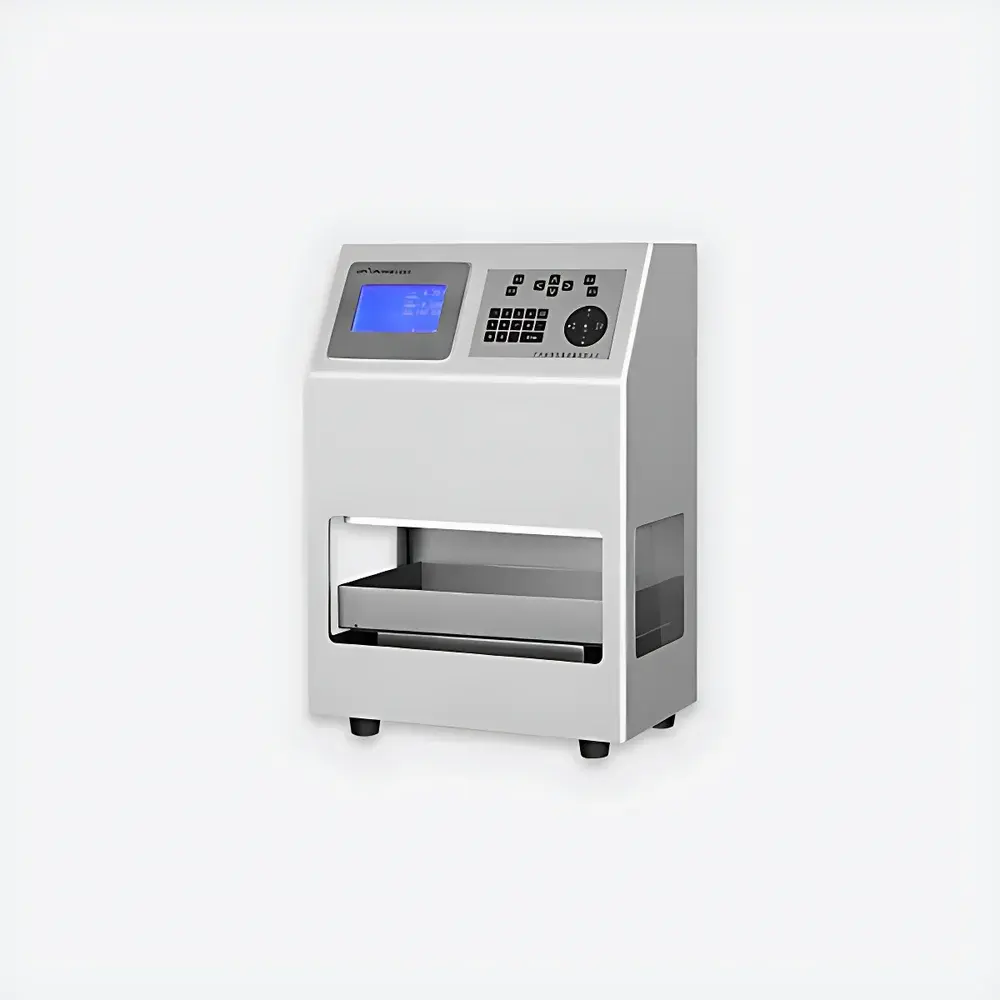
GBPI GBN200A Packaging Bag Compression Tester
| Brand | GBPI (Guangzhou Biaoji) |
|---|---|
| Origin | Guangdong, China |
| Manufacturer Type | Direct Manufacturer |
| Country of Origin | China |
| Model | GBD-B |
| Price Range | USD 1,400 – 7,200 |
| Test Load Capacity | 0–3000 N (selectable) |
| Stroke Range | 0–135 mm |
| Effective Test Area | 500 mm × 400 mm |
| Test Speed | 0–500 mm/min (infinitely variable) |
| Dimensions (W×D×H) | 400 mm × 260 mm × 550 mm |
| Power Rating | 1000 W |
| Supply Voltage | AC 220 V, 50 Hz |
Overview
The GBPI GBN200A Packaging Bag Compression Tester is an electromechanical compression testing system engineered for precise quantification of compressive resistance and burst strength in flexible packaging structures—including stand-up pouches, laminated sachets, vacuum-sealed bags, and rigid-flex hybrid containers. It operates on the principle of controlled uniaxial compression under defined displacement or load conditions, conforming to standardized mechanical deformation protocols used in packaging integrity assessment. The instrument applies a calibrated axial force via a servo-driven crosshead onto a defined test area, measuring real-time load-displacement response to determine critical performance thresholds such as initial yield point, peak compressive load, and structural collapse behavior. Designed for routine quality assurance and regulatory compliance verification, the GBN200A supports deterministic evaluation of package robustness during stacking, transport, and storage—key metrics required by global supply chain stakeholders.
Key Features
- High-precision load cell with selectable full-scale range up to 3000 N, traceable to national metrological standards
- Infinitely variable crosshead speed control (0–500 mm/min), enabling simulation of both static stacking and dynamic impact-like loading profiles
- Dual-mode operation: displacement-controlled (e.g., constant-rate compression to specified stroke) and load-controlled (e.g., hold at target force for dwell-time analysis)
- Integrated embedded computing module with 7-inch TFT-LCD interface—enables fully autonomous testing without external PC connection
- Automated test sequencing: programmable pre-load engagement, auto-fracture detection, post-test return-to-start, and emergency stop logic
- Modular controller architecture—supports both built-in compact configuration and external rack-mountable control unit for enhanced serviceability and future firmware expansion
- Real-time multi-curve overlay display with interactive zoom, pan, and cursor-based data interrogation
- On-device data logging with timestamped metadata; exportable to CSV, PDF, and XML formats compliant with internal QA documentation workflows
Sample Compatibility & Compliance
The GBN200A accommodates flat, semi-rigid, and pre-formed flexible packages with dimensions within its 500 mm × 400 mm active platen area. Samples are secured using non-slip surface fixtures to prevent lateral slippage during compression. The system meets essential mechanical safety and electromagnetic compatibility requirements per CE, FCC, and CCC directives. Its test methodology aligns with internationally recognized packaging performance standards including ISO 2872 (packaging—compression testing of filled transport packages), ISO 12048 (compression and creep testing of corrugated fiberboard boxes), ASTM D642 (standard test method for determining compressive resistance of shipping containers), ASTM D4169 (performance testing of shipping containers and systems), TAPPI T 804 (compressive strength of corrugated and solid fiber boxes), GB/T 16491 (tensile/compression testing machines—general specifications), and GB/T 4857.16 (packaging—compression tests for complete, filled packages). Data acquisition and reporting support audit readiness for GLP and GMP environments, with optional software modules providing 21 CFR Part 11–compliant electronic signatures and audit trails.
Software & Data Management
The GBPI proprietary testing software—compatible with Windows 10/11—provides intuitive workflow navigation, customizable test templates, and automated report generation. Each test record includes operator ID, sample ID, environmental conditions (optional sensor integration), calibration status flags, and raw time-stamped force/displacement arrays. Curve analysis tools enable derivative-based identification of inflection points, elastic modulus estimation (within linear region), and energy absorption calculation (area under curve). Export functions generate ISO/IEC 17025-aligned reports with embedded calibration certificates, uncertainty budgets, and revision-controlled metadata. Software updates are delivered via secure HTTPS channel with SHA-256 signature validation, ensuring integrity across laboratory deployments.
Applications
- Quality control of pharmaceutical blister packs and barrier pouches subjected to palletized warehouse stacking
- Evaluation of food-grade retort pouch integrity after thermal processing and cooling-induced dimensional changes
- Comparative assessment of seal strength degradation in multi-layer laminates exposed to humidity cycling
- Validation of child-resistant packaging compliance under ASTM D3475 and ISO 8317 mechanical stress profiles
- Research into polymer film reinforcement strategies using nanocomposite additives under compressive loading
- Supplier qualification testing for contract packaging vendors operating under IATF 16949 or ISO 13485 frameworks
FAQ
What standards does the GBN200A directly support for compression testing?
It implements test protocols referenced in ISO 2872, ISO 12048, ASTM D642, ASTM D4169, TAPPI T 804, GB/T 16491, and GB/T 4857.16.
Can the instrument perform hold-tests at constant load?
Yes—load-controlled mode allows user-defined dwell times at any target force within the 0–3000 N range.
Is calibration traceable to national metrology institutes?
All load cells are factory-calibrated against NIM (National Institute of Metrology, China)-certified reference standards, with optional UKAS/NIST-traceable recalibration services available.
Does the system require a dedicated PC for operation?
No—the embedded controller enables standalone operation; a PC is only required for advanced data analysis or report customization.
What maintenance intervals are recommended for long-term accuracy?
Annual verification of force transducer linearity and crosshead alignment is advised, with quarterly functional checks per ISO/IEC 17025 Clause 6.4.6.






