
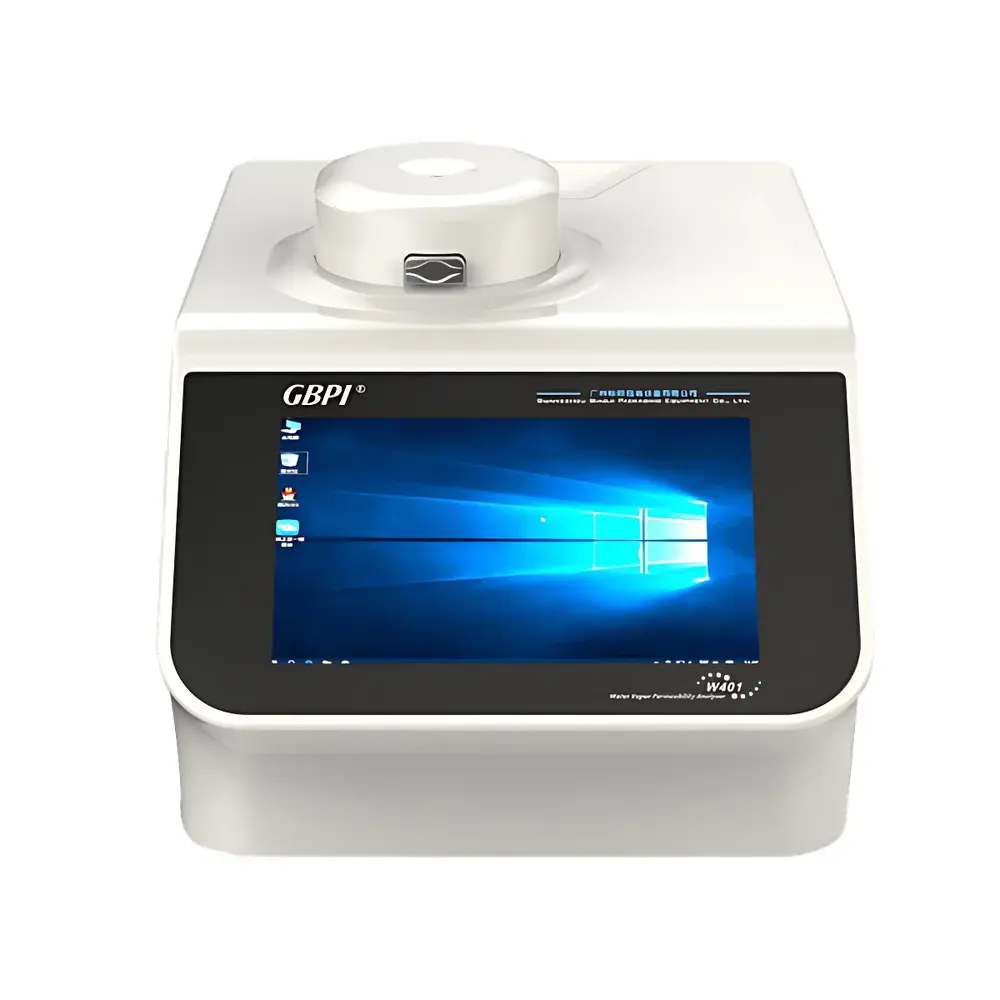
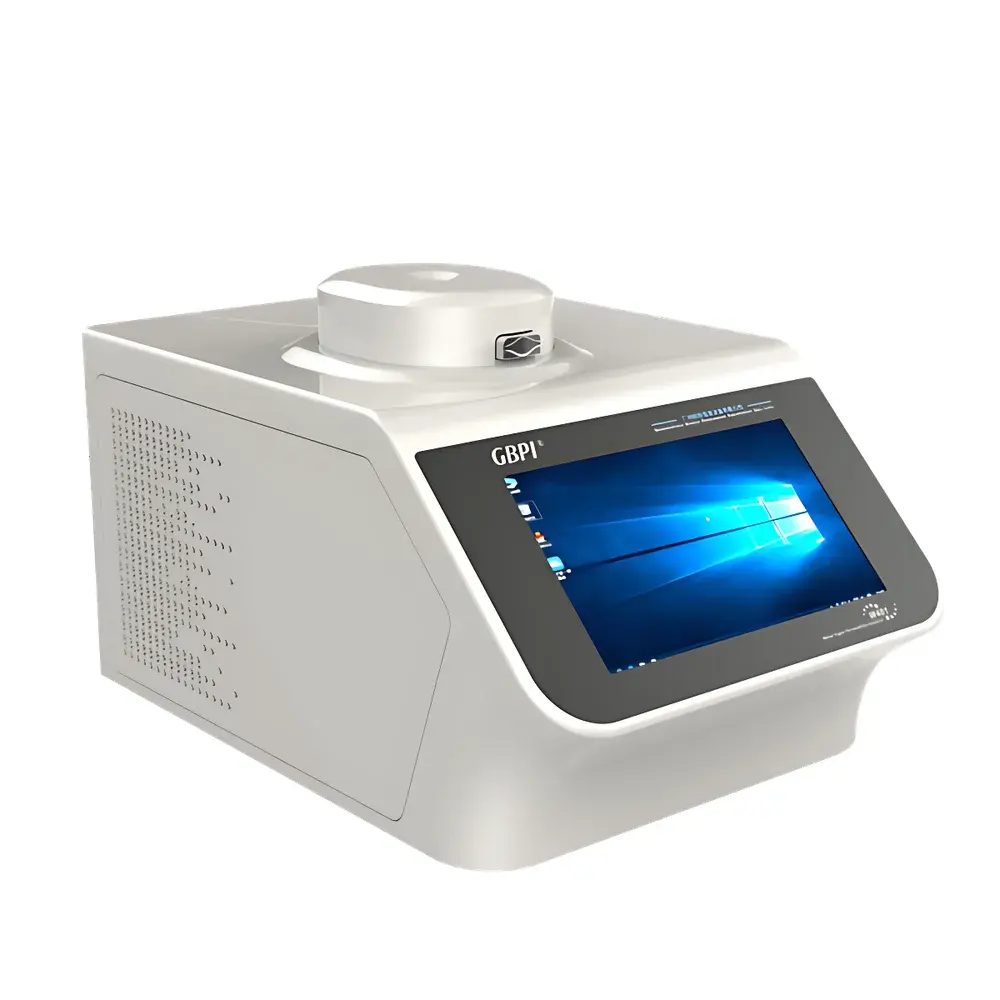
GBPI Y110 2.0 Coulometric Oxygen Transmission Rate (OTR) Analyzer
| Brand | GBPI |
|---|---|
| Origin | Guangdong, China |
| Manufacturer Type | OEM Manufacturer |
| Origin Category | Domestic |
| Model | Y110 2.0 |
| Price | USD 39,500 (FOB Guangzhou) |
| Test Principle | Coulometric Sensor (ASTM D3985 / ISO 15105-2) |
| Standards Compliance | GB/T 19789, ASTM D3985, ASTM F2622, ASTM F1927, ASTM F1037, ISO 15105-2, JIS K-7126-B, DIN 53380-3, YBB00082003 |
| Measurement Range | 0.02–16,500 cm³/(m²·24 h) [up to 260,000 cm³/(m²·24 h) with optional mask fixture] |
| Resolution | 0.001 cm³/(m²·24 h) |
| Temperature Control | 15–45 °C ±0.1 °C |
| Humidity Control | 0% RH (dry), 30–90% RH, 100% RH ±1% RH |
| Test Area | 50.24 cm² (customizable down to 0.785 cm²) |
| Specimen Size | Ø100 mm |
| Max Thickness | ≤3 mm |
| Sample Capacity | 1 specimen per test cycle |
| Carrier Gas Pressure | ≥0.1 MPa |
| Gas Inlet | Φ3 mm tubing / 1/8" NPT |
| Dimensions | 600 × 400 × 330 mm |
| Power | 750 W |
| Supply | AC 220 V, 50 Hz |
Overview
The GBPI Y110 2.0 Coulometric Oxygen Transmission Rate (OTR) Analyzer is a precision laboratory instrument engineered for quantitative determination of oxygen permeability through polymeric films, laminates, foils, coated papers, pharmaceutical packaging, and rigid or flexible containers. It operates on the coulometric detection principle—internationally standardized in ASTM D3985 and ISO 15105-2—where oxygen molecules permeating through a conditioned specimen are carried by high-purity nitrogen (carrier gas) across a diffusion boundary into a sealed electrochemical sensor chamber. The sensor generates a current proportional to the molar flux of O₂, enabling direct calculation of OTR in standardized units (cm³/(m²·24 h)). This method delivers inherently high sensitivity, long-term baseline stability, and minimal drift—critical for regulatory-grade testing in GMP-compliant environments. Unlike optical or paramagnetic methods, coulometric detection provides absolute quantification without calibration drift or interference from CO₂, moisture, or hydrocarbons, making it the reference technique for high-accuracy barrier assessment in food, pharma, medical device, and photovoltaic industries.
Key Features
- High-stability coulometric oxygen sensor (imported, certified lifetime >2 years under continuous operation), delivering resolution of 0.001 cm³/(m²·24 h) and repeatability <1.5% RSD over 10 consecutive measurements.
- Automated pneumatic clamping system with dual-seal design ensures leak-tight specimen mounting (leak rate <1×10⁻⁴ cm³/min) and eliminates operator-induced variability.
- Precision thermoelectric temperature control (±0.1 °C) and dual-path humidity regulation (0–100% RH, ±1% RH) enable strict compliance with accelerated aging protocols and climatic condition mapping per ASTM F1927 and ISO 15105-2 Annex A.
- Integrated 11.6-inch capacitive touchscreen HMI running a deterministic real-time OS; supports six synchronized real-time plots: OTR vs. time, temperature vs. time, RH vs. time, N₂ flow vs. time, O₂ signal amplitude vs. time, and sensor current vs. time—with dynamic zoom, overlay, and curve toggle functionality.
- Modular software architecture compliant with FDA 21 CFR Part 11 requirements: role-based user access (admin/operator/auditor), full audit trail (system events, parameter changes, test execution logs), electronic signature support, and configurable report templates (PDF, CSV, XLSX) with embedded metadata (operator ID, timestamp, environmental conditions, calibration status).
- Native LIMS integration via TCP/IP and OPC UA; optional cloud-enabled IoT platform for remote monitoring, firmware updates, diagnostic telemetry, and secure document repository access (SOPs, calibration certificates, video tutorials).
Sample Compatibility & Compliance
The Y110 2.0 accommodates flat specimens (films, sheets, foils, coated papers) up to Ø100 mm and 3 mm thickness, with interchangeable test cells supporting minimum areas as low as 0.785 cm² for micro-scale evaluation. Optional fixtures extend capability to 3D packaging forms—including pouches, cups, bottles, blister cavities, and tube seals—using volumetric headspace equilibration per ASTM F1307 and ISO 15105-1. All test configurations maintain traceable compliance with pharmacopeial standards (USP , YBB00082003), food contact regulations (FDA 21 CFR §177, EU 10/2011), and medical packaging validation guidelines (ISO 11607-1). Instrument calibration is performed using NIST-traceable certified reference materials (GBW(E)130497 and GBW(E)130498), with documented uncertainty budgets aligned to ISO/IEC 17025 requirements.
Software & Data Management
The embedded analytical suite features programmable test sequences, multi-condition step profiles (e.g., ramped T/RH), automatic endpoint detection based on steady-state criteria (slope threshold <0.05 cm³/(m²·24 h)/h for ≥30 min), and statistical post-processing including mean, SD, CV%, confidence intervals (95%), and outlier rejection per Grubbs’ test. Raw sensor data and processed results are stored in encrypted SQLite databases with immutable timestamps. Export modules support GLP-compliant archiving: PDF reports include digital signatures, revision history, instrument ID, sensor serial number, calibration certificate IDs, and environmental log summaries. System-level interoperability includes HL7 message support for clinical trial supply chain tracking and RESTful API endpoints for enterprise data lake ingestion.
Applications
- Pharmaceutical packaging: OTR validation of cold-form blisters (PVC/PVDC), child-resistant closures, desiccant-containing sachets, and sterile barrier systems per ISO 11607-2.
- Food packaging: Shelf-life modeling for retort pouches (PET/Al/PE), vacuum-sealed trays (PP/EVOH/PP), modified atmosphere packaging (MAP) films, and compostable multilayer structures (PLA/PBAT).
- Medical devices: Barrier integrity verification of IV bag films (PVC/TPU), wound dressing membranes (PU/nonwoven composites), and implant packaging (Tyvek®/PET/PE laminates).
- Electronics & energy: Encapsulation performance assessment of OLED display barriers, perovskite solar cell backsheet films (PET/AlOx/SiNx), and battery pouch foil (Al/PET/PP).
- Regulatory submission: Generation of full analytical datasets for ANDA filings (FDA), CEP dossiers (EDQM), and MDR technical documentation (EU).
FAQ
What gas purity specifications are required for valid ASTM D3985-compliant operation?
High-purity oxygen (≥99.999% O₂, hydrocarbon-free) and nitrogen (≥99.999% N₂, dew point ≤−70 °C) are mandatory. Impurities exceeding 1 ppm CO₂ or H₂O will compromise sensor linearity and accelerate electrolyte depletion.
Can the Y110 2.0 perform tests under elevated pressure differentials?
Yes—the system supports differential pressures up to 0.1 MPa (1 bar) across the specimen, with optional high-pressure test cells rated to 0.3 MPa for specialty applications such as aerospace sealants or fuel tank liners.
Is third-party certification available for IQ/OQ/PQ protocol execution?
GBPI provides vendor-qualified qualification packages aligned with ASTM E2500 and ISPE GAMP 5, including documented risk assessments, URS traceability matrices, and raw data worksheets for customer-executed PQ under internal QA oversight.
How often must the coulometric sensor be recalibrated?
Initial calibration is performed at factory using SRMs; field recalibration is recommended every 6 months or after 500 test cycles, whichever occurs first—validated against GBW(E)130497/130498 reference films with stated expanded uncertainty (k=2) of ±2.3%.
Does the system meet cybersecurity requirements for network-connected lab instruments?
Yes—the embedded OS implements TLS 1.2 encryption for remote sessions, disables unused ports/services by default, enforces password complexity (8+ chars, upper/lower/numeric/symbol), and supports LDAP/Active Directory integration for centralized identity management.





