Geonica DataRain-4000 Precision Weighing Rain Gauge
| Brand | Geonica |
|---|---|
| Origin | Spain |
| Model | DataRain-4000 |
| Measurement Principle | Electronic weighing (load cell-based) |
| Rainfall Rate Range | 0.01–500 mm/h |
| Accuracy | ±1% of full scale across entire range |
| Resolution | 0.01 mm/h |
| Sampling Interval | 1 s to 60 min (user-configurable) |
| Operating Temperature | −40 °C to +85 °C |
| Storage Temperature | −40 °C to +85 °C |
| Relative Humidity | 0–100% RH |
| Ingress Protection | IP66 / NEMA 4X |
| Power Supply (sensor) | 10.5–15 VDC, <5 mW |
| Heater Option | 24 VDC, 1.05 A, 25 W |
| Timekeeping Accuracy | ±4 min/year (±7.6 ppm) |
| Output Interfaces | SDI-12 v1.3, RS-232/RS-422/RS-485 (half-duplex), mechanical pulse (reed switch) |
| Collection Area | Standard 200 cm² (optional 400 cm²) |
| Housing Material | Anodized aluminum / stainless steel |
| Funnel Material | Polypropylene |
| Internal Components | Aluminum / ABS |
| Dimensions | 300 mm H × 185 mm Ø |
| Weight | 1.5 kg |
| Compliance | CE, EMC, ESD, Safety, WMO Guide to Instruments and Methods of Observation (CIMO Guide) |
Overview
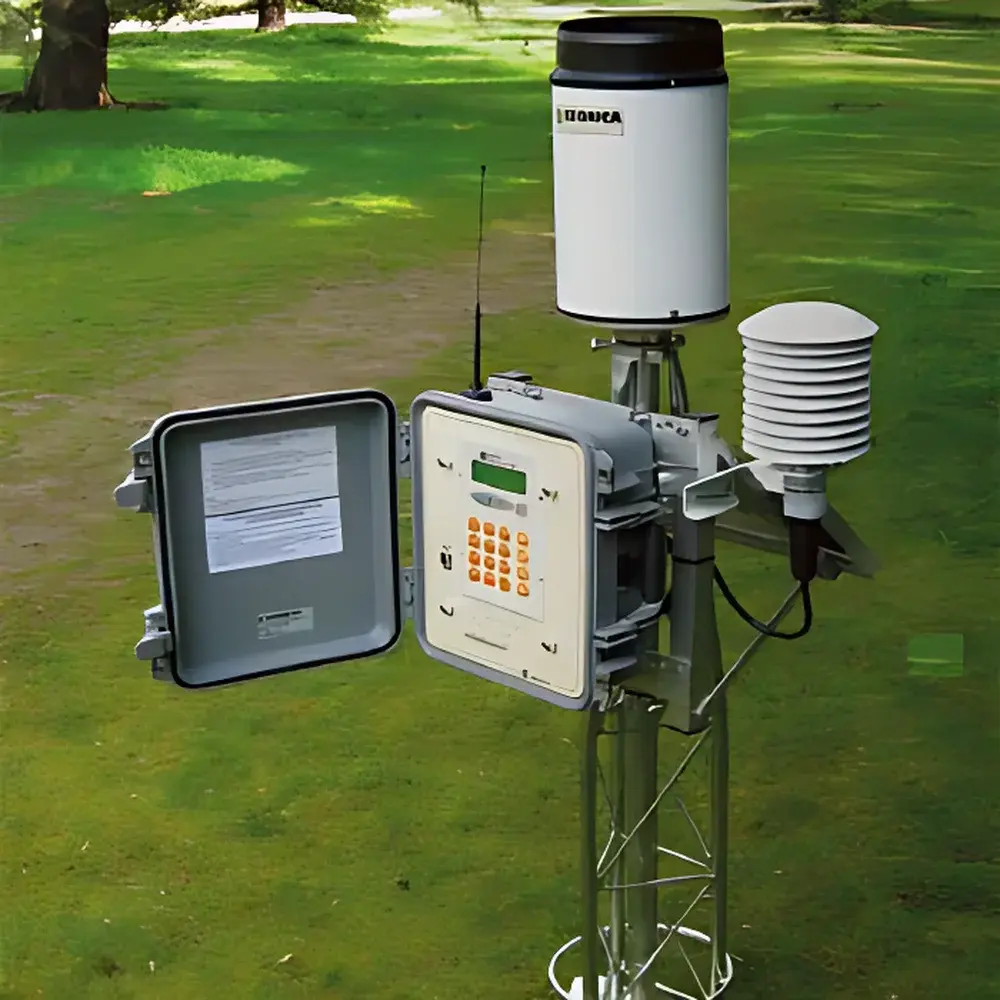
The Geonica DataRain-4000 is a high-precision, all-weather weighing-type rain gauge engineered for continuous, traceable precipitation monitoring in meteorological networks, hydrological observatories, climate research stations, and environmental compliance applications. Unlike tipping-bucket or optical rain sensors, the DataRain-4000 employs a calibrated load cell system to measure accumulated mass of precipitation in real time—enabling accurate quantification of both rainfall and snowfall (when equipped with the optional 25 W heater). Its design adheres strictly to the World Meteorological Organization (WMO) Guide to Meteorological Instruments and Methods of Observation (CIMO Guide), particularly Chapter 5 on precipitation measurement, ensuring compatibility with national weather services and international data exchange protocols such as GTS and BUFR.
Key Features
- True weighing principle: Load cell-based measurement eliminates mechanical wear, hysteresis, and undercatch errors associated with moving parts—delivering consistent resolution of 0.01 mm/h across the full dynamic range (0.01–500 mm/h).
- Full-range accuracy: Maintains ±1% of full-scale accuracy at all intensities—critical for low-intensity drizzle (100 mm/h).
- Integrated intelligent heating: Optional 24 VDC, 25 W PTC heater enables reliable solid-precipitation capture and melt-phase transition without thermal overshoot; controlled via internal ambient temperature and humidity feedback.
- Ultra-low power operation: Sensor electronics consume <5 mW during active measurement—ideal for solar-powered remote stations and long-term unattended deployments.
- Field-calibratable design: Supports on-site verification using certified reference weights (NIST-traceable), eliminating need for return-to-factory recalibration per ISO/IEC 17025 requirements.
- Ruggedized enclosure: IP66/NEMA 4X-rated housing fabricated from anodized aluminum and stainless steel resists corrosion, UV degradation, and mechanical impact in coastal, alpine, and industrial environments.
- Flexible data output: Native support for SDI-12 v1.3 (standard for environmental sensor networks), RS-232/RS-422/RS-485 (half-duplex, multi-drop capable), and dry-contact pulse output for legacy SCADA integration.
Sample Compatibility & Compliance
The DataRain-4000 is validated for liquid precipitation (rain), mixed-phase events (sleet, freezing rain), and solid precipitation (snow, graupel) when operated with the integrated heater. Its 200 cm² (or optional 400 cm²) collection area conforms to WMO-recommended minimum aperture dimensions for minimizing wind-induced undercatch. The instrument meets electromagnetic compatibility (EMC), electrostatic discharge (ESD), and functional safety standards per EN 61326-1 and EN 61000 series. CE marking confirms conformity with EU directives covering radio equipment, electromagnetic compatibility, and low-voltage safety. All firmware and hardware revisions are documented under a formal configuration management system aligned with GLP and ISO 9001 quality frameworks.
Software & Data Management
DataRain-4000 outputs time-stamped mass accumulation values (g) and derived rainfall depth (mm) via configurable sampling intervals (1 second to 60 minutes). Timekeeping stability (±7.6 ppm, equivalent to ±4 minutes/year) supports long-term trend analysis without external GPS synchronization. When integrated into telemetry systems supporting SDI-12 or Modbus RTU over RS-485, it generates audit-ready logs compliant with FDA 21 CFR Part 11 requirements—including electronic signatures, change history, and user-access controls. Raw mass data permits post-processing corrections for evaporation loss, wind turbulence, and density variations—essential for climate-grade datasets archived in GCOS or ICP-MS repositories.
Applications
- National meteorological service observation networks requiring WMO-compliant primary rain gauges
- Hydrological modeling inputs for flood forecasting, reservoir management, and watershed runoff calibration
- Long-term climate monitoring sites (e.g., GCOS reference stations, NOAA CRN)
- Environmental impact assessments (EIA) and regulatory reporting under EPA 40 CFR Part 58 or EU Directive 2008/50/EC
- Agricultural irrigation scheduling and evapotranspiration (ET₀) modeling
- Aviation weather observation (AWOS/ASOS) where precipitation phase discrimination is critical
- Research on microphysical precipitation processes, including snow water equivalent (SWE) estimation
FAQ
Does the DataRain-4000 require periodic factory recalibration?
No—its load cell architecture and field-verifiable calibration protocol allow on-site validation using traceable test masses, satisfying ISO/IEC 17025 clause 6.5.2 for in-situ verification.
Can it operate reliably in sub-zero conditions without heater activation?
Yes—the sensor core functions down to −40 °C; however, snow accumulation will not be measured unless the heater is engaged and configured for melt-cycle control.
What is the maximum cable length supported for RS-485 communication?
Up to 1,200 meters at 9.6 kbps (per TIA/EIA-485-A), with proper twisted-pair shielding and termination resistors.
Is the collection funnel interchangeable between 200 cm² and 400 cm² configurations?
Yes—both apertures use standardized mounting interfaces and maintain identical load cell calibration coefficients; switching requires only mechanical replacement and firmware parameter update.
How does the device handle evaporation error during prolonged dry intervals?
The sealed weighing chamber and passive condensation management minimize evaporative loss; residual moisture is accounted for via zero-drift compensation algorithms executed during scheduled self-diagnostics.