
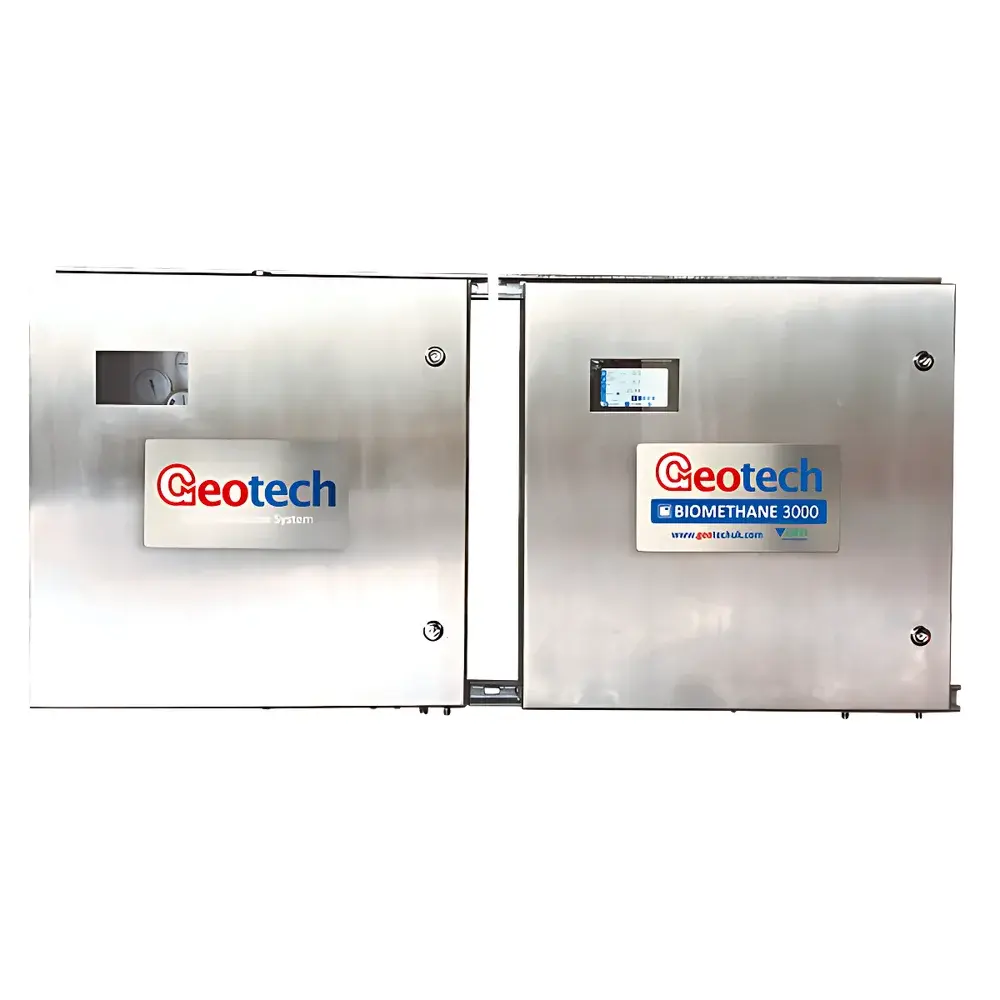
Geotech Biomethane3000 Online Biogas Analyzer
| Brand | Geotech (UK) |
|---|---|
| Origin | USA |
| Manufacturer Status | Authorized Distributor |
| Origin Category | Imported |
| Model | Biomethane3000 |
| Price Range | USD 6,800 – 13,600 (est.) |
| Product Type | Online Biogas Analyzer |
| Resolution | 0.5% vol |
| Response Time (T90) | 40 s |
| Measurement Principle | Non-Dispersive Infrared (NDIR) Spectroscopy for CH₄ and CO₂ |
Overview
The Geotech Biomethane3000 is a certified online biogas analyzer engineered for continuous, real-time monitoring of raw and upgraded biogas streams in industrial anaerobic digestion, biomethane upgrading, and renewable natural gas (RNG) production facilities. It employs dual-channel non-dispersive infrared (NDIR) spectroscopy for high-stability, interference-resistant quantification of methane (CH₄) and carbon dioxide (CO₂), complemented by electrochemical sensors for oxygen (O₂), hydrogen sulfide (H₂S), hydrogen (H₂), and carbon monoxide (CO). Designed to operate unattended under variable ambient conditions—from agricultural digesters to municipal wastewater treatment plants—the Biomethane3000 delivers trace-level detection, calibrated accuracy traceable to ISO/IEC 17025-accredited standards, and robust performance in hazardous environments classified under ATEX and IECEx Zone 2.
Key Features
- High-precision CH₄ measurement across 0–100% vol with ±0.5% vol accuracy in the 90–100% range—critical for biomethane injection compliance (e.g., EN 16723-1, ASTM D7165)
- O₂ sensing optimized for sub-1% vol concentrations (±0.05% vol accuracy), enabling precise air ingress detection and combustion safety control
- Modular sensor architecture supports field-replaceable modules for CH₄/CO₂ (NDIR), O₂ (electrochemical), and optional H₂S/H₂/CO (electrochemical)—minimizing downtime during maintenance
- Automated zero/span calibration with built-in reference gas management; calibration status and drift alerts are logged and reported via relay and display
- ATEX II 3G Ex nA nC IIA T1 Gc and IECEx certification for safe deployment in gas-handling zones where explosive atmospheres may occur (e.g., digester headspaces, upgrading skids)
- IP65-rated stainless-steel enclosure (600 × 600 × 210 mm), integrated condensate level monitoring, and user-selectable heated sample line (100 W, ATEX-certified) for dew-point mitigation
- Configurable 4–20 mA analog outputs (up to six channels) and Modbus RTU over RS-485 as standard; optional Profibus DP, Profinet, or Ethernet/IP interfaces for SCADA and DCS integration
Sample Compatibility & Compliance
The Biomethane3000 is validated for direct, pressure-balanced sampling from wet, particulate-laden biogas streams at operating pressures between −350 mbar and +350 mbar. Its integrated 2.0 µm PTFE coalescing filter and replaceable microfiber pre-filter ensure long-term sensor protection without external conditioning systems. All measurements comply with ISO 10156 (gas hazard classification), BS EN 50270:2006 (electromagnetic compatibility for gas detection equipment), and BS EN 61010-1:2010 (safety requirements for electrical equipment in measurement/control laboratories). Calibration certificates issued by UKAS-accredited laboratories meet ISO/IEC 17025:2017 requirements, supporting GLP/GMP audit readiness and regulatory reporting for EU RED II and US EPA Renewable Fuel Standard (RFS) compliance.
Software & Data Management
The embedded firmware provides full local control via a 480 × 272-pixel RGB TFT touchscreen interface with intuitive navigation and multilingual support (English, German, Spanish, French). All measurement data—including raw sensor outputs, calibration logs, alarm timestamps, and condensate fill status—are stored internally with battery-backed memory (Li-ion backup >72 h). Historical records are exportable via USB or Modbus register polling. The system supports configurable alarm thresholds (seven user-defined setpoints), fault relay activation (6 A / 24 Vdc), and event-driven notifications—including automatic calibration success/failure, low-flow detection (350 mbar vacuum). No proprietary software license is required for basic operation or data retrieval.
Applications
- Continuous monitoring of CH₄ and CO₂ in agricultural AD plants processing manure, crop residues, or food waste
- Inlet/outlet gas analysis for pressure swing adsorption (PSA), water scrubbing, and membrane separation units
- Real-time O₂ and H₂S tracking in biogas desulfurization and deoxygenation systems to prevent catalyst poisoning and corrosion
- Compliance verification for vehicle-grade biomethane (EN 16723-1 Class B) and grid injection (e.g., Germany’s DVGW G262)
- Process optimization in wastewater sludge digestion, landfill gas recovery, and co-digestion facilities
- Leak detection and safety interlocking in CHP engine feed lines and storage buffer tanks
FAQ
What gases does the Biomethane3000 measure as standard, and which require optional modules?
Standard configuration measures CH₄, CO₂, and O₂ using NDIR and electrochemical technology. H₂S, H₂, and CO are available as plug-in electrochemical modules—up to four total components may be active simultaneously.
Is the instrument suitable for installation in outdoor, unheated enclosures?
Yes—its −20°C to +50°C operating range, IP65 ingress protection, and ATEX/IECEx certification allow direct wall-mounting in outdoor process areas, provided ambient humidity remains non-condensing (0–95% RH).
How often must calibration be performed, and what gases are required?
Factory calibration is traceable to ISO/IEC 17025; field recalibration frequency depends on application severity. Automatic zero/span is supported using certified CH₄/N₂ and CO₂/N₂ span gases; O₂ calibration uses ambient air or certified O₂/N₂ mixtures.
Can the Biomethane3000 integrate with existing PLC or DCS systems?
Yes—Modbus RTU over RS-485 is standard; Profibus DP, Profinet, and Ethernet/IP are factory-configurable options. All digital protocols support read/write access to real-time values, alarms, and diagnostic registers.
What maintenance intervals are recommended for consumables?
Microfiber filters and PTFE coalescers should be replaced every 3–6 months depending on gas particulate load; electrochemical O₂ sensors last ~3 years in air, while H₂S/H₂/CO sensors have a typical service life of 2 years under normal biogas exposure.




