
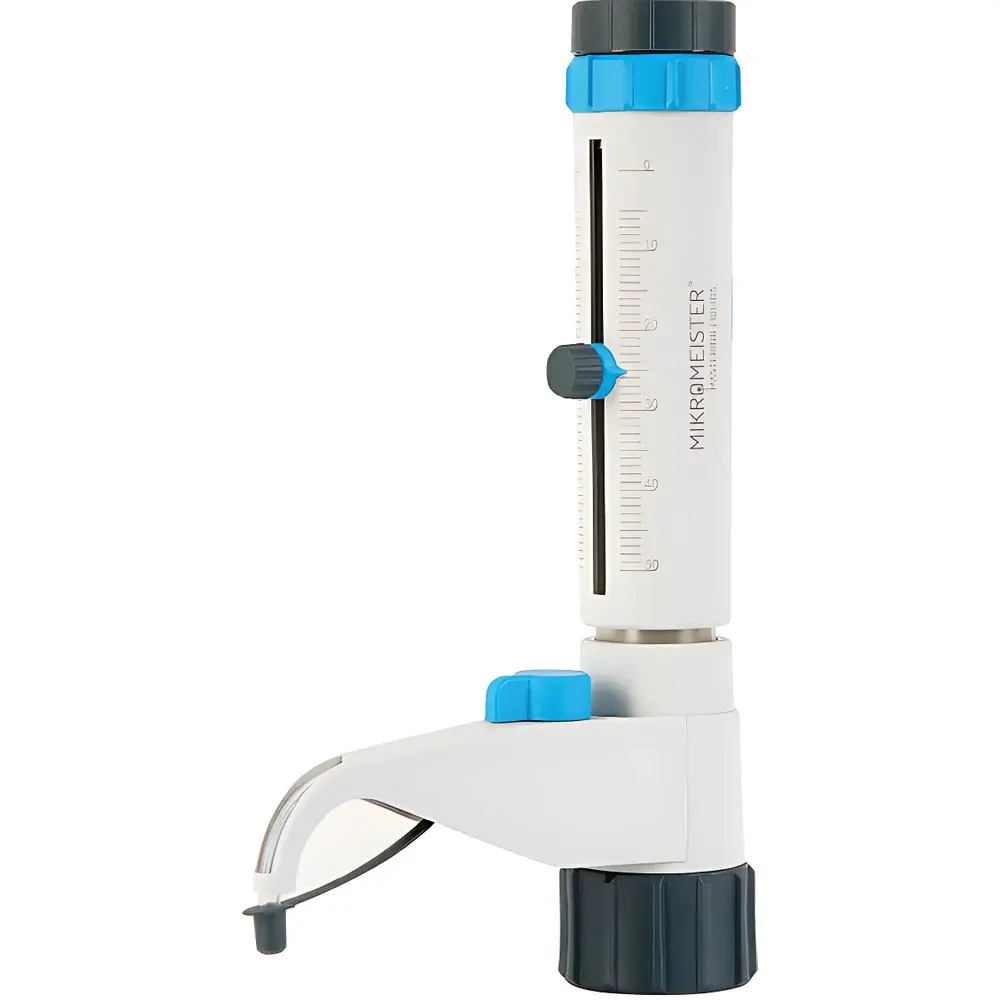
Gerhardt Bottle Top Dispenser Series 4201–4205
| Brand | Gerhardt |
|---|---|
| Origin | Germany |
| Type | Manual Bottle Top Dispenser |
| Volume Range | 0.25–50 mL |
| Graduation Interval | 0.25 mL |
| Accuracy | ±0.5% |
| Precision | 99.5% |
| Available Models | 2.50 mL, 5.00 mL, 10.00 mL, 25.00 mL, 50.00 mL |
| Compliance | ISO 8655-3, DIN EN ISO 8655-3, GLP-ready design |
Overview
The Gerhardt Bottle Top Dispenser Series 4201–4205 is a precision-engineered manual liquid handling system designed for reliable, repeatable volumetric dispensing in analytical, quality control, and routine laboratory environments. Based on the piston-driven positive displacement principle, each model operates via a calibrated glass or PTFE-coated piston within a chemically resistant cylinder, ensuring consistent delivery independent of liquid viscosity, vapor pressure, or surface tension. These dispensers are optimized for use with standard GL45 and GL32 threaded reagent bottles, enabling direct mounting without adapters. Their German engineering emphasizes mechanical robustness, ergonomic operation, and long-term metrological stability—critical attributes for laboratories adhering to ISO/IEC 17025, USP , and EU GMP Annex 15 requirements.
Key Features
- Five standardized volume models (2.50 mL, 5.00 mL, 10.00 mL, 25.00 mL, and 50.00 mL) covering the full operational range of 0.25–50 mL per dispense
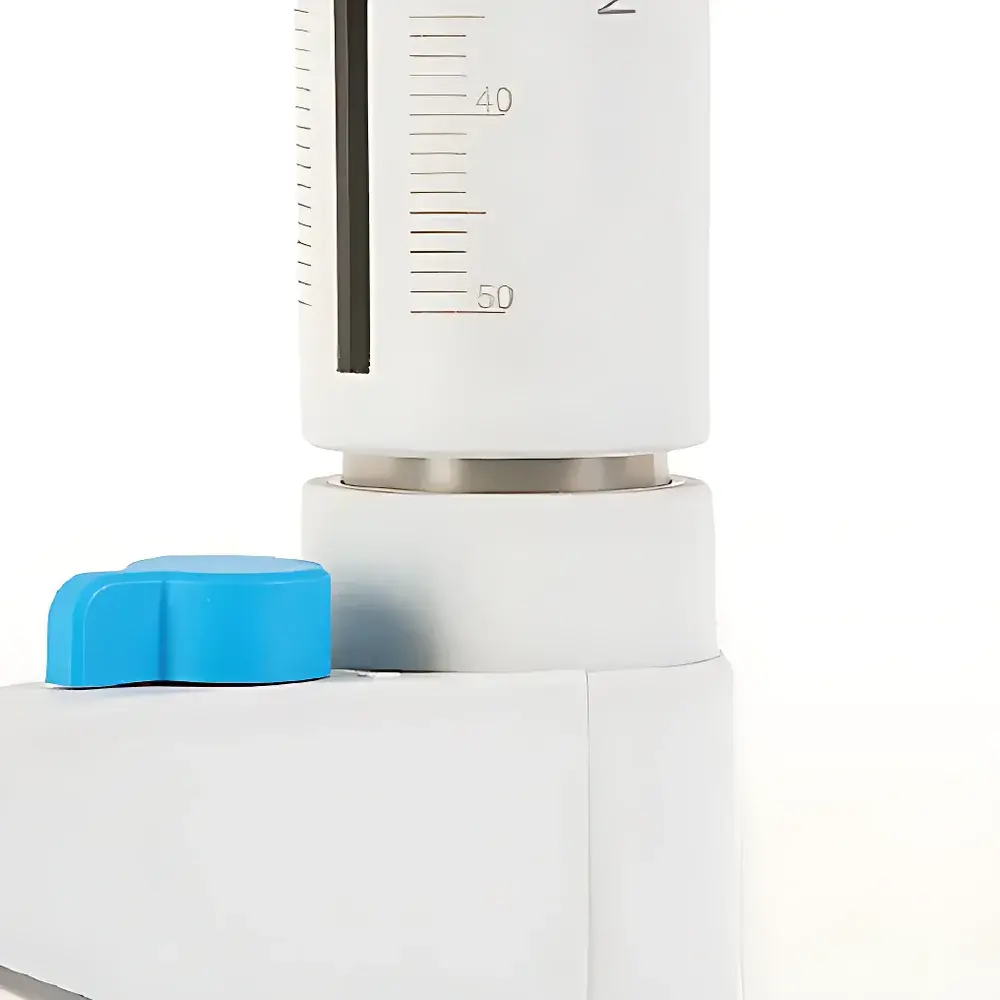
- Graduated scale with 0.25 mL increments, engraved directly onto high-contrast anodized aluminum housing for long-term readability and resistance to chemical fogging
- Double-seal piston system with fluoropolymer (PTFE/FEP) components, validated for compatibility with aggressive solvents including acetone, chloroform, concentrated acids, and bases
- Integrated air purge valve and self-cleaning rinse function to prevent cross-contamination between sequential dispensing cycles
- Ergonomic lever mechanism requiring ≤12 N actuation force, minimizing operator fatigue during high-throughput workflows
- Calibration certificate traceable to PTB (Physikalisch-Technische Bundesanstalt) included with each unit; optional UKAS-accredited calibration available upon request
Sample Compatibility & Compliance
The 4201–4205 series accommodates aqueous solutions, organic solvents, viscous media up to 500 mPa·s (e.g., glycerol/water mixtures), and low-volatility reagents without priming loss or droplet formation. All wetted parts comply with USP Class VI biocompatibility standards and meet REACH SVHC criteria. The dispensers conform to ISO 8655-3:2022 for piston-operated dispensers, including requirements for linearity, repeatability (RSD ≤ 0.3%), and temperature-induced drift (<0.02%/°C). Design supports full auditability under GLP and GMP frameworks: serial-numbered components, non-erasable calibration records, and mechanical lockout for volume setting prevent unauthorized parameter modification.
Software & Data Management
As a fully manual instrument, the 4201–4205 series requires no firmware, drivers, or software integration. However, its metrological documentation aligns with electronic record requirements under FDA 21 CFR Part 11 when used in conjunction with LIMS or ELN systems. Each dispenser ships with a printed calibration report containing uncertainty budget (k=2), environmental conditions at time of verification, and reference standard traceability. Optional digital logbook templates (CSV/PDF) are provided for routine user verification checks, supporting periodic performance monitoring per ISO/IEC 17025 Clause 7.7.
Applications
- Preparation of standard solutions and calibration blanks in environmental testing (EPA Method 502.2, ISO 11843)
- Accurate reagent addition in titration workflows (ISO 9001-certified QC labs)
- Dilution series generation for HPLC mobile phase preparation and spectrophotometric assay validation
- Controlled dosing of catalysts or initiators in polymer synthesis R&D
- Safe handling of hazardous substances (e.g., hydrazine, bromine water) via closed-system dispensing, reducing exposure risk per OSHA Lab Standard 29 CFR 1910.1450
FAQ
What regulatory standards does the Gerhardt 4201–4205 series comply with?
ISO 8655-3:2022, DIN EN ISO 8655-3, USP , and GLP/GMP Annex 15 metrological requirements.
Can these dispensers be recalibrated in-house?
Yes—users may perform routine verification using certified volumetric flasks (Class A, ISO 1042) and distilled water at 20 °C; full recalibration requires Gerhardt-certified service centers or accredited third-party labs.
Is chemical resistance data available for specific solvents?
A comprehensive compatibility matrix covering >120 solvents—including acetonitrile, nitric acid (65%), sodium hydroxide (5 mol/L), and THF—is provided in the technical appendix of the operating manual.
Do the dispensers support sterile applications?
While not autoclavable, all models can be sterilized via ethylene oxide (EtO) or hydrogen peroxide plasma (VHP) processes; validation protocols are available upon request.
What maintenance intervals are recommended?
Visual inspection before each use; piston lubrication every 6 months or after 5,000 cycles; full seal replacement every 24 months under continuous operation.
Related Products



