
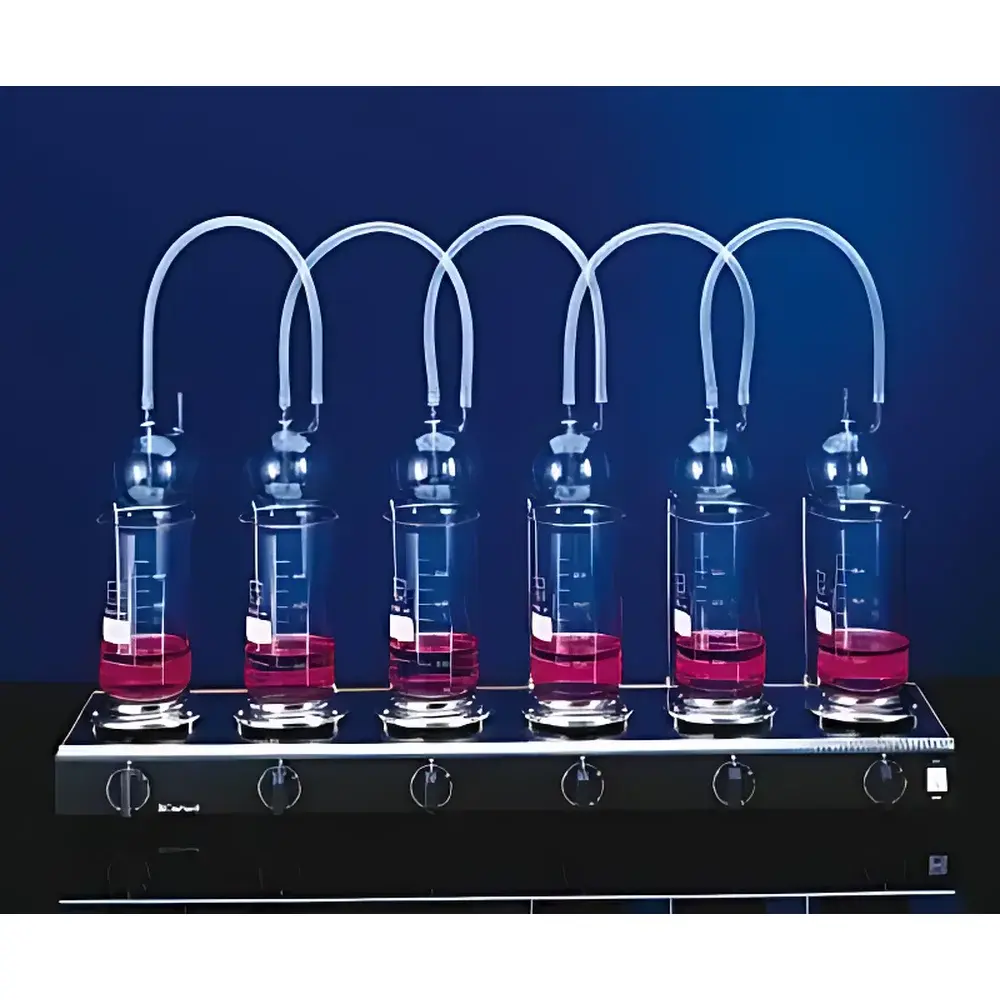
C. Gerhardt RF16/4 & RF16/6 Crude Fibre Digestion System
| Brand | C. Gerhardt |
|---|---|
| Origin | Germany |
| Model | RF16/4 / RF16/6 |
| Max Temperature | 425 °C |
| Heating Positions | 4 / 6 |
| Voltage | 230 V AC |
| Frequency | 50–60 Hz |
| Power | 1800 W / 2700 W |
| Dimensions (W×D×H) | 600×225×340 mm / 900×225×340 mm |
| Weight | 12 kg / ~18 kg |
| Order Codes | 10-0017 / 10-0018 |
Overview
The C. Gerhardt RF16/4 and RF16/6 Crude Fibre Digestion Systems are benchtop electric heating digesters engineered for standardized acid-base hydrolysis of organic samples in crude fibre analysis according to AOAC 962.09, ISO 6865, and EN ISO 5986. These systems implement classical Weende method principles—sequential digestion with boiling sulphuric acid (0.125 M) followed by boiling sodium hydroxide (0.125 M)—to isolate the indigestible lignin-cellulose-hemicellulose residue. Unlike fully automated fibre analyzers (e.g., Fibretherm), the RF16 series provides a manually supervised, thermally stable platform optimized for reproducible reflux conditions, precise temperature control at 425 °C maximum furnace setpoint, and consistent sample exposure time across all digestion vessels. Its robust cast-aluminium heating block architecture ensures uniform thermal distribution and long-term stability under continuous laboratory use.
Key Features
- High-precision electric heating furnace with independent temperature regulation up to 425 °C, calibrated to ±2 °C accuracy over full operating range
- Dual configuration options: RF16/4 supports four 600-mL digestion flasks; RF16/6 accommodates six, enabling parallel batch processing without cross-contamination
- Integrated reflux condenser mounting points and standardized neck geometry (ISO 24/40) for compatibility with standard Liebig or Allihn condensers
- Thermally insulated housing with front-access safety grille and overtemperature cut-off circuitry compliant with IEC 61000-6-2 EMC standards
- Front-panel digital display with dual LED indicators for power status and active heating mode, supporting manual timing via external stopwatch or lab timer integration
- Stainless-steel support frame and corrosion-resistant enamel-coated base plate for resistance to acidic vapour exposure during prolonged digestion cycles
Sample Compatibility & Compliance
The RF16 series is validated for solid biological matrices including animal feed, forage, cereal grains, and botanical extracts. Sample preparation follows AOAC official methods requiring homogenization to ≤1 mm particle size prior to weighing into borosilicate glass digestion flasks. The system meets mechanical and electrical safety requirements per EN 61010-1:2019 for laboratory equipment. While the instrument itself does not perform analytical quantification, its thermal performance supports full compliance with GLP documentation workflows when paired with certified balances, volumetric glassware, and ashing furnaces meeting ISO/IEC 17025 traceability requirements. No software-based audit trail is provided—data recording remains manual per SOP-driven paper-based or LIMS-integrated logbooks.
Software & Data Management
The RF16/4 and RF16/6 operate as standalone hardware units with no embedded microprocessor, firmware, or digital interface. All operational parameters—including heating duration, acid/base addition volumes, filtration timing, and drying/ashing steps—are executed manually per established Weende protocol. Consequently, no proprietary software, driver installation, or data export functionality is included. Laboratories integrating these systems into regulated environments (e.g., ISO 17025-accredited feed testing labs) must implement external procedural controls: timed logs, signed analyst records, and instrument calibration certificates maintained per internal QA schedule. No FDA 21 CFR Part 11 electronic signature capability is applicable.
Applications
- Routine determination of crude fibre content in compound feeds and raw materials for nutritional labelling (EU Regulation No. 767/2009)
- Quality assurance in agricultural cooperatives performing in-house feedstuff verification prior to shipment
- Method validation studies comparing classical Weende digestion against enzymatic-gravimetric fibre fractionation (e.g., NDF/ADF protocols)
- Teaching laboratories demonstrating fundamental principles of proximate analysis and acid-detergent fibre chemistry
- Reference digestion step in interlaboratory proficiency testing schemes coordinated by EURL-FB (European Union Reference Laboratory for Feed Additives)
FAQ
What standards does the RF16 series comply with for crude fibre analysis?
It supports AOAC 962.09, ISO 6865:2000, and EN ISO 5986:2014 methodologies through precise thermal control and reproducible reflux conditions.
Can the RF16 be used for detergent fibre analysis (NDF/ADF)?
No—this system is designed exclusively for classical crude fibre (Weende) hydrolysis. NDF/ADF requires neutral/acid detergent solutions, specific boiling times, and amylase treatment not supported by RF16 hardware.
Is temperature calibration traceable to national standards?
Yes—users may perform periodic verification using NIST-traceable PT100 probe thermometers inserted into dummy flasks during operation.
What maintenance is required for long-term reliability?
Annual inspection of heating element continuity, cleaning of vapour vents with non-abrasive solvents, and verification of electrical grounding integrity per EN 61000-6-3.
Are replacement parts such as heating blocks or flask holders available?
Original spare parts—including order-specific furnace inserts, support racks, and condenser adapters—are supplied directly by C. Gerhardt GmbH under part numbers referenced in the technical manual.



