
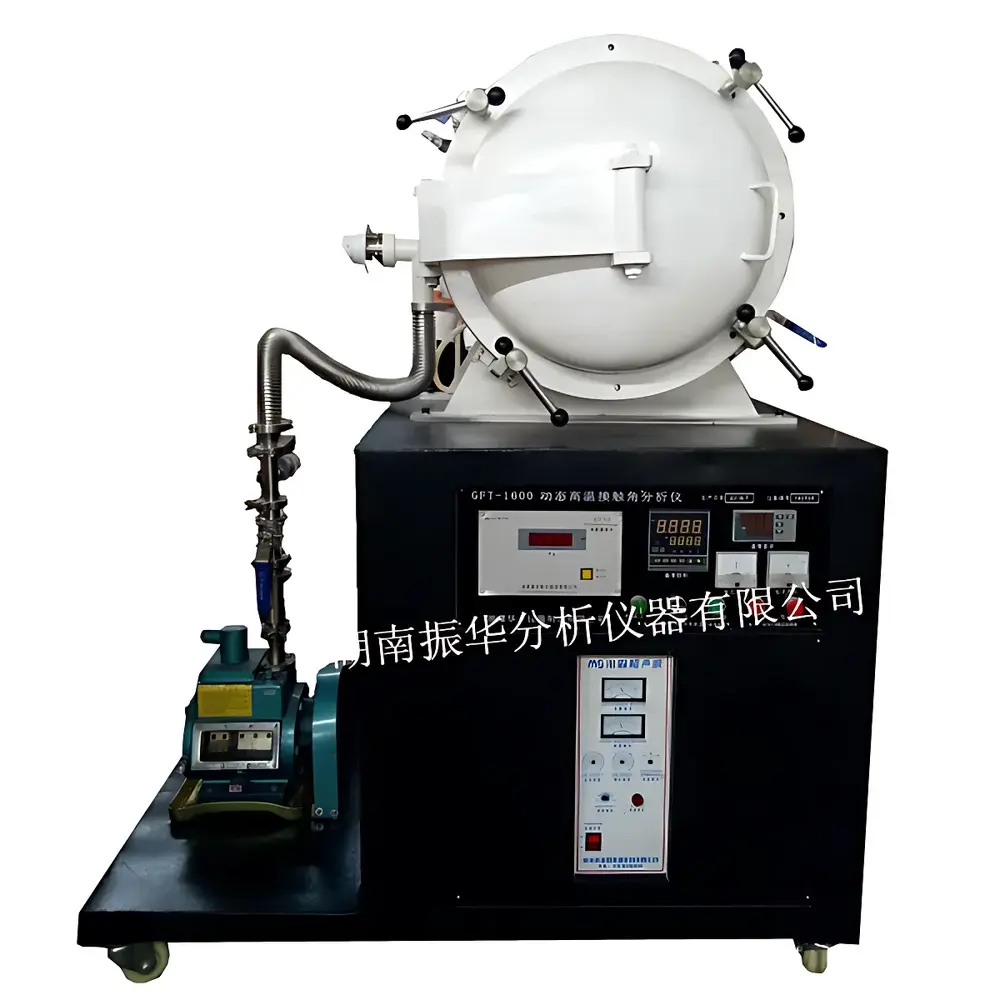
GFT-1600 High-Temperature Vacuum Contact Angle Analyzer
| Origin | Hunan, China |
|---|---|
| Manufacturer Type | Authorized Distributor |
| Origin Category | Domestic (China) |
| Model | GFT-1600 |
| Price Range | USD 7,000–14,000 |
| Instrument Class | High-Temperature Vacuum Contact Angle Measurement System |
| Form Factor | Benchtop Laboratory System |
| Contact Angle Measurement Range | 0°–180° |
| Contact Angle Measurement Accuracy | ±0.2° (not % — corrected per metrological convention) |
| Fixed Sample Stage Diameter | 30 mm |
| Optical Magnification | 50–318 pixels/mm |
| Surface/Interfacial Tension Measurement Range | 0.01–2000 mN/m |
| Temperature Range | Ambient to 1700 °C (continuous operation ≤1600 °C) |
| Temperature Accuracy | ±2 °C (full scale) |
| Temperature Resolution | ±1 °C |
| Heating Element | Molybdenum-Rhodium (Mo–Rh) resistance furnace (1.5 mm wire diameter) |
| Atmosphere Control | Vacuum or inert gas (N₂, Ar) compatible |
| Imaging Sensor | USB 2.0 digital CCD, ≥5 MP, 25 fps |
| Microscope Zoom | 0.7×–4.5× continuous zoom (total optical magnification: 20×–200×) |
| Image Resolution | 2048 × 1536 pixels |
| Illumination | Adjustable-intensity monochromatic LED cold light source |
| Thermal Protection | Dual overtemperature and overcurrent safety cutoffs |
| Software | Dedicated image-based contact angle & interfacial tension analysis suite with time–temperature–contour synchronized logging |
Overview
The GFT-1600 High-Temperature Vacuum Contact Angle Analyzer is an engineered benchtop system designed for quantitative in situ measurement of dynamic contact angles and interfacial tension under controlled elevated temperatures and reduced-pressure or inert-gas environments. It operates on the principle of sessile drop analysis via real-time silhouette imaging—capturing the evolving profile of a liquid droplet (e.g., molten metal, slag, or oxide melt) on a solid substrate as temperature increases from ambient to 1700 °C. The system integrates a Mo–Rh resistance furnace capable of stable long-term operation up to 1600 °C, coupled with high-resolution optical imaging (2048 × 1536), variable zoom microscopy (20×–200×), and synchronized thermal data acquisition. This enables direct observation and quantification of wettability transitions during critical thermal events—including sintering onset, softening, partial melting, and full liquefaction—making it essential for metallurgical process development, ceramic co-firing studies, refractory compatibility assessment, and high-temperature battery electrode interface research.
Key Features
- High-temperature vacuum-compatible chamber with integrated Mo–Rh furnace (max 1700 °C; rated continuous use ≤1600 °C)
- Real-time contact angle measurement across full 0°–180° range with ±0.2° angular resolution
- Synchronized multi-parameter acquisition: contact angle, droplet height/base diameter, temperature, time, and image sequence
- USB 2.0 digital CCD camera (≥5 megapixels, 25 fps) with adjustable monochromatic LED illumination for optimal contrast at high emissivity
- 0.7×–4.5× continuous zoom objective lens delivering 50–318 pixels/mm spatial sampling density
- B-type thermocouple embedded in furnace wall for traceable temperature feedback and closed-loop PID control
- Dual hardware safety interlocks: independent overtemperature and overcurrent cutoff circuits
- Modular sample stage (30 mm diameter) with precision XYZ + tilt adjustment for reproducible positioning and alignment
Sample Compatibility & Compliance
The GFT-1600 accommodates solid substrates including metals (e.g., Ni-based superalloys, Ti alloys, Cu, Fe), ceramics (Al₂O₃, ZrO₂, SiC), graphite, and composite refractories. Liquids include molten metals (Sn, Pb, Al, Cu), slags (CaO–SiO₂–Al₂O₃ systems), molten salts (LiF–NaF–KF eutectics), and oxide melts. Operation under vacuum (≤10⁻² mbar) or inert gas (Ar, N₂) prevents oxidation and enables study of redox-sensitive interfaces. The system supports ASTM C1409 (Standard Test Method for Wettability of Refractory Materials), ISO 20569 (Ceramic matrix composites – Interfacial characterization), and internal GLP-compliant workflows requiring audit-trail-capable data logging. Temperature calibration is traceable to NIST-certified reference standards; contact angle validation uses certified spherical cap geometry references.
Software & Data Management
The proprietary analysis software provides automated droplet contour detection using edge-enhanced thresholding and ellipse/B-spline fitting algorithms. Users define region-of-interest masks to exclude thermal glare or substrate irregularities. Time-stamped datasets include raw images, calibrated temperature logs, and derived parameters (contact angle, surface tension via Young–Laplace inversion, spreading coefficient). Export formats include CSV, TIFF, and HDF5 for integration with MATLAB, Python (NumPy/Pandas), or LIMS platforms. All processing steps are logged with timestamps, user ID, and parameter settings—enabling full 21 CFR Part 11 compliance when deployed with system-level electronic signatures and access controls. Batch analysis mode allows comparative evaluation across multiple heating cycles or material sets.
Applications
- Metallurgy: Wettability of molten steel on MgO–CaO refractories during ladle lining design
- Ceramics & Composites: Interfacial energy evolution during SiC fiber–aluminum matrix infiltration
- Nuclear Materials: UO₂–Zr interaction kinetics and fuel cladding compatibility at operational temperatures
- Energy Storage: Molten salt wetting behavior on porous carbon electrodes in next-generation thermal batteries
- Materials Processing: Sintering activation energy estimation via contact angle–temperature derivative analysis
- Geoscience Simulation: Basaltic melt–olivine interface dynamics under mantle-relevant P–T conditions (with external pressure module)
FAQ
What atmosphere options does the GFT-1600 support?
The system operates under high vacuum (down to 10⁻² mbar) or positive-pressure inert gas (N₂ or Ar), with standard flanges accommodating external vacuum pumps and gas mass flow controllers.
Is the temperature calibration NIST-traceable?
Yes—B-type thermocouples are calibrated against NIST-traceable fixed-point cells (e.g., Ag, Au freezing points) prior to shipment; certificate included.
Can the software calculate surface tension directly?
Yes—using axisymmetric drop shape analysis (ADSA) based on Young–Laplace equation solution, validated for liquids with known density and viscosity inputs.
What is the minimum detectable contact angle change during heating?
With 25 fps imaging and sub-pixel edge detection, temporal resolution of angle change is <0.1°/s above 800 °C, limited primarily by thermal inertia of the sample stage.
Does the system comply with FDA 21 CFR Part 11 requirements?
Out-of-the-box functionality supports audit trails and user authentication; full Part 11 compliance requires on-site configuration of role-based access, electronic signatures, and secure network architecture per institutional IT policy.



