
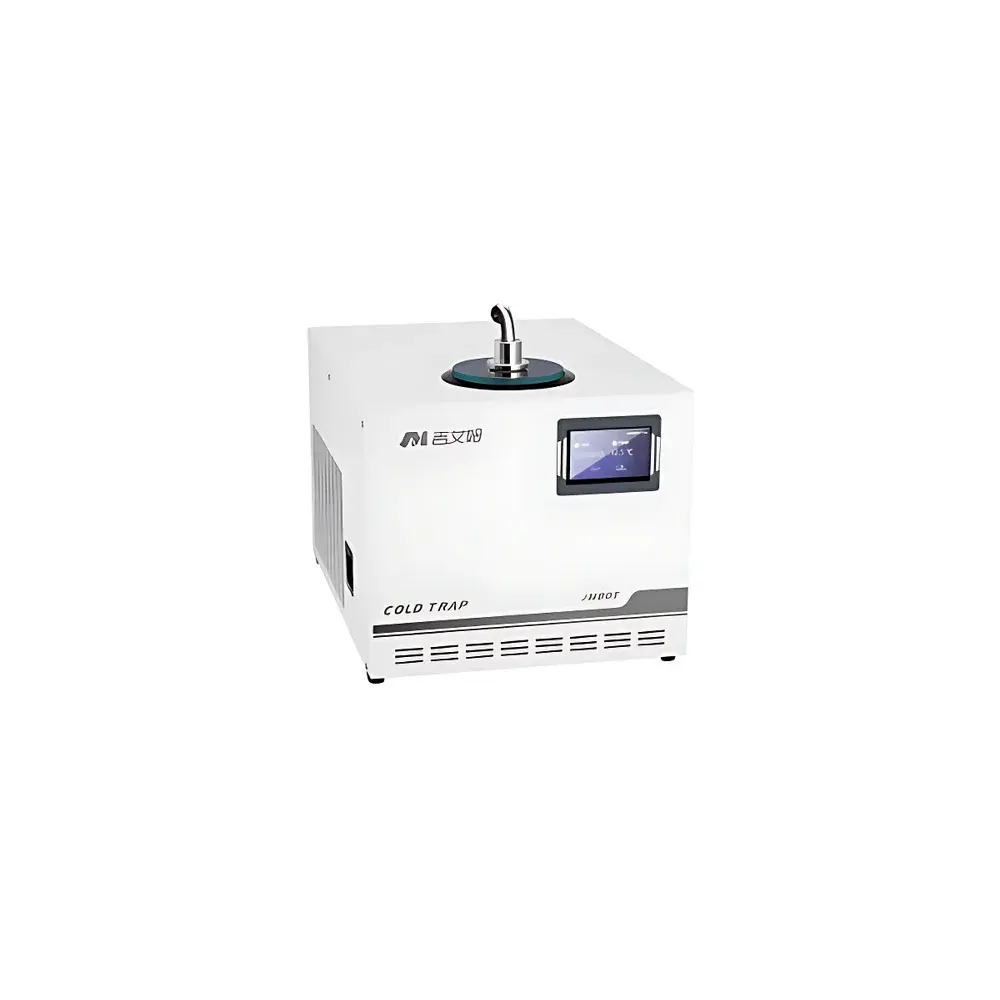
GiAim JM80T Ultra-Low Temperature Cold Trap
| Brand | GiAim |
|---|---|
| Model | JM80T |
| Temperature Range | −80 °C (minimum) |
| Cold Trap Capacity | 2000 mL |
| Ultimate Vacuum Compatibility | KF16 flange interface |
| Power Consumption | 1000 W |
| Dimensions (L×W×H) | 620 × 450 × 400 mm |
| Weight | 70 kg |
| Electrical Supply | AC 220 V, 50/60 Hz, 10 A |
| Construction | 304 stainless steel body with Teflon high-temperature coating |
| Drain System | PTFE tubing + European-sourced dual-stage isolation valve |
| Refrigerant | Eco-friendly, non-CFC/HFC azeotropic blend |
| Compressor | European-branded hermetic scroll compressor |
| Heat Exchanger | Brazed plate-type |
| Temperature Control Accuracy | ±1 °C |
Overview
The GiAim JM80T Ultra-Low Temperature Cold Trap is an engineered component for vacuum-based sample preparation systems—specifically designed to intercept and condense volatile solvent vapors generated during rotary evaporation, centrifugal concentration, freeze-drying, or molecular distillation. Operating on the principle of cryogenic condensation, the JM80T achieves a stable base temperature of −80 °C using a closed-loop refrigeration circuit with a high-efficiency brazed plate heat exchanger and a European-sourced hermetic scroll compressor. Its thermodynamic architecture enables rapid thermal stabilization (<30 minutes from ambient to −80 °C), minimizing downtime between runs and improving throughput in high-volume analytical or preparative workflows. Unlike passive dry-ice or liquid nitrogen traps, the JM80T delivers consistent, operator-independent cold surface performance without consumables—making it suitable for GLP-compliant laboratories where traceability, reproducibility, and long-term operational stability are required.
Key Features
- Full-touch HMI interface with real-time display of setpoint temperature, actual cold finger surface temperature, runtime logging, and historical temperature profiles—enabling post-run thermal auditability.
- Monolithic 304 stainless steel cold trap chamber fabricated via deep-drawing process, followed by uniform high-temperature Teflon coating (up to 260 °C continuous service) to resist aggressive organic solvents including chloroform, acetone, ethyl acetate, DMSO, and acetonitrile.
- Dual-stage sealing system: primary O-ring (FKM/Viton®) + secondary backup seal integrated into the lid assembly—ensuring leak integrity under sustained high vacuum (≤1 × 10⁻³ mbar).
- KF16 vacuum flange standard compliant with ISO-KF specifications; optimized for low outgassing and mechanical repeatability across multiple instrument couplings.
- Compact footprint (450 mm width) facilitates benchtop integration alongside centrifugal concentrators or vacuum ovens without requiring dedicated floor space or structural reinforcement.
- PTFE-lined drain line with European-manufactured diaphragm isolation valve—designed for full liquid evacuation under vacuum break conditions while preventing backstreaming contamination.
Sample Compatibility & Compliance
The JM80T is validated for use with Class I–III organic solvents per ASTM D4291 and IEC 61000-6-3 emission standards. Its corrosion-resistant construction supports extended exposure to acidic (e.g., TFA, formic acid), basic (e.g., triethylamine), and halogenated media commonly encountered in peptide synthesis, small-molecule purification, and polymer characterization. The unit complies with CE marking requirements (2014/30/EU EMC Directive and 2014/35/EU LVD Directive), and its electrical design meets IP20 ingress protection rating. While not intrinsically rated for ATEX Zone 1 environments, it may be deployed in general laboratory settings adhering to ISO/IEC 17025 quality management frameworks when integrated into validated vacuum concentration platforms.
Software & Data Management
The embedded controller logs temperature data at 1-second intervals to internal flash memory (≥30 days retention). Export is supported via USB 2.0 port in CSV format for integration with LIMS or ELN systems. Audit trail functionality includes timestamped operator ID entry (via optional network authentication module), parameter change history, and alarm event records—including overtemperature, compressor fault, and vacuum loss detection. The firmware architecture supports firmware updates via signed binary packages, ensuring compliance with FDA 21 CFR Part 11 requirements when deployed in regulated pharmaceutical QC/QA environments under documented configuration control.
Applications
- Solvent recovery in parallel synthesis workflows involving multi-step organic reactions.
- Protection of vacuum pumps during lyophilization of biologics containing volatile excipients (e.g., tert-butanol, ethanol).
- Cold trapping of volatile degradation products during accelerated stability studies (ICH Q1A).
- Pre-concentration of environmental water samples prior to GC-MS analysis (EPA Method 524.4, 8260D).
- Removal of low-boiling solvents (e.g., pentane, diethyl ether) in nanomaterial dispersion protocols where pump oil contamination must be avoided.
- Supporting ultra-high-vacuum stages in surface science instrumentation where hydrocarbon backstreaming must remain below 1 × 10⁻⁹ Torr.
FAQ
What vacuum level is required for optimal condensation efficiency?
For complete capture of common organics (bp < 150 °C at 760 Torr), the JM80T performs optimally at ≤5 × 10⁻² mbar. Below this threshold, condensation kinetics improve significantly—particularly for low-molecular-weight solvents such as methylene chloride or THF.
Can the JM80T be used with corrosive acid vapors (e.g., HCl, HF)?
No. While the Teflon coating resists liquid-phase organics, gaseous mineral acids exceed its chemical resistance envelope. For such applications, specialized glass-lined or Hastelloy-cold traps are recommended.
Is remote monitoring supported via Ethernet or RS485?
Standard configuration includes only USB data export. Optional RS485 Modbus RTU interface is available under custom order (lead time: 8 weeks) for SCADA integration.
Does the unit include pump protection interlock capability?
Yes—dry contact outputs (NO/NC) are provided for integration with vacuum pump controllers to initiate shutdown upon detected overpressure or thermal runaway.
What maintenance intervals are recommended?
Compressor oil inspection every 12 months; full refrigerant charge verification and filter-drier replacement every 36 months—per ISO 8573-1:2010 air purity classification guidance for laboratory refrigeration systems.



