
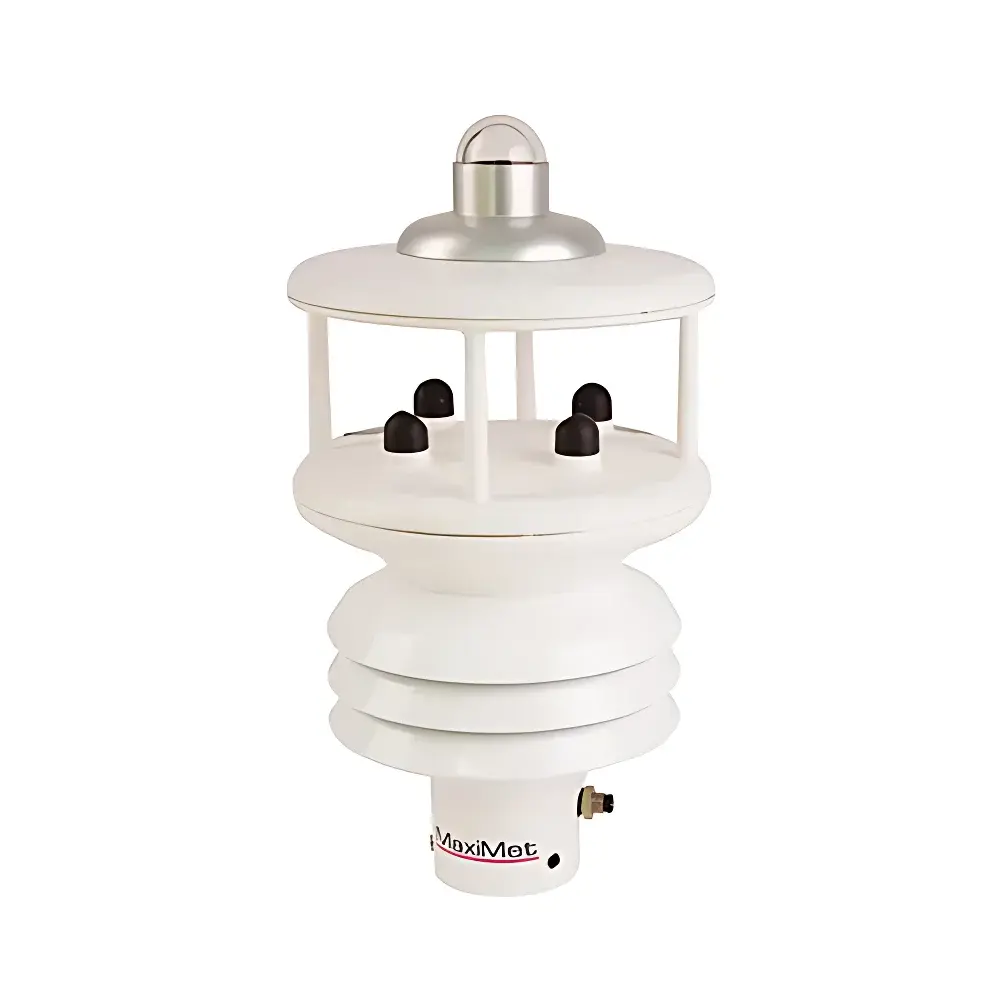
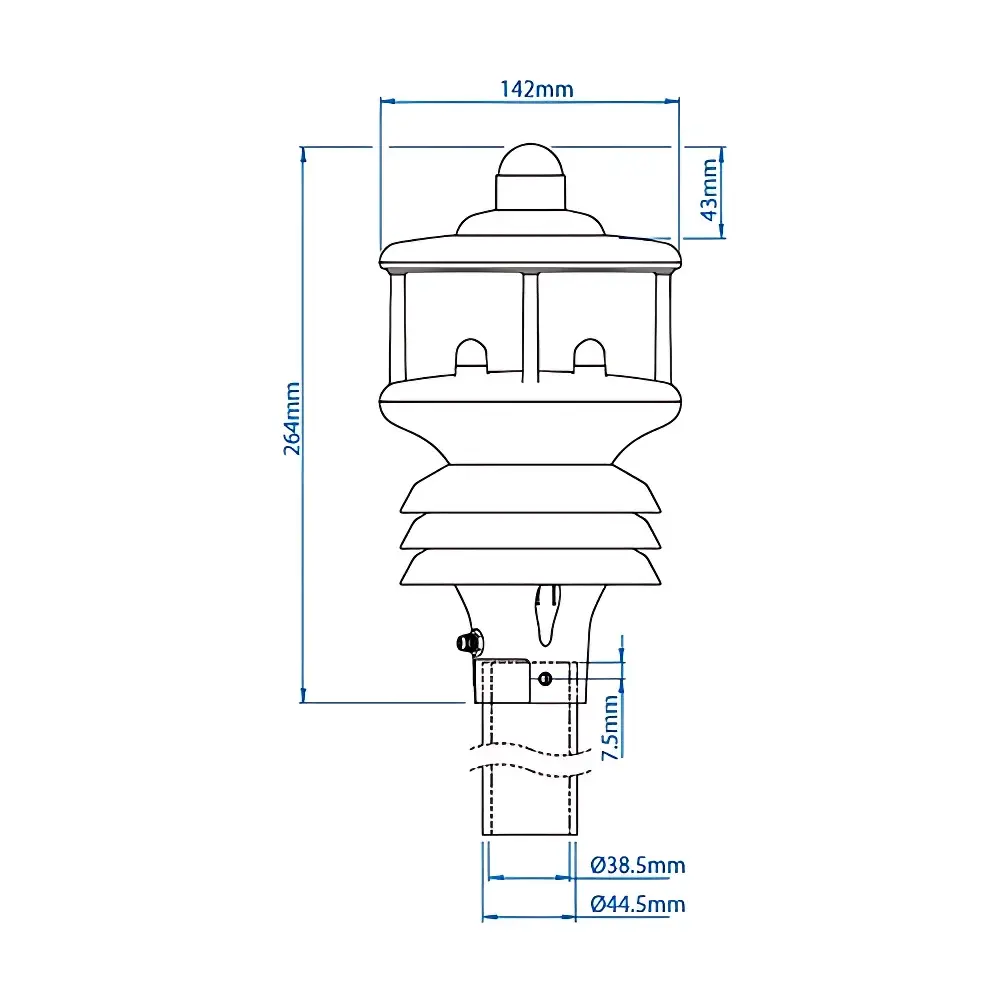
Gill GMX551 Compact Weather Station
| Brand | Gill |
|---|---|
| Origin | United Kingdom |
| Model | GMX551 |
| Instrument Type | Portable Weather Station |
| Compliance | ISO 9060 (Solar Radiation), WMO Guidelines |
| Output Interfaces | RS-232/422/485 (ASCII), SDI-12, NMEA 0183, MODBUS RTU, Analog (optional) |
| Solar Sensor | Integrated Hukseflux LP02 Pyranometer |
| Wind Measurement | Ultrasonic (no moving parts) |
| Radiation Field of View | 180° hemispherical |
| Rain Input | External tipping-bucket rain gauge (user-supplied, resolution selectable up to 9.998 mm) |
Overview
The Gill GMX551 Compact Weather Station is an integrated, maintenance-free environmental monitoring system engineered for high-reliability deployment in demanding outdoor applications. Designed and manufactured in the United Kingdom by Gill Instruments—a globally recognized leader in precision meteorological instrumentation—the GMX551 implements a modular, sensor-fused architecture that eliminates mechanical wear while ensuring long-term measurement stability. Its core sensing principle relies on solid-state ultrasonic wind measurement (Doppler time-of-flight), capacitive humidity detection with temperature-compensated thermal conductivity pressure transduction, and thermopile-based solar irradiance quantification compliant with ISO 9060:2018 Class C specifications. Unlike traditional rotating-cup or vane-based stations, the GMX551’s lack of moving parts significantly reduces calibration drift and field maintenance intervals—critical for unattended operation across remote agricultural plots, coastal infrastructure sites, renewable energy farms, and academic research networks.
Key Features
- Integrated tri-sensor module for air temperature, relative humidity, and barometric pressure housed within a triple-layer, UV-stabilized, naturally ventilated radiation shield—designed to minimize solar loading error and thermal lag per WMO Guide to Meteorological Instruments and Methods of Observation (CIMO Guide, Chapter 4).
- Embedded Hukseflux LP02 thermopile pyranometer with fused silica dome, delivering spectral response from 305–2800 nm and calibrated traceability to the World Radiometric Reference (WRR).
- Ultrasonic wind sensor providing simultaneous wind speed (0.01–60 m/s) and wind direction (0–359.9°) measurements; outputs include 2-, 10-, and 60-second WMO-standard averaged vectors, gust parameters, and apparent wind components.
- Optional integrated GPS module enabling true wind vector computation, georeferenced timestamping, solar position algorithms (sunrise/sunset, solar noon, twilight phases), and mean sea level (MSL) pressure derivation.
- Flexible rain input interface supporting industry-standard tipping-bucket gauges; user-selectable resolution from 0.01 to 9.998 mm per tip, with accumulated total, hourly, and 24-hour rainfall reporting.
- Multi-protocol digital output suite including ASCII over RS-232/422/485, SDI-12 for sensor networks, NMEA 0183 for marine/GNSS integration, MODBUS RTU for SCADA compatibility, and optional 4–20 mA or 0–5 V analog outputs.
Sample Compatibility & Compliance
The GMX551 meets international metrological requirements for operational weather observation. Its solar irradiance subsystem conforms to ISO 9060:2018 Class C (formerly “Second Class”) for spectral responsivity, directional response, and temperature dependence. Pressure measurements are referenced to IEC 61290-2 and traceable to national standards via Gill’s UKAS-accredited calibration laboratory. Temperature and humidity performance aligns with EN 13037-2 for ambient air monitoring. The station supports GLP-compliant data logging when paired with certified third-party dataloggers, and its ASCII/NMEA output formats facilitate audit-ready traceability in regulated sectors including aviation weather reporting (ICAO Annex 3), solar farm performance monitoring (IEC 61724-1), and environmental impact assessments governed by EU Directive 2008/50/EC.
Software & Data Management
Raw sensor data is delivered in configurable ASCII strings containing over 30 derived and primary parameters—including wet-bulb temperature, air density, absolute humidity, wind chill index, and solar zenith angle—calculated onboard using embedded thermodynamic and astronomical algorithms. Gill provides free configuration software (GMX ConfigTool) for parameter setup, firmware updates, and diagnostic logging. Third-party compatibility includes Campbell Scientific LoggerNet, DTN Meteologger, and open-source platforms such as WeeWX and CumulusMX. All digital outputs support timestamped, comma-delimited records suitable for ingestion into SQL databases, cloud IoT platforms (AWS IoT Core, Azure IoT Hub), and regulatory reporting systems requiring 21 CFR Part 11–compliant audit trails when deployed with validated middleware.
Applications
- Agricultural microclimate monitoring for irrigation scheduling, frost prediction, and pest lifecycle modeling.
- Solar PV plant performance ratio analysis and soiling loss quantification via synchronized irradiance and environmental baselines.
- Coastal erosion studies and maritime safety systems requiring real-time wind/wave correlation inputs.
- Smart city infrastructure management, including HVAC load forecasting and urban heat island mapping.
- Educational meteorology labs where robustness, low power consumption (<2.5 W typical), and pedagogical transparency of measurement principles are essential.
- Transportation authorities deploying roadside weather information systems (RWIS) compliant with AASHTO R 102 and FHWA guidelines.
FAQ
Does the GMX551 require periodic recalibration?
Yes—Gill recommends annual calibration for pressure and humidity sensors, and biennial verification for the LP02 pyranometer, following ISO/IEC 17025 procedures. Calibration certificates include uncertainty budgets traceable to NPL (UK) standards.
Can the GMX551 operate autonomously on solar power?
Yes—it supports 6–30 V DC input and draws <2.5 W at 12 V, making it compatible with standard 10–20 W solar panels and deep-cycle batteries commonly used in off-grid environmental networks.
Is the ultrasonic wind sensor affected by icing or heavy precipitation?
The transducer array features active heating (optional) and hydrophobic coating; field data from Nordic deployments confirm stable operation down to −30°C with snow accumulation mitigation via acoustic self-cleaning pulses.
What level of accuracy does the integrated radiation sensor achieve?
The LP02 delivers ±3% daily total uncertainty (k=2) under clear-sky conditions per ISO 9060:2018, with non-linearity <±0.5%, zero-offset <7 W/m², and thermal offset <5 W/m² across −40°C to +70°C ambient range.
How is GPS integration implemented for true wind calculation?
When enabled, the optional GPS module supplies vessel/platform velocity and heading; the station’s onboard processor applies vector subtraction to apparent wind measurements to derive true wind speed/direction—essential for marine and mobile platform deployments.
Related Products







