
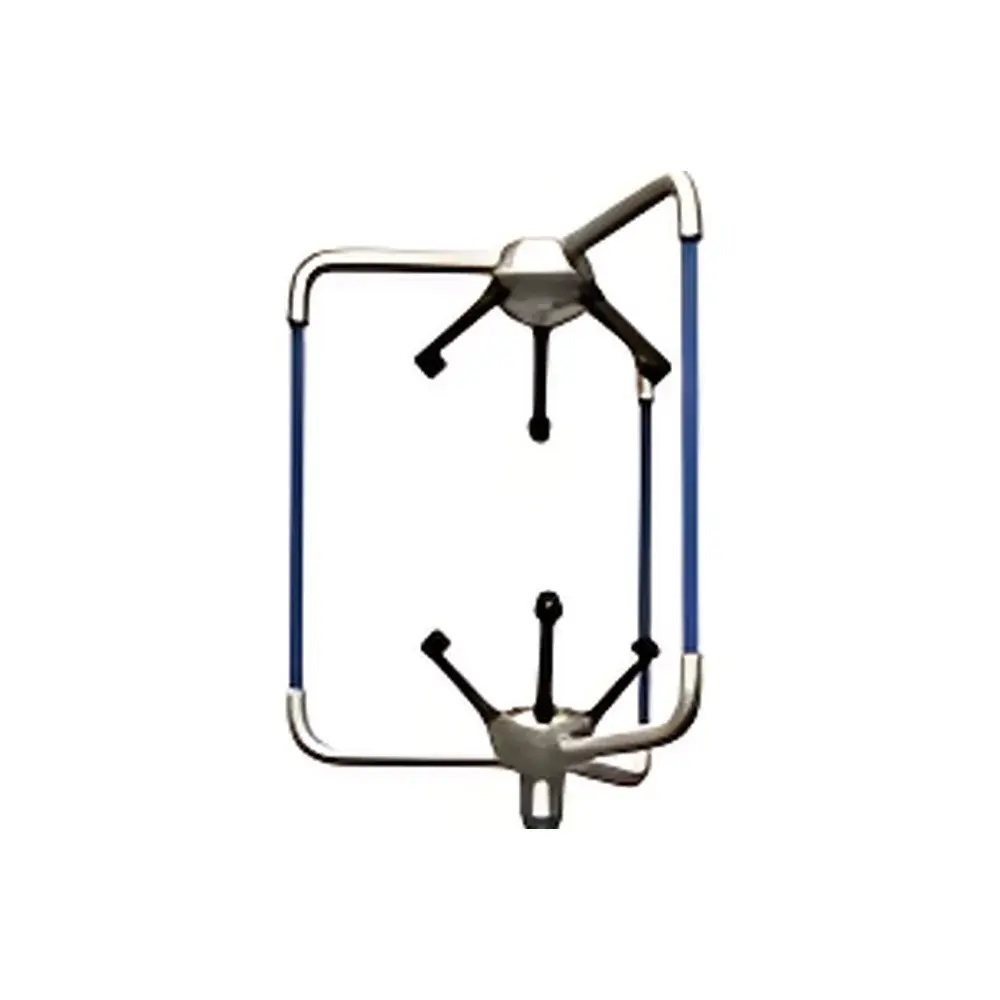
Gill HS-50 Three-Dimensional Ultrasonic Anemometer
| Brand | Gill |
|---|---|
| Origin | United Kingdom |
| Instrument Type | Ultrasonic Anemometer |
| Resolution | 0.01 m/s |
| Measurement Sampling Frequencies | 1, 2, 4, 8, 10, 16, 20 Hz (32 Hz optional) |
| Accuracy | < ±0.5% @ 20°C (Speed of Sound), < ±1° RMS (Wind Direction), < 1% RMS (Wind Speed @ ≤30° incidence) |
| Operating Temperature | -40°C to +70°C |
| Relative Humidity Range | 5%–100% RH |
| Ingress Protection | IP65 |
| Wind Speed Range | 0–45 m/s |
| Wind Direction Range | 0–359° |
| Ultrasonic Temperature Range | Not applicable (HS-50 model lacks integrated PRT) |
| Output Interfaces | RS422 full-duplex, 8 data bits, 1 stop bit, no parity |
| Baud Rate | 2400–115200 bps |
| Output Format | UVW vector components + Speed of Sound |
| Power Supply | 9–30 V DC (<150 mA @ 24 V DC or 300 mA @ 12 V DC) |
| Dimensions | 1305 mm × 344 mm × 120 mm |
| Weight | 2.5 kg |
| Housing Material | Stainless steel |
Overview
The Gill HS-50 is a high-fidelity, three-dimensional ultrasonic anemometer engineered for precision atmospheric turbulence measurement and long-term environmental monitoring in demanding field deployments. Unlike cup-and-vane or hot-wire systems, the HS-50 employs time-of-flight ultrasonic transit-time differential measurement across three orthogonal acoustic paths to compute instantaneous U, V, and W wind vector components without moving parts. This principle enables direct, inertia-free sampling of turbulent fluctuations at up to 50 Hz internal sampling rate—critical for eddy covariance flux studies, boundary-layer characterization, and wind energy site assessment. Its horizontally mounted transducer array minimizes flow shadowing and aerodynamic distortion, particularly at high angles of attack, ensuring minimal flow perturbation and high-fidelity spectral response down to sub-Hz frequencies. Designed and manufactured in the UK by Gill Instruments—a leader in ultrasonic meteorological sensing since 1995—the HS-50 undergoes individual wind-tunnel calibration prior to shipment, traceable to NPL (National Physical Laboratory) standards, and is validated for continuous operation across extreme climatic gradients—from Arctic tundra to desert margins.
Key Features
- Horizontally oriented transducer geometry optimized to reduce flow distortion and shadow effects, especially under oblique wind incidence (±30° acceptance angle specified)
- Stainless steel structural housing rated IP65 for dust-tightness and protection against low-pressure water jets (300 mm/hr precipitation tolerance)
- High-resolution wind vector output (0.01 m/s speed resolution, 1° directional resolution) with RMS accuracy <1% for wind speed and <±1° for wind direction under nominal conditions
- Internal sampling at 50 Hz, with configurable output rates from 0.4 Hz to 50 Hz via RS422 serial interface
- Full-duplex RS422 communication (8N1, 2400–115200 bps) supporting robust, noise-immune data transmission over distances up to 1,200 m
- Low-power operation (≤150 mA @ 24 V DC), compatible with solar-battery telemetry systems for remote installations
- Factory-calibrated in controlled wind tunnel environment; calibration certificates include uncertainty budgets per ISO/IEC 17025 requirements
Sample Compatibility & Compliance
The HS-50 is designed for unattended, multi-year deployment in open-air environments including flux towers, offshore platforms, transportation corridors, and urban meteorological networks. It complies with IEC 61326-1 (EMC for industrial environments), EN 60529 (IP65 ingress protection), and meets mechanical durability requirements outlined in WMO No. 8 (Guide to Meteorological Instruments and Methods of Observation). While not intrinsically certified for hazardous locations, its stainless-steel construction and absence of ignition sources permit use in non-classified outdoor zones. The instrument supports integration into GLP- and GMP-aligned environmental monitoring systems when paired with audit-trail-capable data loggers (e.g., Campbell Scientific CR6 or Onset HOBO RX3000), and its ASCII-formatted output facilitates validation under FDA 21 CFR Part 11 when used with compliant software infrastructure.
Software & Data Management
The HS-50 outputs raw UVW components and speed-of-sound values in ASCII format, enabling seamless ingestion into third-party analysis platforms such as MATLAB, Python (via PySerial or Pandas), EddyPro®, TK3, or IRGA synchronization tools. Gill provides configuration utilities (Windows-based) for baud rate, output frequency, and data framing—no proprietary drivers required. For regulatory applications, users may implement timestamped, checksummed logging with metadata tagging to satisfy ALCOA+ (Attributable, Legible, Contemporaneous, Original, Accurate, Complete, Consistent, Enduring, Available) data integrity principles. Optional analog outputs (±2.5 V) support legacy SCADA integration, while digital outputs are compatible with SDI-12 gateways and MQTT-enabled edge devices for IoT telemetry architectures.
Applications
- Eddy covariance flux measurements for CO₂, H₂O, CH₄, and energy balance studies (aligned with AmeriFlux, ICOS, and FLUXNET protocols)
- Wind resource assessment and turbine wake characterization in onshore and offshore wind farm development
- Road weather information systems (RWIS) for crosswind hazard detection and de-icing decision support
- Boundary-layer meteorology research, including stable/unstable stratification diagnostics and momentum flux profiling
- Structural wind loading analysis for tall buildings, bridges, and suspension structures during wind tunnel correlation campaigns
- Volcanic plume dispersion modeling and emergency response air quality monitoring
FAQ
Does the HS-50 include an integrated temperature sensor?
No—the HS-50 model does not incorporate a platinum resistance thermometer (PRT); temperature must be measured externally using a co-located calibrated sensor.
What is the maximum recommended cable length for RS422 communication?
Up to 1,200 meters is supported using shielded twisted-pair cable (e.g., Belden 9841) with proper grounding and termination.
Can the HS-50 operate continuously at -40°C?
Yes—the electronics and transducers are qualified for uninterrupted operation from -40°C to +70°C ambient, with full specification compliance verified per MIL-STD-810G thermal shock testing.
Is wind tunnel calibration traceable to national standards?
Yes—each unit is calibrated in Gill’s ISO/IEC 17025-accredited facility using NPL-traceable reference standards; calibration reports include expanded uncertainty (k=2) for all primary parameters.
How is flow distortion quantified for the HS-50’s horizontal transducer layout?
Gill publishes wind tunnel-derived correction coefficients for vertical velocity bias and spectral attenuation up to 10 Hz; these are implemented in standard post-processing workflows for eddy covariance.
Related Products







