
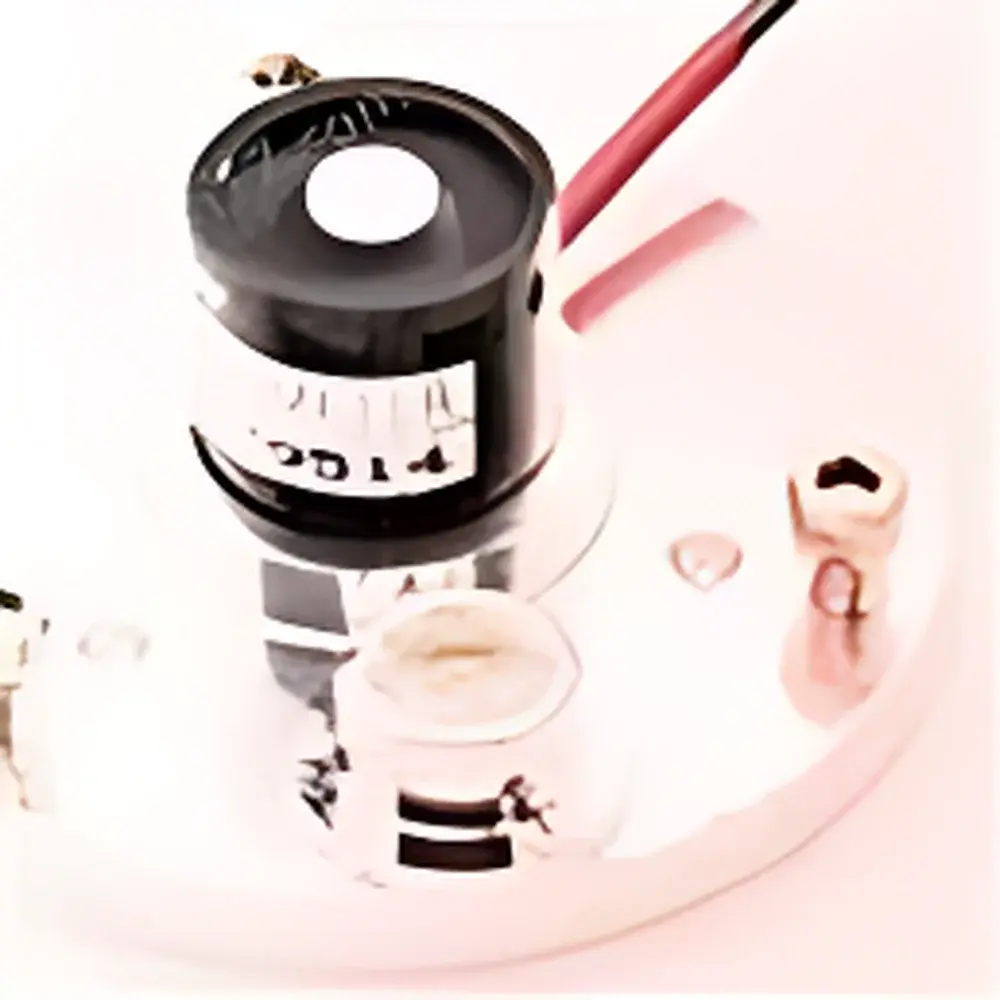
Global Water WE300 Pyranometer
| Brand | Global Water |
|---|---|
| Origin | USA |
| Manufacturer Type | Authorized Distributor |
| Origin Category | Imported |
| Model | WE300 |
| Instrument Type | Other Weather Station |
| Application Scenario | Agricultural Meteorological Station |
| Output Signal | 4–20 mA |
| Detector | High-Stability Blue-Enhanced Silicon Photovoltaic Cell |
| Measurement Range | 0–1500 W/m² |
| Spectral Response | 400–1100 nm |
| Accuracy | ±1% of reading |
| Operating Voltage | 10–36 VDC |
| Warm-up Time | ≥3 s |
| Operating Temperature | −40 to +55 °C |
| Dimensions | 7.6 cm diameter × 3.8 cm height |
| Weight | 114 g |
| Cable | 7.5 m marine-grade, shielded, 2-conductor (extendable up to 150 m with optional WQEXC cable) |
| Output Configuration | 2-wire loop-powered 4–20 mA |
| Included Accessories | EB0000 sensor unit, 7.5 m cable, user manual |
Overview
The Global Water WE300 Pyranometer is a precision-calibrated, thermally compensated silicon photodiode-based radiometer engineered for continuous, long-term measurement of global horizontal irradiance (GHI) — the total shortwave solar radiation incident on a horizontal surface. It operates on the principle of photovoltaic conversion, where incident photons within the 400–1100 nm spectral band generate a proportional photocurrent, linearly converted and conditioned into a robust 4–20 mA analog output signal. Designed for integration into agricultural meteorological stations, irrigation control systems, photovoltaic performance monitoring networks, and climate research deployments, the WE300 delivers high reproducibility under variable environmental conditions. Its blue-enhanced silicon detector ensures improved spectral responsivity across the photosynthetically active radiation (PAR) range (400–700 nm), supporting applications in agronomy and ecosystem modeling. The instrument features a hermetically sealed electronics housing, integrated bubble level and leveling screws for precise horizontal alignment, and marine-grade cabling rated for outdoor exposure and electromagnetic interference (EMI) resilience.
Key Features
- High-stability blue-enhanced silicon photovoltaic detector with calibrated spectral response from 400 to 1100 nm
- Industrial-grade 2-wire, loop-powered 4–20 mA output — compatible with standard SCADA, PLC, and data logger inputs without external power at the sensor node
- Compact, weatherproof stainless-steel and anodized aluminum housing (7.6 cm Ø × 3.8 cm H; 114 g) with IP67-rated sealing
- Integrated bubble level and fine-thread leveling screws for rapid, repeatable horizontal mounting
- 7.5 m marine-grade, twisted-pair, shielded cable included; extendable to 150 m using optional WQEXC extension cable (sold separately)
- Low power consumption (<1.5 mA at 24 VDC) and wide operating voltage range (10–36 VDC)
- Fast thermal stabilization: full electrical stability achieved within ≥3 seconds after power-on
- Extended operational temperature range: −40 °C to +55 °C — validated for deployment in arid, alpine, and coastal environments
Sample Compatibility & Compliance
The WE300 is designed for direct measurement of broadband solar irradiance on horizontal surfaces and is suitable for use in unshaded, open-sky locations with clear line-of-sight to the solar disk and diffuse sky hemisphere. It complies with the functional specifications outlined in ISO 9060:2018 for “Secondary Standard” pyranometers (Class C), though it is not classified as a thermopile-based primary standard device. Its calibration traceability follows NIST-traceable protocols performed by Global Water’s ISO/IEC 17025-accredited calibration laboratory. The sensor meets IEC 61215 and IEC 61724 requirements for PV system monitoring instrumentation and supports compliance with FAO-56 reference evapotranspiration (ET₀) calculations used in irrigation scheduling. No sample preparation or consumables are required; routine maintenance is limited to periodic cleaning of the optical dome and verification of leveling accuracy.
Software & Data Management
The WE300 outputs a standardized 4–20 mA signal that interfaces seamlessly with third-party data acquisition systems including Campbell Scientific CR series loggers, Onset HOBO RX3000, Delta-T Devices DL2e, and industrial PLC platforms (e.g., Siemens S7, Allen-Bradley CompactLogix). When paired with the optional PC300 Pyranometer Controller, users can configure programmable alarm thresholds (e.g., irradiance >1000 W/m² triggers pump activation) and local LED status indication. Integration with the GL500 Solar Radiation Data Logger enables timestamped, high-resolution (1 Hz default) recording, internal memory storage (up to 1 million readings), and USB/SD card data export in CSV format. All logged datasets include embedded metadata (sensor ID, firmware version, calibration date) and support audit-ready documentation per GLP and ISO 17025 requirements. Firmware updates and configuration are performed via ASCII command protocol over RS-232 or TTL serial interface.
Applications
- Agricultural meteorology: Real-time GHI input for evapotranspiration modeling (FAO Penman-Monteith), deficit irrigation scheduling, and greenhouse climate control
- Photovoltaic (PV) performance monitoring: Validation of plane-of-array (POA) irradiance for energy yield analysis and degradation trending
- Hydrological modeling: Input parameter for snowmelt simulation and watershed energy balance estimation
- Educational and field research deployments: Low-cost, reliable irradiance node for student-led atmospheric science projects and distributed sensor networks
- Smart city infrastructure: Integration into urban microclimate monitoring systems assessing solar heat gain and daylight harvesting potential
FAQ
What is the calibration uncertainty of the WE300, and how often should recalibration be performed?
The factory calibration uncertainty is ±1% (k=2) against a NIST-traceable reference standard. Global Water recommends recalibration every 2 years for critical applications or after physical impact, prolonged soiling, or exposure beyond specified environmental limits.
Can the WE300 measure diffuse or direct normal irradiance (DNI)?
No — the WE300 is configured as a global horizontal irradiance (GHI) sensor only. For diffuse irradiance, a shading ring or tracking ball must be added; for DNI, a dedicated sun-tracking pyrheliometer is required.
Is the 4–20 mA output linear across the full 0–1500 W/m² range?
Yes — the output is factory-linearized with end-point calibration at 0 W/m² (4.00 mA) and 1500 W/m² (20.00 mA), with nonlinearity <±0.2% of span.
Does the sensor require desiccant or dome heating in humid environments?
No — the optical dome is hydrophobic-coated and the sealed housing eliminates internal condensation risk; no heater or desiccant cartridge is integrated or required.
What mounting hardware is included, and is pole-mounting supported?
The standard kit includes a universal U-bolt mounting bracket, leveling base plate, and M6 stainless steel hardware — compatible with standard 1.5–2.5 inch OD meteorological mounting poles.
Related Products







