
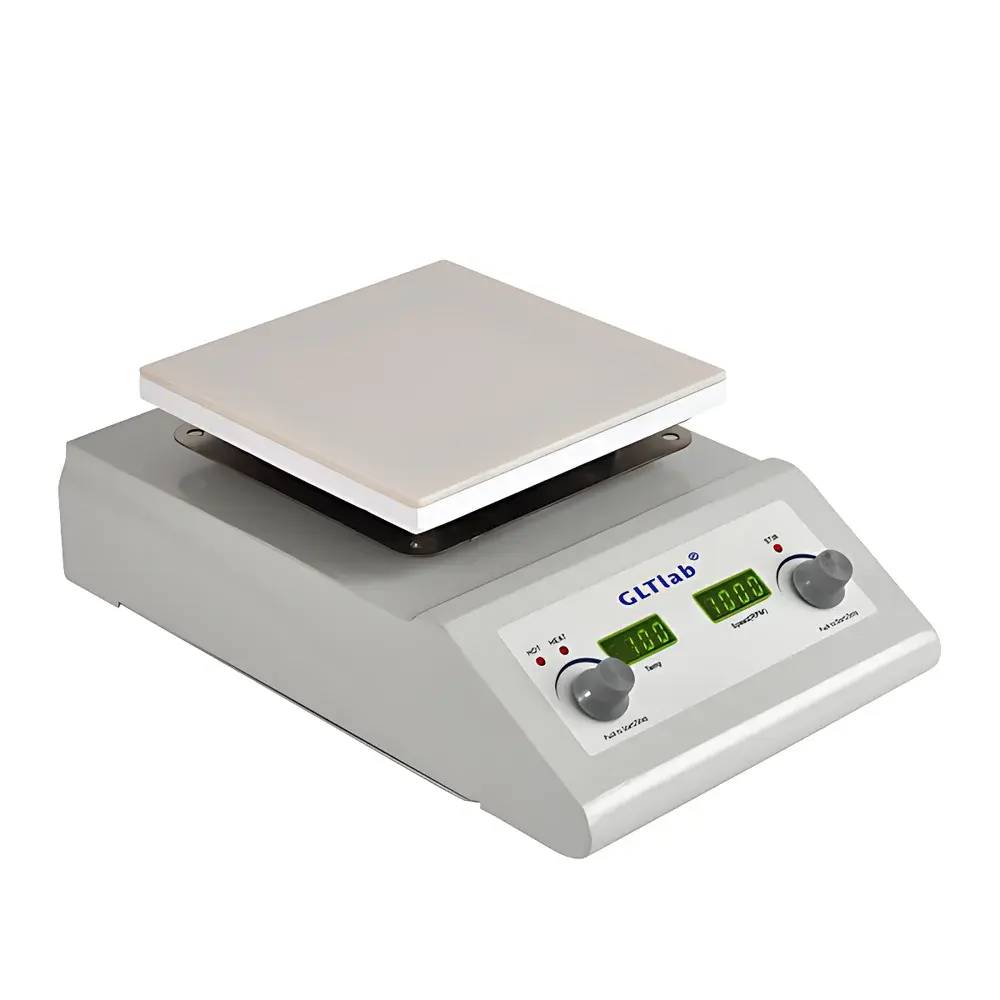
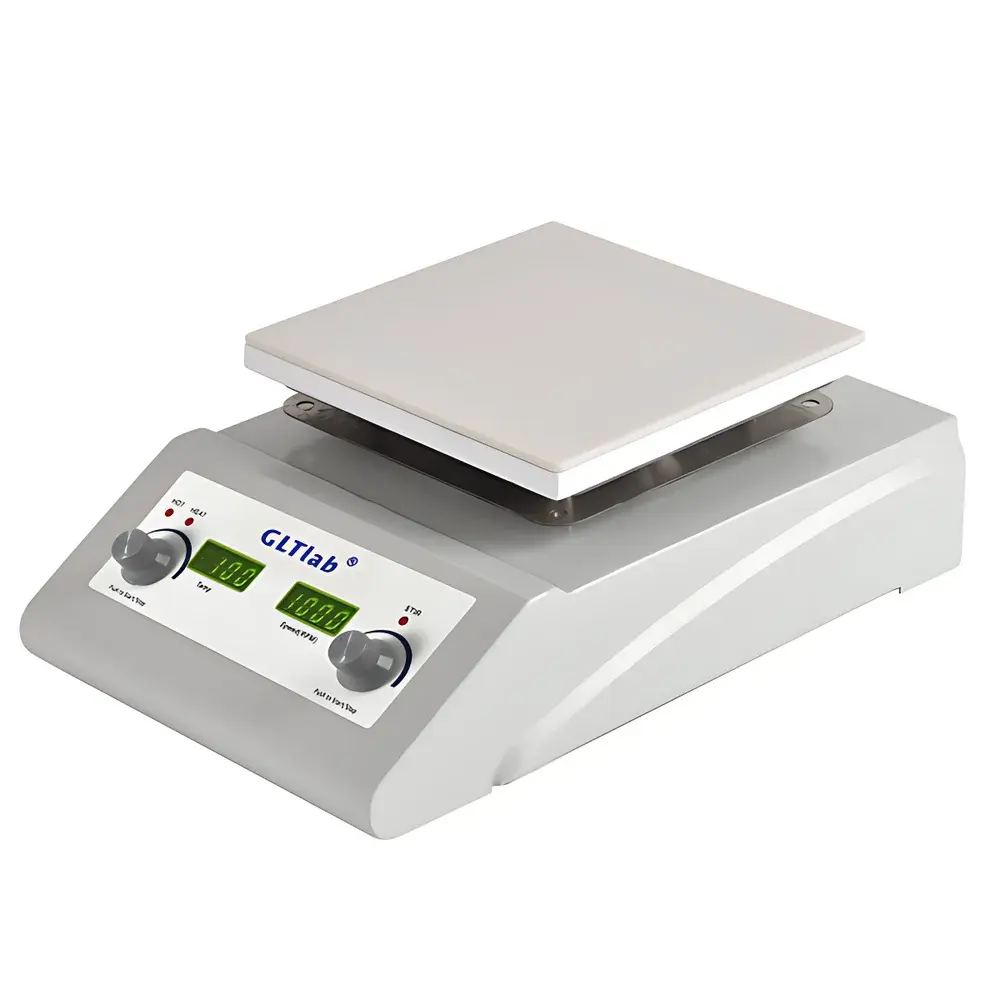
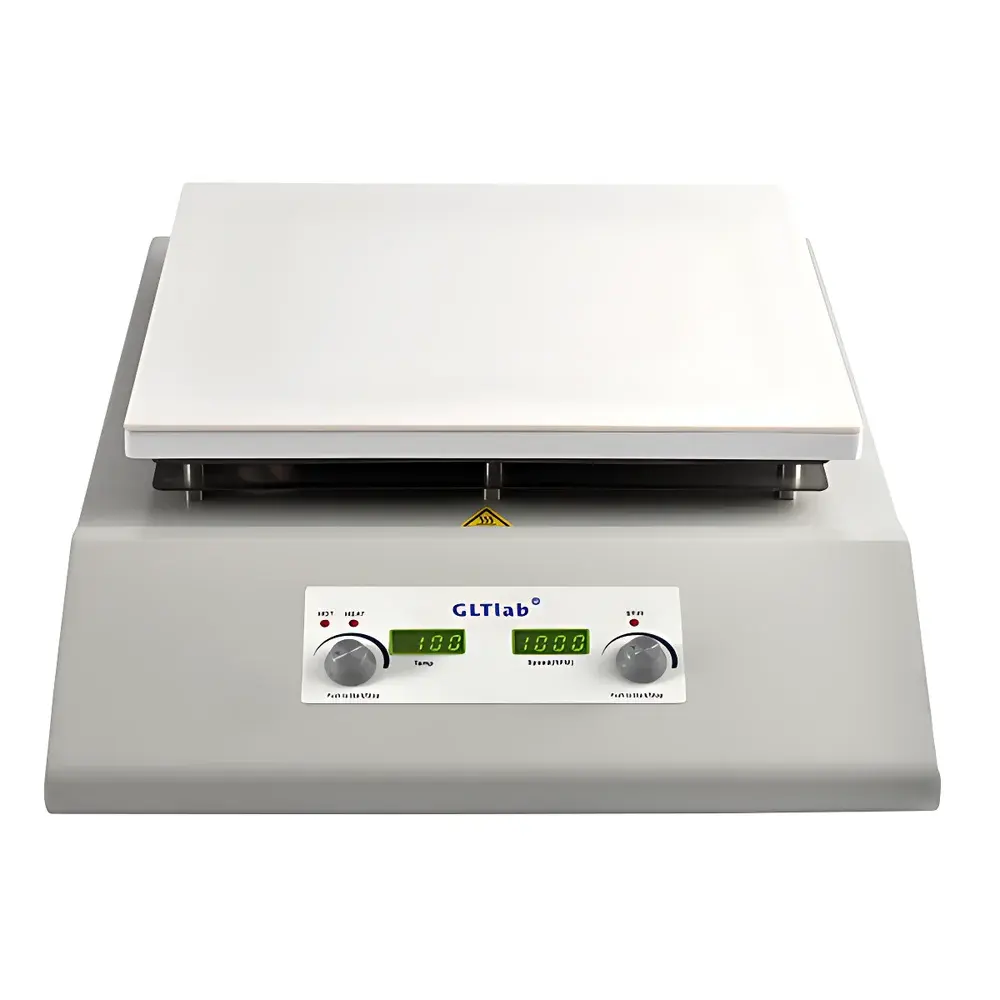
GLTlab SHC-1 Digital Display Ceramic-Plate Magnetic Stirrer with Heating
| Brand | GLTlab |
|---|---|
| Model | SHC-1 |
| Type | Magnetic Stirrer |
| Max Stirring Volume | 10 L (H₂O) |
| Speed Range | 150–1500 rpm |
| Solution Temperature Range | 35–200 °C |
| Ceramic Plate Surface Temperature Range | 35–500 °C |
| Temperature Setting Resolution (Solution) | 0.1 °C |
| Temperature Setting Resolution (Plate) | 1 °C |
| Temperature Stability | ±1 °C |
| PT1000 Sensor Accuracy | ±0.5 °C |
| External Probe Calibration Function | Yes |
| Panel Material | Alumina Ceramic (D150 mm) |
| Power | 600 W |
| Input Voltage | 100–130 V / 200–240 V, 50/60 Hz |
| Dimensions (W×D×H) | 190 × 290 × 100 mm |
| Weight | 3.5 kg |
| Operating Ambient | 5–40 °C, ≤80% RH |
| Protection Rating | IP21 |
Overview
The GLTlab SHC-1 is a precision-engineered digital magnetic stirrer with integrated ceramic heating plate, designed for reliable, repeatable heating and mixing of laboratory samples under controlled thermal conditions. It operates on the principle of magnetic coupling—rotating a PTFE- or glass-coated stir bar within a vessel via a rotating magnetic field generated beneath a non-magnetic, high-temperature-resistant ceramic surface. Unlike conventional stainless-steel or aluminum hotplates, the SHC-1 employs an alumina-based ceramic plate (Ø150 mm), offering exceptional chemical inertness, thermal stability up to 500 °C at the surface, and resistance to scratching, acid corrosion, and thermal shock. This architecture supports both direct contact heating of vessels (e.g., beakers, flasks) and precise solution temperature regulation—where the internal PT1000 resistance temperature detector (RTD) monitors liquid-phase temperature in real time when paired with an optional external probe. The device is engineered for use in analytical chemistry, pharmaceutical formulation development, materials synthesis, and quality control laboratories where consistent thermal homogeneity and contamination-free operation are essential.
Key Features
- Ceramic heating surface (alumina, 96% purity) rated for continuous operation up to 500 °C—enabling rapid thermal ramping and compatibility with aggressive solvents including concentrated acids and alkalis.
- Dual-mode temperature control: independent selection between “plate mode” (surface heating only) and “solution mode” (feedback-controlled via external PT1000 probe), with resolution of 1 °C (plate) and 0.1 °C (solution).
- High-torque DC motor delivering stable rotational speeds from 150 to 1500 rpm, optimized for viscosity ranges typical of aqueous solutions, polymer dispersions, and low-to-medium viscosity organic media.
- Integrated thermal warning system with LED indicator and automatic shutdown upon detection of overheating or dry-run conditions.
- Full digital interface with large backlit LCD display showing real-time speed, setpoint temperature, actual temperature (probe or plate), and operational status.
- Robust mechanical design compliant with IEC 61010-1 safety standards; IP21-rated enclosure protects against vertically falling solids and limited ingress of moisture during routine lab use.
Sample Compatibility & Compliance
The SHC-1 accommodates standard laboratory glassware (e.g., 50 mL to 5000 mL beakers, Erlenmeyer flasks, round-bottom flasks) placed directly on its ceramic surface. Its 10 L maximum stirring capacity (water-equivalent) assumes use of appropriately sized stir bars (25–60 mm length) and vessels with adequate depth-to-diameter ratio to ensure vortex formation without splashing. The device meets electromagnetic compatibility (EMC) requirements per EN 61326-1 and conforms to electrical safety standards IEC 61010-1:2010 and UL 61010-1. While not inherently 21 CFR Part 11-compliant as a standalone instrument, its digital log output (via optional RS232/USB interface module) supports integration into validated environments when paired with compliant LIMS or ELN systems—facilitating audit trails for GLP and GMP workflows.
Software & Data Management
The SHC-1 operates as a stand-alone unit with no embedded firmware-based data logging. However, it features a standardized analog/digital communication interface (optional accessory) supporting ASCII protocol over RS232 or USB virtual COM port. When connected to host software (e.g., LabVIEW, Python-based acquisition scripts, or third-party lab automation platforms), users can record time-stamped speed and temperature profiles, export CSV-formatted datasets, and trigger external events (e.g., start/stop of peristaltic pumps or data acquisition modules). All parameter settings—including speed ramp rates, hold times, and dual-temperature setpoints—are retained after power cycling. Internal calibration constants for the PT1000 sensor are accessible and adjustable via service menu, enabling traceable recalibration using NIST-traceable reference thermometers.
Applications
- Precipitation and crystallization studies requiring simultaneous heating and gentle agitation to control nucleation kinetics.
- Buffer and reagent preparation in molecular biology labs, where pH-sensitive components demand uniform thermal distribution without metal ion leaching.
- Synthesis of metal-organic frameworks (MOFs) and nanomaterials in sealed reaction vessels under reflux conditions.
- Viscosity benchmarking of polymer solutions and colloidal suspensions across defined thermal gradients.
- Stability testing of active pharmaceutical ingredients (APIs) in accelerated degradation protocols per ICH Q1A(R2).
- Environmental sample digestion (e.g., EPA Method 3050B) using hotplate-assisted acid digestion prior to ICP-MS analysis.
FAQ
Can the SHC-1 heat solutions above 200 °C?
No—the solution temperature limit is capped at 200 °C to prevent boiling, decomposition, or thermal runaway in common solvents; however, the ceramic plate itself may reach 500 °C for applications such as glassware drying or preheating.
Is the external PT1000 probe included by default?
No—the probe is an optional accessory; the unit ships with internal plate-sensing only. Solution-mode operation requires purchase and connection of the calibrated external probe.
What stir bar sizes are recommended for optimal performance at 10 L volume?
For 10 L aqueous loads in cylindrical vessels ≥250 mm in diameter, use elliptical or cross-shaped stir bars 50–60 mm in length with ≥8 mm diameter and PTFE/glass coating.
Does the SHC-1 support programmable multi-step heating/stirring sequences?
Not natively—the front panel allows single-setpoint operation only; sequence programming requires external controller integration via RS232/USB.
How often should the PT1000 sensor be recalibrated?
Annual verification is recommended under GLP conditions; more frequent checks are advised if used daily in regulated environments or after mechanical impact to the probe tip.



