
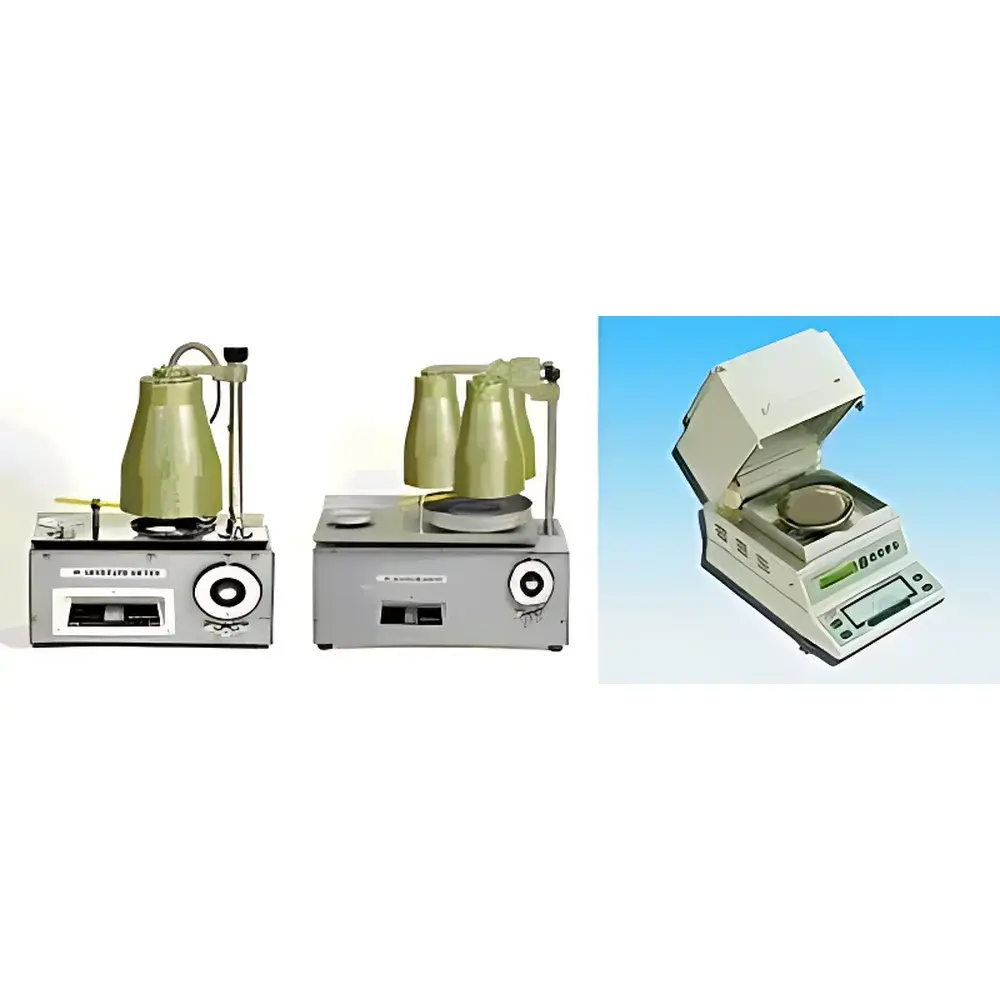
GMK-508-1L/3L & SC60 Halogen Moisture Analyzer
| Key | Origin: Imported |
|---|---|
| Manufacturer Type | Authorized Distributor |
| Model | GMK-508-1L / GMK-508-3L / SC60 |
| Measurement Range | 0.1–100% H₂O |
| Accuracy | ±0.2% |
| Sample Capacity | 5 g (GMK-508-1L), 50 g (GMK-508-3L), 10–100 g (SC60) |
| Readability | 0.001 g |
| Heating Source | Halogen Lamp (200 W × 1 for GMK-508-1L |
| Display | LCD with real-time moisture %, initial/final weight & temperature |
| Interface | RS232 for printer/data export |
| Pan Diameter | Φ80 mm (GMK-508-1L), Φ170 mm (GMK-508-3L), Φ110 mm (SC60) |
| Dimensions | 260×130×370 mm (GMK-508-1L), 410×245×425 mm (GMK-508-3L), 350×200×260 mm (SC60) |
| Weight | 4.5 kg (GMK-508-1L), 10 kg (GMK-508-3L), 7.5 kg (SC60) |
Overview
The GMK-508 series and SC60 Halogen Moisture Analyzers are precision thermogravimetric instruments engineered for rapid, reliable quantification of moisture content in solid and semi-solid samples. Unlike traditional oven-drying methods requiring external balances and manual weighing intervals, these analyzers integrate a high-resolution analytical balance (0.001 g readability) with a calibrated halogen heating system—enabling real-time mass loss monitoring during controlled thermal drying. The principle relies on the ASTM D4442-22 and ISO 4611:2022 standard methodology: sample mass is recorded before and after infrared-assisted evaporation of free and loosely bound water under defined temperature profiles. This gravimetric approach ensures traceable, operator-independent results without chemical reagents or calibration curves—making it suitable for routine QC, incoming raw material verification, and R&D process optimization across regulated and non-regulated environments.
Key Features
- Triple-model platform: GMK-508-1L (compact, 5 g max load), GMK-508-3L (high-capacity, 50 g max load with triple 200 W halogen emitters), and SC60 (versatile 10–100 g range with programmable 50–150 °C temperature control).
- High-stability electromagnetic force compensation balance with automatic internal calibration and draft shield integration to minimize environmental drift.
- Halogen lamp heating provides uniform radiant energy distribution, faster response than conventional IR lamps, and precise thermal ramping—critical for heat-sensitive materials such as pharmaceutical actives or roasted coffee beans.
- Large backlit LCD display simultaneously shows moisture %, initial/final weight, sample temperature (measured via integrated thermocouple), drying time, and drying curve slope—enabling immediate assessment of drying kinetics.
- RS232 serial interface supports direct connection to label printers, laboratory information management systems (LIMS), or PCs for GLP-compliant data archiving with timestamped records.
- Comprehensive accessory kit includes calibrated weights, stainless-steel sample pans (Φ80 mm, Φ110 mm, and Φ170 mm variants), tweezers, spatula, reference thermometer, and spare halogen lamps—ensuring operational continuity and metrological traceability.
Sample Compatibility & Compliance
The analyzers accommodate diverse matrices including granular solids (grains, powders, pellets), fibrous materials (tobacco, textiles, paper pulp), hygroscopic chemicals (pharmaceutical excipients, catalysts), and foodstuffs (tea leaves, dairy powders, pet feed). Each model meets IEC 61010-1 safety requirements for laboratory electrical equipment and complies with key regulatory frameworks: ASTM D4442 (wood moisture), AOAC 952.07 (food moisture), USP (moisture determination), and ISO 712:2022 (cereals and cereal products). Data integrity features—including user-level access control, audit trail logging, and electronic signature readiness—support alignment with FDA 21 CFR Part 11 and EU Annex 11 expectations where electronic records are subject to inspection.
Software & Data Management
While standalone operation requires no PC, optional Windows-based software enables advanced method development, multi-step drying protocols (e.g., stepwise temperature ramping), statistical batch reporting (mean, SD, RSD, min/max), and export to CSV or PDF formats. All measurements retain full metadata: operator ID, date/time stamp, method name, pan ID, ambient humidity/temperature (if external sensor connected), and raw weight-vs.-time datasets. Audit trails record every parameter change, result modification, or calibration event—fully compliant with GLP and GMP documentation standards for quality-controlled laboratories.
Applications
- Pharmaceutical manufacturing: moisture verification of APIs, excipients, and lyophilized products per USP and EP 2.5.32.
- Food & beverage QA: rapid moisture testing of flour, sugar, spices, dried fruits, and meat analogs to ensure shelf-life stability and microbial safety limits.
- Agricultural commodity trading: on-site moisture grading of rice, corn, soybeans, and tobacco leaf—reducing reliance on third-party lab submissions.
- Chemical & polymer production: monitoring residual solvent in resins, catalyst drying efficiency, and hygroscopicity of silica gels or molecular sieves.
- Research laboratories: kinetic studies of desorption behavior, comparative evaluation of drying protocols, and method transfer validation between benchtop and production-scale systems.
FAQ
What standards does this instrument comply with?
It conforms to ASTM D4442-22, ISO 4611:2022, ISO 712:2022, AOAC 952.07, and USP , with design features supporting FDA 21 CFR Part 11 and EU Annex 11 data integrity requirements.
Can the SC60 perform multi-stage heating programs?
Yes—the SC60 supports up to five user-defined temperature segments with independent time and setpoint parameters, enabling optimized drying of thermally labile or heterogeneous samples.
Is calibration traceable to national standards?
Internal calibration uses certified weights (included); external verification may be performed using NIST-traceable mass standards. Full calibration certificates are available upon request.
How is sample heterogeneity addressed during measurement?
Recommended practice specifies homogenization prior to loading and use of representative sub-samples within the recommended weight ranges (e.g., 10–100 g for SC60) to ensure statistical relevance and minimize particle-size bias.
Does the instrument require routine maintenance beyond lamp replacement?
Beyond periodic cleaning of the pan chamber and draft shield, and scheduled halogen lamp replacement (typical lifespan >5,000 hours), no consumables or recalibration are required under normal operating conditions.



