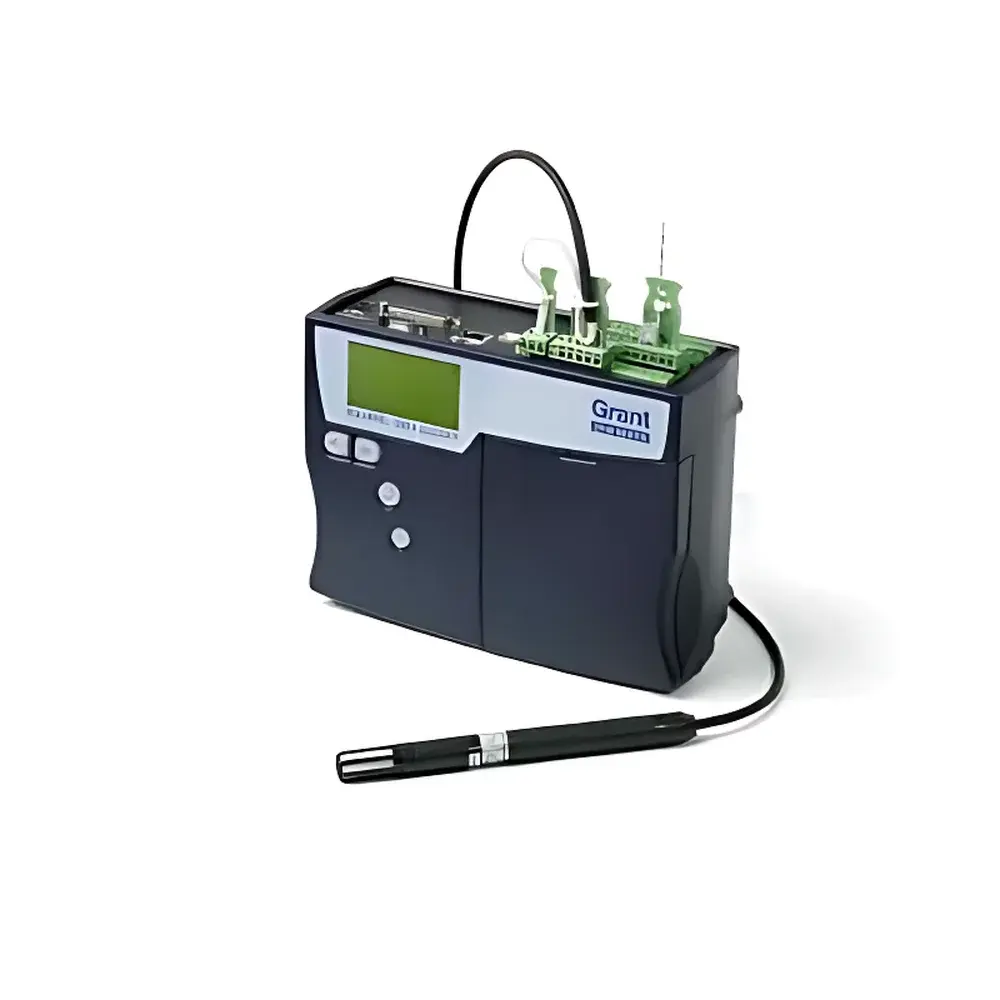
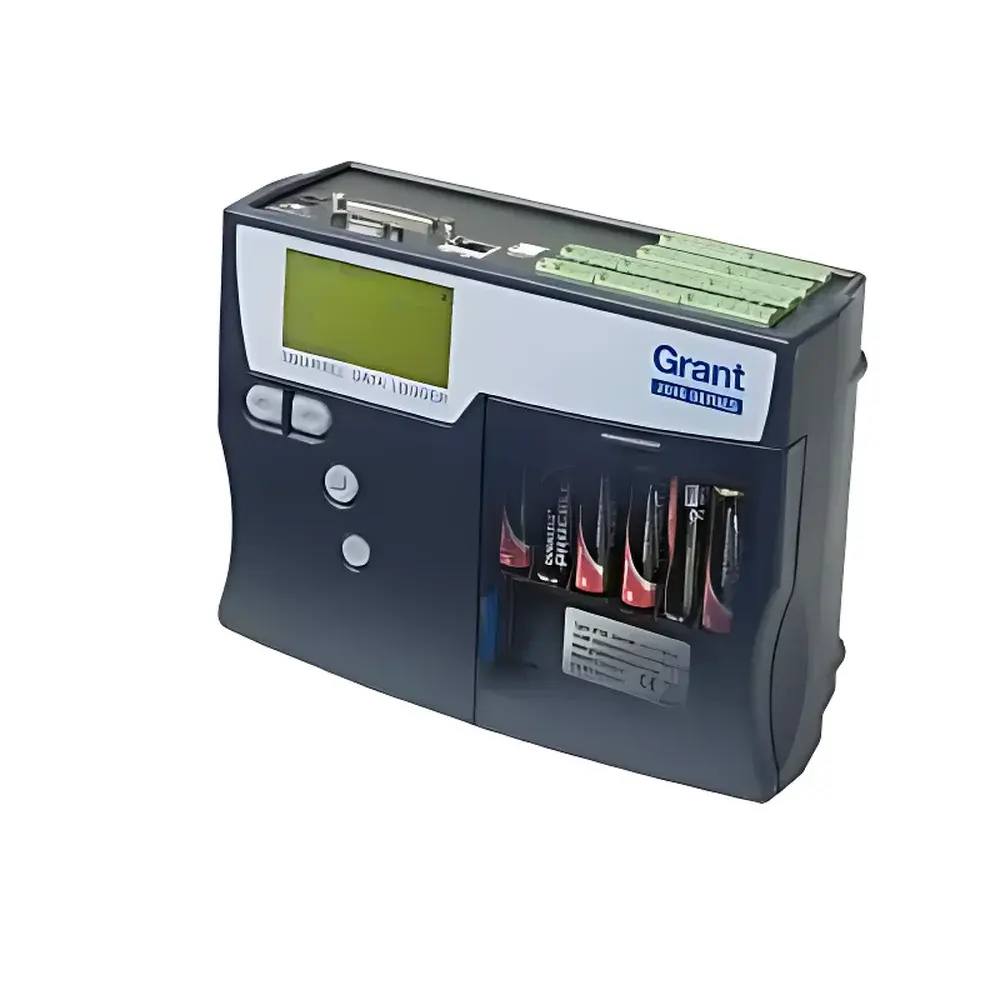
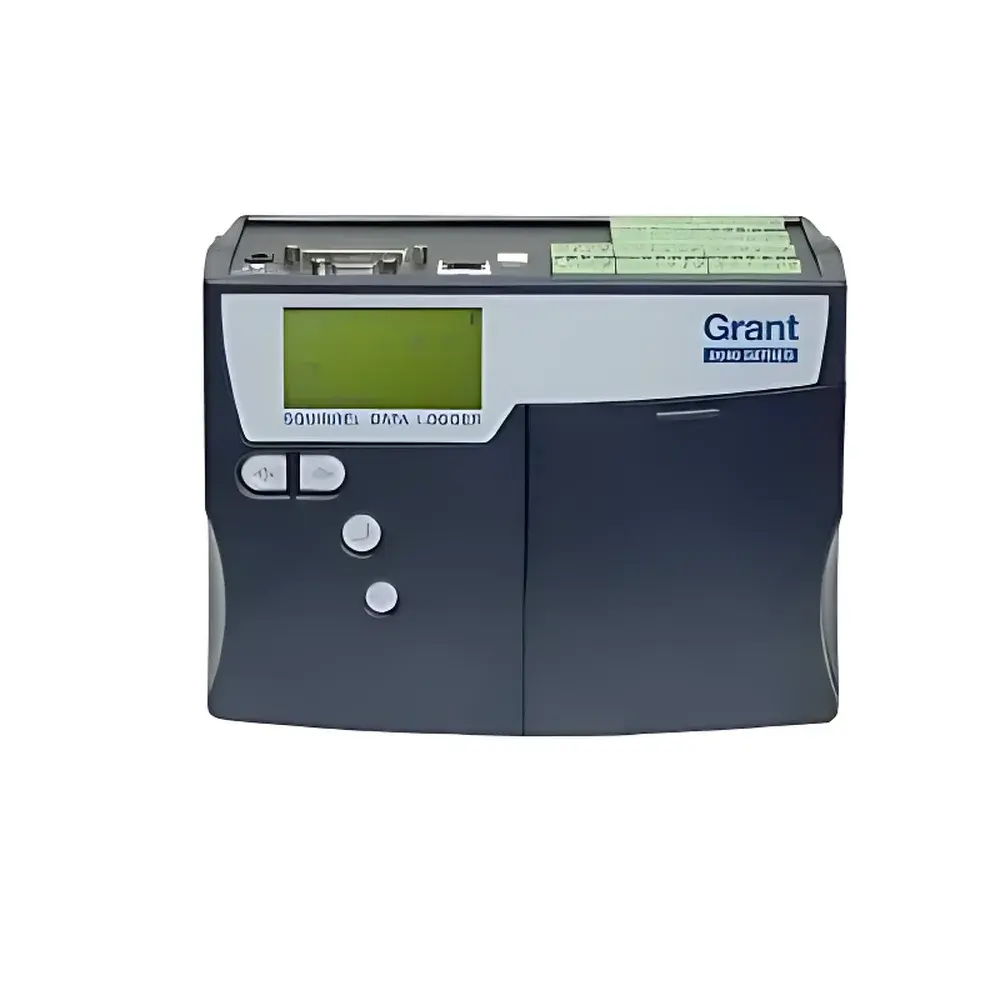
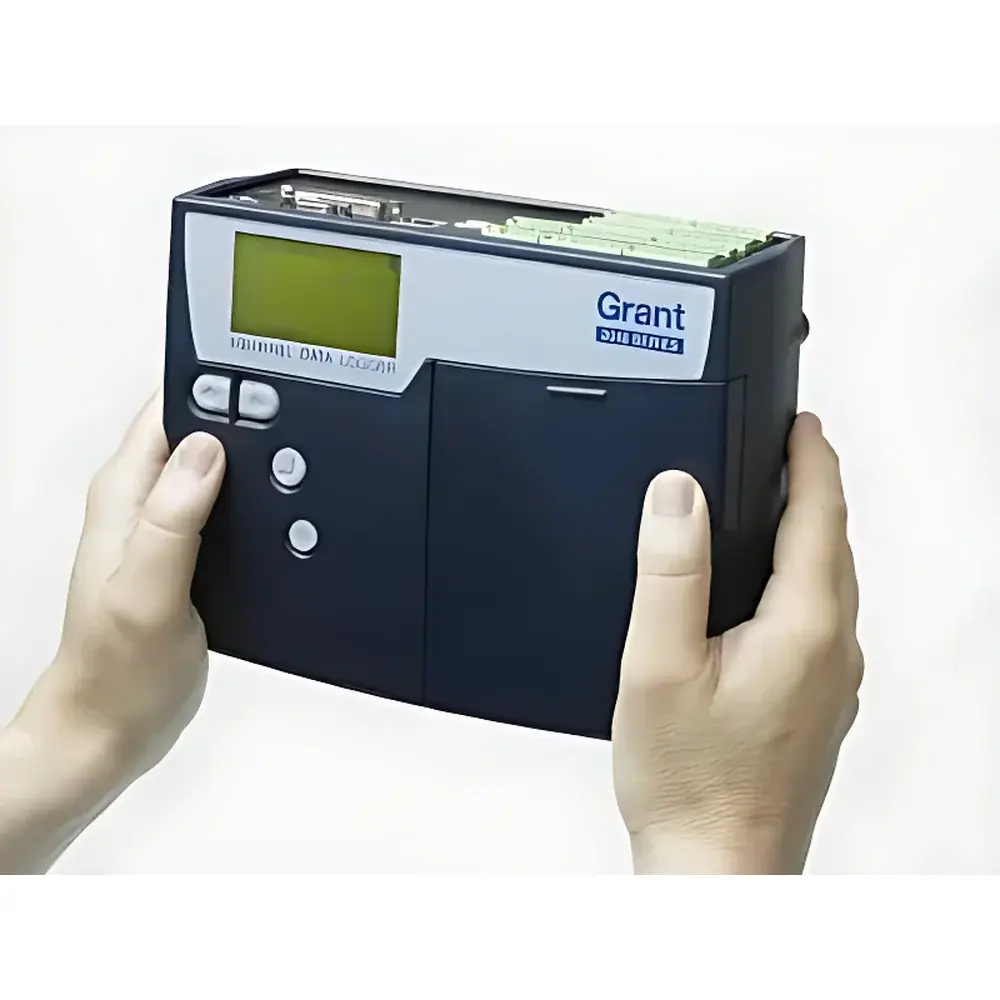
Grant Squirrel SQ2040 Data Acquisition Unit
| Brand | Grant |
|---|---|
| Origin | United Kingdom |
| Model | SQ2040 |
| Analog Inputs | 16 differential / 32 single-ended (24-bit ADC) |
| Thermocouple Support | K, R, B, T, S, C, N, J, D types |
| RTD Support | Pt100/Pt1000 (2-/3-/4-wire, up to 8 channels on SQ2040-4F16) |
| Thermistor Support | Y, U, custom curves |
| Voltage Ranges | ±0.075 V to ±25 V |
| Current Input | 4–20 mA (with 10 Ω shunt) |
| Resistance Ranges | 0–300 kΩ (2-wire), 0–4 kΩ (3-/4-wire) |
| High-Voltage Inputs | 4–20 V, 4–40 V, 4–60 V (up to two ranges selectable) |
| Pulse Inputs | 2 × fast (64 kHz), 2 × slow (100 Hz) |
| Digital/Event Inputs | 8-channel status or 1×8-bit binary |
| Sampling Rate | up to 100 Hz on 4 channels (SQ2040-4F16) or 2 channels (SQ2040-2F16) |
| Internal Memory | 128 MB (up to 14 million readings) |
| Removable Storage | MMC/SD card (up to 1 GB) |
| Communication | Ethernet (10/100 Base-T), USB 1.1/2.0, RS232 (auto-baud up to 115.2 kbps) |
| Power | 6 × AA alkaline batteries or 10–18 VDC external supply |
| Operating Temperature | –30 °C to +65 °C, ≤95% RH non-condensing |
| Display | 128 × 64 dot-matrix graphic LCD with 4-button keypad |
| Calculated Channels | up to 16 virtual channels using log(x), ln(x), sqrt(x), arithmetic, and conditional functions |
| Compliance | CE, RoHS, EN 61326-1 (EMC for industrial environments) |
Overview
The Grant Squirrel SQ2040 Data Acquisition Unit is a high-precision, field-deployable data logger engineered for demanding multi-sensor applications across industrial process monitoring, environmental research, pharmaceutical stability testing, and quality assurance laboratories. Built upon a dual-processor architecture with multiple synchronous 24-bit sigma-delta analog-to-digital converters (ADCs), the SQ2040 delivers true simultaneous sampling across mixed-signal inputs—enabling time-aligned capture of thermocouple, RTD, voltage, current, pulse, and digital event data without inter-channel skew. Its modular input architecture supports universal analog signal conditioning internally, eliminating the need for external signal conditioners in most deployments. Designed for autonomous long-term operation, the unit integrates non-volatile internal memory (128 MB), removable MMC/SD storage, and battery-backed real-time clock with three configurable date/time formats—ensuring traceable, auditable data acquisition under GLP and ISO/IEC 17025-aligned workflows.
Key Features
- True simultaneous sampling across up to 4 analog channels at 100 Hz (SQ2040-4F16) or 2 channels (SQ2040-2F16), with independent sample rate configuration per channel
- 16 differential or 32 single-ended analog inputs with programmable voltage, current (4–20 mA via integrated 10 Ω shunts), resistance, thermistor, and thermocouple excitation
- Comprehensive temperature sensor support: K, R, B, T, S, C, N, J, D thermocouples; Pt100/Pt1000 RTDs (2-/3-/4-wire, up to eight 3-/4-wire channels on 4F16 variant); Y/U-type and user-defined thermistors
- Two high-voltage analog inputs (selectable ranges: 4–20 V, 4–40 V, 4–60 V)
- Four pulse inputs (two fast: 64 kHz; two slow: 100 Hz) and eight digital/event inputs (configurable as discrete status or 8-bit binary)
- Six pre-stored instrument configurations retained in non-volatile memory—enabling rapid reconfiguration without PC connectivity
- 16 calculated (virtual) channels supporting logarithmic, natural logarithmic, square root, linear scaling, offset correction, and Boolean logic operations
- Integrated 128 × 64 graphic LCD with intuitive 4-button keypad for on-device setup, real-time value viewing, and alarm status monitoring
- Robust power management: 6 × AA alkaline batteries (typical 6-month life in low-duty-cycle logging) or 10–18 VDC external supply with reverse polarity and overvoltage protection
Sample Compatibility & Compliance
The SQ2040 accommodates a broad spectrum of passive and active sensors without external signal conditioning. Its universal analog front-end accepts millivolt-level thermocouple outputs, 2-/3-/4-wire RTD bridges, 2-wire resistive elements (0–300 kΩ), and standard 4–20 mA loop-powered transmitters. The device complies with EN 61326-1 for electromagnetic compatibility in industrial environments and bears CE and RoHS markings. While not FDA 21 CFR Part 11–certified out-of-the-box, its audit-trail-capable firmware architecture—including timestamped configuration changes, read-only internal memory logs, and deterministic data write sequences—supports validation under GxP frameworks when deployed with SquirrelView Plus and documented SOPs. All analog input specifications—including ±0.05% of reading + 0.025% of range accuracy at 25 °C, 100 dB common-mode rejection, and 50/60 Hz normal-mode rejection—are verified per IEC 61000-4-30 Class A test methodology.
Software & Data Management
Configuration, data retrieval, and post-acquisition analysis are managed via SquirrelView (included) and optional SquirrelView Plus. SquirrelView provides full instrument setup—including channel type assignment, scaling, alarm thresholds, trigger conditions, and scheduled logging profiles—as well as real-time telemetry display and batch export to CSV, Excel, or XML. SquirrelView Plus extends functionality with automated report generation, statistical process control (SPC) charting, alarm event correlation, and secure FTP/SFTP upload to network servers or cloud repositories. Internal memory operates in either stop-on-full or circular overwrite mode; data may be offloaded locally via USB or remotely via TCP/IP over Ethernet or serial link. MMC/SD cards serve exclusively for configuration backup and internal memory dump—no runtime logging to removable media, ensuring data integrity and simplifying 21 CFR Part 11 compliance efforts. Firmware updates and configuration templates are version-controlled and digitally signed to prevent unauthorized modification.
Applications
- Continuous environmental monitoring in cleanrooms, cold chain logistics, and HVAC commissioning (temperature, humidity via analog transmitters, pressure differentials)
- Accelerated stability studies per ICH Q1 guidelines, capturing multi-point thermal profiles across incubators and stability chambers
- Industrial machine health monitoring: vibration (via IEPE accelerometers), motor current draw, bearing temperature, and rotational speed (pulse counting)
- Energy consumption auditing using clamp-on current transducers and voltage taps on distribution panels
- Calibration laboratory reference data logging for thermocouple and RTD probe verification against primary standards
- Field-deployed geotechnical instrumentation: piezometer pressure, inclinometer tilt, and strain gauge bridge outputs
- Academic research requiring synchronized acquisition of heterogeneous sensor modalities—e.g., reaction kinetics (temperature + pH + optical density)
FAQ
Does the SQ2040 support Modbus or other industrial protocols?
No—the SQ2040 communicates natively via ASCII-based serial commands over RS232/USB or TCP/IP socket connections. It does not implement Modbus RTU, Modbus TCP, Profibus, or CANopen stacks. Integration into SCADA systems requires middleware or custom scripting to parse its native protocol.
Can I use third-party SD cards?
Yes—standard SD/SDHC cards up to 1 GB are supported for data dump and configuration backup. Cards must be formatted FAT16/FAT32. Industrial-grade cards are recommended for extended temperature operation.
Is calibration certificate included?
A factory calibration report (traceable to UKAS-accredited standards) is available upon request at time of order. Grant Instruments offers optional annual recalibration services aligned with ISO/IEC 17025 requirements.
How is time synchronization handled in networked deployments?
The internal RTC maintains accuracy within ±2 seconds per month. When connected to an Ethernet network, optional NTP client functionality (enabled via firmware update) allows automatic synchronization with designated time servers.
What is the maximum cable length for thermocouple inputs?
For optimal noise immunity and accuracy, thermocouple extension cables should not exceed 30 meters with twisted-pair, shielded construction. Longer runs require local signal conditioning or thermocouple-to-digital transmitters.