
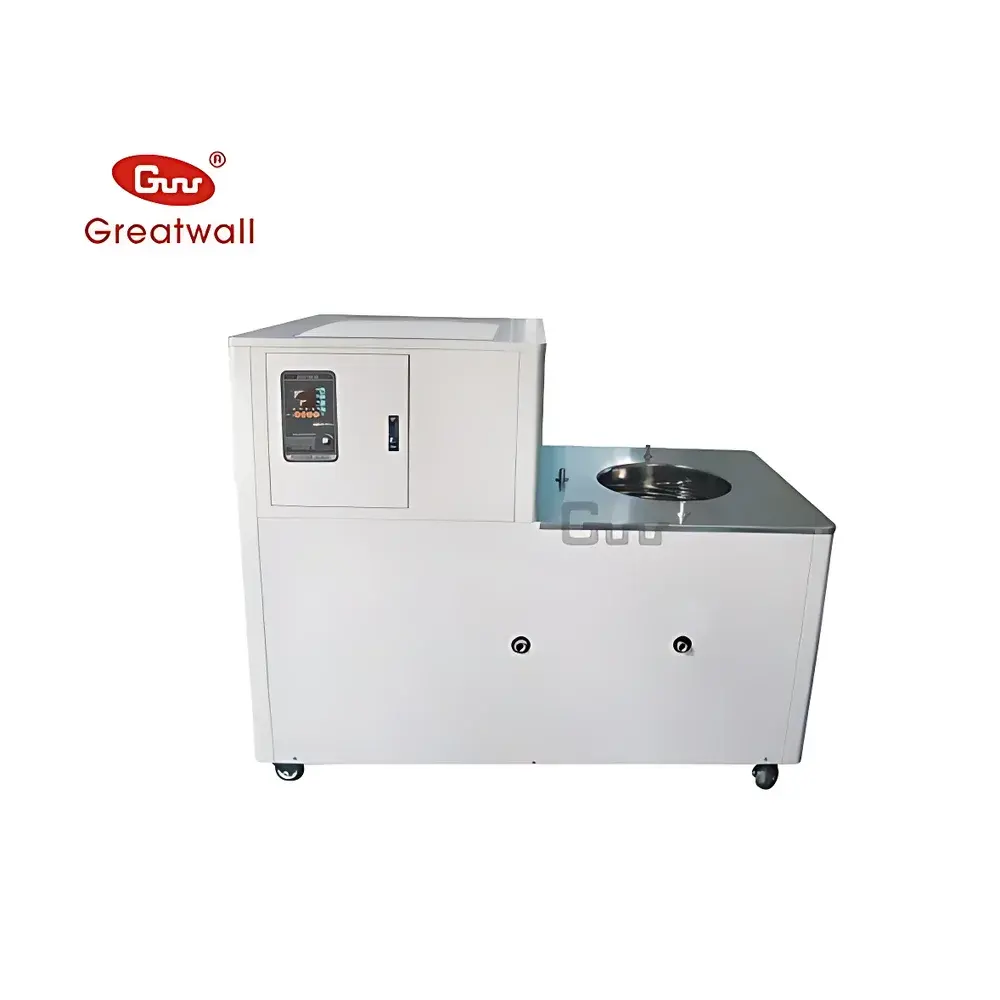
The Great Wall DHJF-1220 Cryogenic Stirred Reaction Bath
| Brand | The Great Wall |
|---|---|
| Origin | Henan, China |
| Manufacturer Type | Direct Manufacturer |
| Country of Origin | China |
| Model | DHJF-1220 |
| Price Range | USD 7,000–14,000 |
| Temperature Range | −120 °C to −60 °C |
| Ambient Operating Temperature | 5–25 °C |
| Temperature Stability | ±2 °C |
| Power Supply | 3-phase, 380 V, 50 Hz |
| Bath Volume | 20 L |
| Bath Dimensions (Ø × H) | 300 mm × 300 mm |
| Opening Diameter | 280 mm |
| Cooling Capacity | 600 W at −60 °C, 480 W at −80 °C, 180 W at −100 °C, 40 W at −120 °C |
| Max Flask Capacity | 5000 mL |
| Total Power Consumption | 3234 W |
| Housing Material | Cold-rolled steel with electrostatic epoxy coating |
| External Dimensions (L×W×H) | 1200 mm × 810 mm × 1310 mm |
| Net Weight | 190 kg |
| Circulation System | Stainless steel 304 + polymer-based corrosion-resistant components |
| Low-Temperature Operation Limitation | No active circulation below −100 °C |
Overview
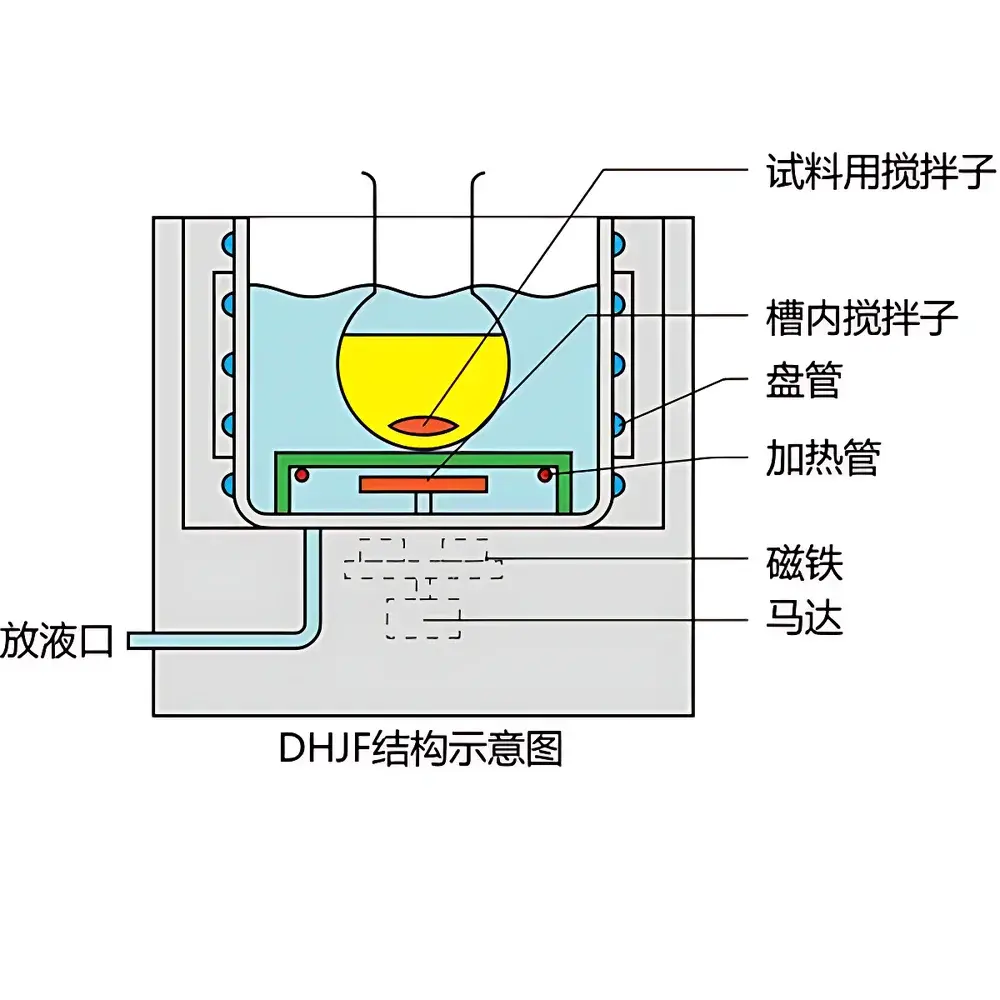
The Great Wall DHJF-1220 Cryogenic Stirred Reaction Bath is an engineered thermal management system designed for laboratory-scale low-temperature chemical synthesis, cryogenic reaction control, and material property testing under precisely regulated sub-zero conditions. It employs a single-stage compression fractional condensation refrigeration architecture—distinct from conventional cascade systems—to achieve stable operation down to −120 °C in the bath reservoir. This architecture integrates high-efficiency compressors sourced from established European and North American OEMs (Germany, France, USA), ensuring long-term mechanical reliability and consistent thermal output across extended duty cycles. Unlike standard recirculating chillers, the DHJF-1220 incorporates an integrated magnetic or mechanical stirring mechanism directly within the bath vessel, enabling simultaneous temperature control and homogeneous mixing of reaction media without external agitation hardware. Its operational envelope is constrained to ambient environments between 5 °C and 25 °C, with thermal stability maintained within ±2 °C under steady-state load—a specification validated per ISO 17025-compliant calibration protocols when used with traceable reference thermometers.
Key Features
- Single-stage fractional condensation refrigeration system optimized for deep-cryogenic performance (−120 °C minimum setpoint)
- Integrated stirring assembly (mechanical or magnetic coupling) co-located with the bath reservoir to ensure uniform thermal and kinetic conditions during exothermic/endothermic reactions
- Corrosion-resistant fluid path constructed from AISI 304 stainless steel and chemically inert polymer composites, rated for prolonged exposure to low-temperature organic solvents (e.g., liquid N₂-cooled THF, diethyl ether, pentane)
- Digital PID temperature controller with membrane keypad interface and high-contrast LED display for real-time setpoint, actual bath temperature, and system status monitoring
- Reinforced cold-rolled steel enclosure with electrostatic epoxy powder coating, providing mechanical durability and resistance to laboratory environmental stressors (humidity, incidental chemical splashes)
- No active circulation below −100 °C—thermal homogeneity maintained via passive conduction and controlled stirring; this design mitigates pump cavitation and seal degradation at extreme cryogenic thresholds
Sample Compatibility & Compliance
The DHJF-1220 accommodates standard laboratory glassware up to 5 L capacity (e.g., round-bottom flasks, jacketed reactors, cryo-reaction vessels) through its 280 mm opening diameter and 300 mm internal bath depth. Fluid compatibility includes common low-temperature heat transfer media such as ethanol, methanol, silicone oils (e.g., DC200 series), and specialized cryo-fluids meeting ASTM D1298 density specifications. The unit complies with IEC 61010-1:2010 for electrical safety in laboratory equipment and conforms to CE marking requirements for electromagnetic compatibility (EMC Directive 2014/30/EU). While not intrinsically explosion-proof, it may be operated in Class I, Division 2 hazardous locations when installed per NEC Article 500 guidelines and paired with externally certified spark-free stirrers. Documentation supports GLP audit readiness, including factory calibration certificates traceable to NIM (China National Institute of Metrology).
Software & Data Management
The DHJF-1220 operates via embedded firmware with no proprietary PC software dependency. All operational parameters—including setpoint, real-time temperature, compressor runtime, and fault codes—are logged internally with timestamping (non-volatile memory, 30-day buffer). Optional RS485 Modbus RTU or analog 4–20 mA outputs enable integration into centralized LabVantage or Siemens Desigo CCMS platforms for automated data archiving. Audit trails meet FDA 21 CFR Part 11 requirements when interfaced with validated third-party SCADA systems supporting electronic signatures and user-access hierarchies. Data export is supported via USB flash drive (FAT32 format) in CSV format, compatible with MATLAB, Python pandas, and JMP for statistical process analysis.
Applications
- Cryogenic Grignard and organolithium reagent synthesis requiring sustained −78 °C to −100 °C control
- Polymerization kinetics studies under ultra-low-temperature initiation (e.g., anionic polymerization of isoprene)
- Low-temperature crystallization screening for pharmaceutical polymorph isolation (aligned with ICH Q5A and USP <1058> analytical instrument qualification)
- Calibration of cryogenic sensors and thermocouples per ISO/IEC 17025 Clause 6.5.2
- Material embrittlement testing of aerospace alloys and composite laminates per ASTM E1820 and ISO 12737
- Superconductivity precursor synthesis where thermal ramp rates below 0.5 °C/min are critical
FAQ
Does the DHJF-1220 support external temperature feedback control loops?
Yes—via optional 4–20 mA or 0–10 V analog input, allowing closed-loop regulation using an external probe placed inside the reaction vessel.
Is the bath fluid circulation system active at −120 °C?
No. Circulation is disabled below −100 °C per design safety protocol; temperature uniformity relies on internal stirring and conductive thermal mass equilibrium.
What maintenance intervals are recommended for compressor oil and filter replacement?
Compressor oil and suction-line filter replacement is required every 6,000 operating hours or biannually—whichever occurs first—using OEM-specified polyolester (POE) lubricant and micron-rated particulate filters.
Can the unit be integrated into a nitrogen gas purged glovebox environment?
Yes, provided the external air intake and exhaust ducts are routed outside the glovebox, and all electrical penetrations comply with ISO 10648-2 leak-rate specifications.
Is remote monitoring via Ethernet or Wi-Fi supported?
Not natively; however, third-party industrial IoT gateways (e.g., Advantech ECU-1251) can be deployed to bridge Modbus RTU to MQTT/TCP/IP networks under IT security review.



