
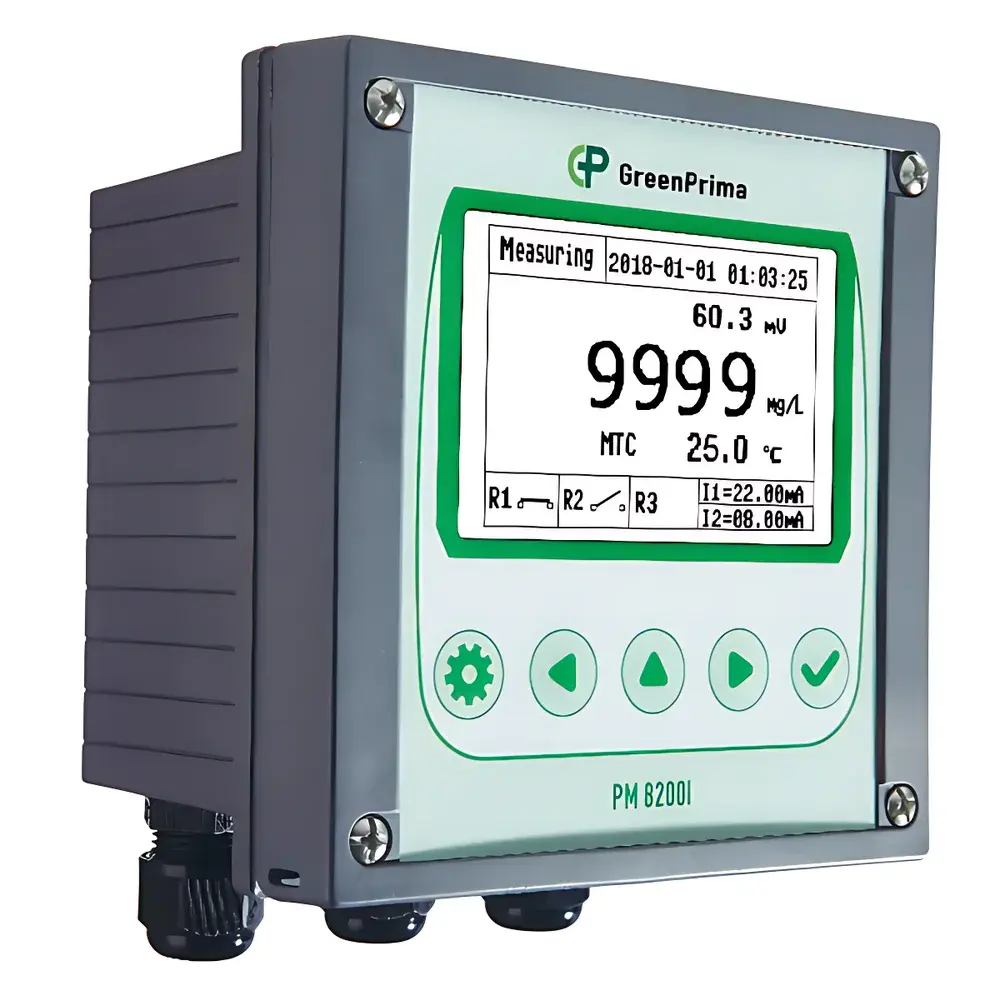
GreenPrima 8200I Online Chloride Ion Analyzer
| Brand | GreenPrima |
|---|---|
| Origin | United Kingdom |
| Manufacturer | GreenPrima Ltd. |
| Model | 8200I |
| Instrument Type | Online Ion Analyzer |
| Ion Measured | Chloride (Cl⁻) |
| Measurement Range | 0–30,000 mg/L |
| Detection Limit | 1 mg/L |
| Response Time | ≤5 seconds |
| Accuracy | ±3% of Full Scale |
| Temperature Range | 0–80 °C |
| Resolution | 0.01 mg/L |
| Sensor Material | PPS (Polyphenylsulfone) |
| Max Operating Pressure | 3.5 bar |
| Cable Length | 5 m |
| Enclosure Rating | IP65 |
| Display | Backlit Graphic LCD |
| Output | Dual Isolated 4–20 mA (≤500 Ω), RS485 Modbus RTU |
| Power Supply | 90–260 VAC, 50/60 Hz or 24 VDC optional |
| Dimensions (H×W×D) | 144 × 144 × 106 mm |
| Panel Cutout | 138 × 138 mm |
| Weight | 0.86 kg |
Overview
The GreenPrima 8200I Online Chloride Ion Analyzer is a robust, CE-marked industrial-grade sensor system engineered for continuous, real-time quantification of chloride ion (Cl⁻) concentration in aqueous streams. It operates on the principle of potentiometric measurement using a solid-state, ion-selective electrode (ISE) — specifically the Bsens720 chloride-specific sensor — which generates a stable Nernstian potential proportional to the logarithm of chloride activity in solution. Designed for deployment in demanding water quality monitoring environments, the 8200I delivers high reproducibility and long-term stability without reagent consumption. Its architecture supports direct integration into SCADA, DCS, or PLC-based control systems via standard industrial protocols, making it suitable for regulatory-compliant process monitoring in utilities, power generation, pharmaceutical manufacturing, and boiler feedwater management.
Key Features
- IP65-rated, fully sealed enclosure with corrosion-resistant PPS sensor housing — engineered for humid, chemically aggressive, and outdoor installations.
- Backlit high-contrast graphic LCD display showing real-time Cl⁻ concentration (mg/L), measured temperature (°C), relay status, and system diagnostics.
- Dual isolated 4–20 mA analog outputs configurable for chloride concentration and/or temperature — compliant with IEC 61000-6-2/4 EMC standards and calibrated to ≤0.1% FS accuracy.
- RS485 interface supporting Modbus RTU protocol (ASCII optional); HART communication available upon request for legacy system integration.
- Configurable cleaning cycle (0.1–1000 h interval; 1–1000 s duration) to mitigate fouling in suspended-solids-rich or biofilm-prone applications.
- Two independent programmable alarm relays (5 A / 250 VAC / 30 VDC) with adjustable hysteresis — suitable for triggering shutdown, dosing, or notification events.
- Temperature compensation via integrated NTC10K or PT1000 probe (manual or auto mode), covering -10 to +130 °C for accurate activity-to-concentration conversion.
Sample Compatibility & Compliance
The 8200I is validated for use in potable water, wastewater effluent, cooling tower makeup, reverse osmosis permeate, boiler feedwater, and pharmaceutical purified water (PW) and water-for-injection (WFI) distribution loops. It complies with ISO 10523 (water quality — determination of pH), ASTM D6508 (standard test method for determination of anions in water by ion chromatography — referenced for validation context), and supports GLP/GMP data integrity requirements through password-protected configuration (calibration code: 1100; setup code: 1200). The system meets EN 61326-1 for electrical equipment used in measurement, control, and laboratory applications, and its sensor design adheres to ISO 7888 for conductivity-based ion measurement principles where applicable.
Software & Data Management
No proprietary PC software is required for basic operation; all configuration, calibration, and diagnostics are performed locally via the front-panel interface with intuitive multilevel menu navigation (English/Chinese selectable). For centralized fleet management, the device supports Modbus register mapping for seamless ingestion into Historian platforms (e.g., OSIsoft PI, Inductive Automation Ignition) or cloud-based IIoT dashboards. Audit trails — including calibration timestamps, parameter changes, and alarm events — are retained in non-volatile memory and accessible via Modbus read commands. While native FDA 21 CFR Part 11 electronic signature functionality is not embedded, the system is compatible with third-party validation packages that enforce user authentication, change control, and electronic record retention when deployed under GxP frameworks.
Applications
- Chloride monitoring in municipal drinking water treatment plants to ensure compliance with WHO and EU Drinking Water Directive limits (250 mg/L).
- Real-time detection of seawater ingress or de-icing salt contamination in groundwater and surface water intakes.
- Corrosion control in thermal power plant condensate and boiler feedwater systems — early warning of chloride-induced stress corrosion cracking (SCC).
- In-process verification of chloride removal efficiency in ion exchange resin beds and electrodialysis reversal (EDR) units.
- Final rinse water quality assurance in pharmaceutical clean-in-place (CIP) cycles per USP and EP 2.2.38.
- Effluent compliance reporting for industrial dischargers subject to local environmental permits (e.g., UK EA, US EPA NPDES).
FAQ
What calibration standards are recommended for the Bsens720 chloride sensor?
Standard solutions traceable to NIST-certified reference materials: 10 mg/L, 100 mg/L, and 1000 mg/L NaCl in deionized water (pH 6–8, conductivity <10 µS/cm). Calibration frequency depends on application severity — typically every 7–30 days in stable systems; daily in high-fouling or variable-pH environments.
Can the 8200I measure chloride in high-turbidity or oily water?
Yes — provided the Bsens720 sensor is installed with appropriate mechanical prefiltration (e.g., 50 µm wedge-wire strainer) and periodic automated cleaning. Oil films may attenuate response; we recommend inline coalescer filtration for hydrocarbon-laden streams.
Is temperature compensation mandatory for accurate chloride readings?
Yes. The Nernst equation governing ISE output is inherently temperature-dependent. The 8200I applies automatic temperature compensation (ATC) using either built-in or external RTD input; uncorrected measurements at varying temperatures introduce systematic bias exceeding ±5% FS.
Does the system support remote firmware updates?
No — firmware updates require physical access and use of a dedicated USB-to-serial adapter and GreenPrima’s authorized configuration utility. This design prioritizes operational security and regulatory auditability in critical infrastructure.
What maintenance intervals are specified for the Bsens720 sensor?
Electrode membrane replacement is recommended every 12–18 months under continuous operation. Electrolyte replenishment (if applicable) and reference junction inspection should occur quarterly. Full sensor recalibration is advised after any membrane replacement or exposure to extreme pH (12) or oxidants (e.g., chlorine >2 ppm).







