
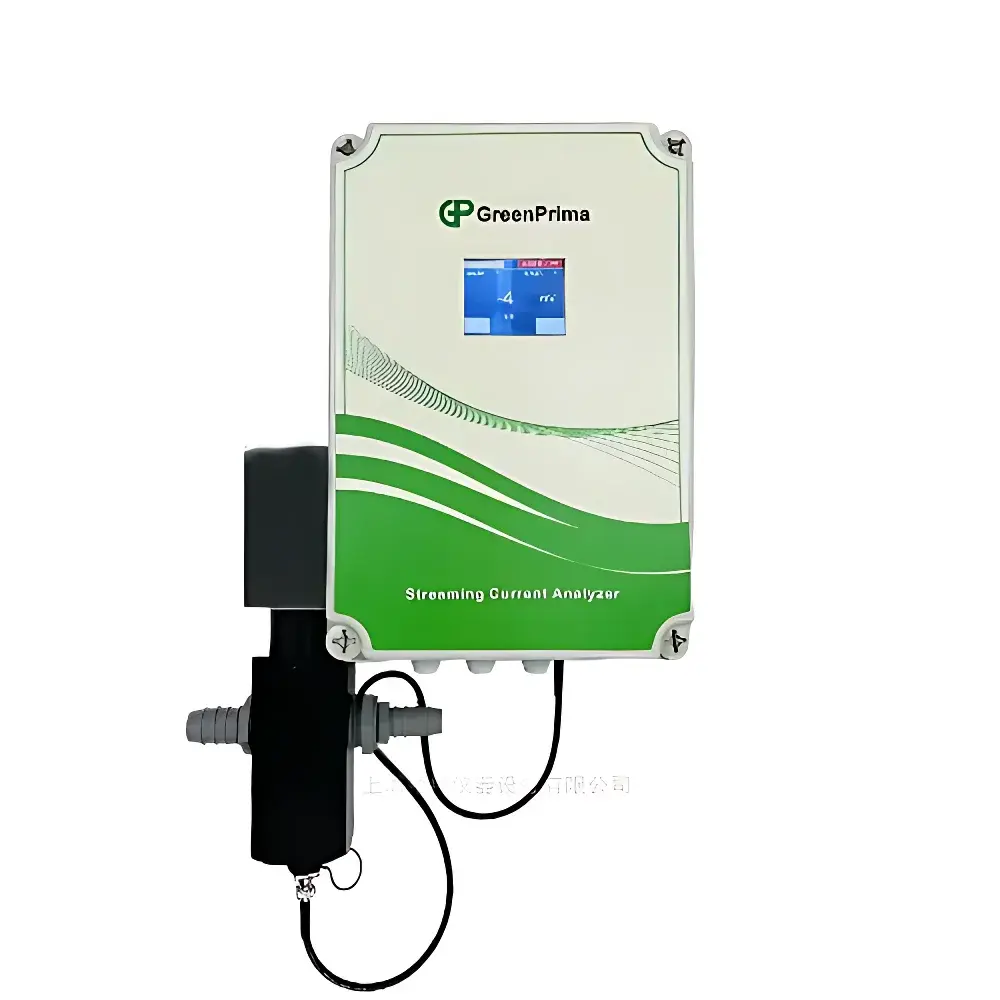
GreenPrima Aqualysis200SCD Streaming Current Detector
| Brand | GreenPrima |
|---|---|
| Origin | United Kingdom |
| Manufacturer Type | Original Equipment Manufacturer (OEM) |
| Product Category | Imported Instrument |
| Model | Aqualysis200SCD |
| Instrument Type | Online Water Quality Analyzer |
| Measured Parameter | Streaming Current |
| Measurement Range | −1000 to +1000 mV |
| Accuracy | ±0.1% of full scale |
| Display | LED |
| Flow Rate | 1 L/min |
| Inlet/Outlet Connections | 1/2″ inlet, 3/4″ outlet |
| Response Time | 1 second |
| Auto-zero Calibration | Yes |
| Sensor Materials | Delrin housing, 316 stainless steel wetted parts, PTFE seals |
| Output Signals | 4–20 mA, −10 to +10 V, 0–10 V |
| Communication Protocol | MODBUS RTU (optional) |
| Alarm Outputs | High/Low relay contacts |
| Enclosure Rating | IP65 |
| Dimensions | 230 × 330 mm (W × H) |
| Power Supply | 100–240 VAC, 50/60 Hz |
| Weight | 8 kg |
Overview
The GreenPrima Aqualysis200SCD Streaming Current Detector is an industrial-grade online analyzer engineered for real-time measurement of streaming current—a direct electrophoretic indicator of colloidal charge stability in aqueous suspensions. Based on the principle of electrokinetic flow potential, the instrument applies controlled mechanical shear to a continuous water sample stream via a reciprocating piston within a precision-machined sensor cell. This action disrupts the electrical double layer surrounding suspended colloids and fine particulates, liberating counter-ions that migrate under hydrodynamic stress and generate a measurable alternating current across embedded electrodes. Unlike indirect proxies such as turbidity or zeta potential inferred from light scattering, streaming current provides a process-relevant, linear correlate to coagulant demand—enabling precise, feedback-driven dosing control in dynamic water and wastewater treatment systems.
Key Features
- Real-time streaming current measurement with 1-second response time for closed-loop coagulant dosing control
- Integrated auto-zero calibration routine eliminating manual drift correction and reducing maintenance intervals
- Robust sensor architecture featuring Delrin body, 316 stainless steel fluid-contact surfaces, and chemically resistant PTFE seals for long-term stability in aggressive municipal and industrial effluents
- Triple analog output options (4–20 mA, ±10 V, 0–10 V) plus optional MODBUS RTU serial communication for seamless integration into PLC-based SCADA environments
- IP65-rated enclosure suitable for wall- or panel-mount installation in wet, corrosive plant environments
- Dual high/low relay alarm outputs configurable for over-dose, under-dose, or sensor fault conditions per operational protocols
Sample Compatibility & Compliance
The Aqualysis200SCD is validated for continuous operation in raw surface water, clarified effluent, tertiary filtrate, and anaerobic digester supernatant—covering typical conductivity ranges from 50 to 2,000 µS/cm and suspended solids concentrations up to 500 mg/L. Its measurement principle remains insensitive to color, turbidity, or organic interference, making it uniquely suited for applications where optical methods fail. The device complies with IEC 61326-1 (EMC for industrial environments), meets CE marking requirements, and supports audit-ready data logging when interfaced with compliant DCS systems. While not certified for direct regulatory reporting under EPA Method 100.1 or ISO 10707, its output is widely accepted by utilities as a primary control variable aligned with GLP-aligned process validation frameworks.
Software & Data Management
The Aqualysis200SCD operates as a standalone field instrument with local LED display and does not require proprietary software for basic operation. However, when connected via MODBUS RTU to a central historian or asset management platform (e.g., Siemens Desigo, Honeywell Experion, or Schneider EcoStruxure), it delivers timestamped streaming current values, diagnostic status flags (e.g., flow fault, electrode contamination warning), and relay state logs at user-defined intervals. All analog outputs are factory-calibrated traceable to NIST-traceable reference standards. For facilities operating under FDA 21 CFR Part 11 or EU Annex 11 requirements, third-party data acquisition systems may be configured to enforce electronic signature, audit trail, and role-based access controls around setpoint adjustments and calibration events.
Applications
- Optimization of ferric chloride, aluminum sulfate, or polyaluminum chloride (PACl) dosing in potable water rapid mix basins
- Dynamic coagulant control during seasonal changes in raw water quality (e.g., increased NOM or algal load)
- Sludge conditioning monitoring prior to centrifuge or belt-press dewatering to maximize dry solids content
- Feedback control of polymer addition in tertiary filtration backwash recovery loops
- Process validation support for ISO 22000 or HACCP-compliant food processing wastewater lines
- Research-grade charge characterization in pilot-scale membrane pretreatment studies
FAQ
How does streaming current differ from zeta potential?
Streaming current reflects bulk colloidal charge imbalance under shear and correlates directly with coagulant dosage requirements; zeta potential is a calculated surface potential estimate derived from electrophoretic mobility and requires dilution or particle suspension assumptions—not suitable for online use.
Can the Aqualysis200SCD be installed in pressurized pipelines?
Yes—when used with an external pressure-regulated sidestream loop (recommended flow pressure ≤ 3 bar), the unit maintains accuracy without requiring inline tapping or process interruption.
What maintenance is required beyond zero calibration?
Annual inspection of piston seal integrity and electrode surface cleanliness; no consumables or reagents are needed—sensor cleaning is performed manually using mild citric acid solution per manufacturer guidelines.
Is temperature compensation applied automatically?
No—streaming current is inherently temperature-stable across typical water treatment ranges (5–40°C); the instrument does not incorporate thermal correction, preserving signal fidelity and eliminating compensation-induced lag.
Related Products







