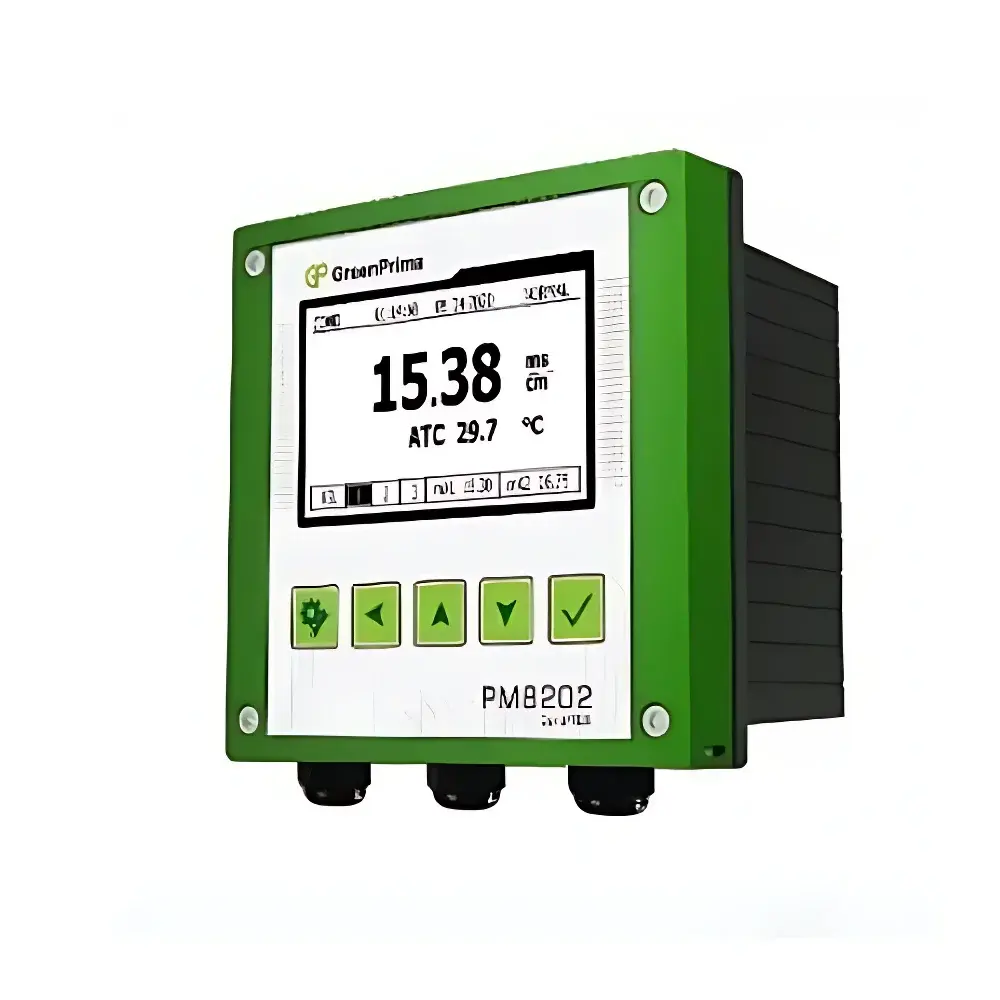
GreenPrima PM 8202C Online Conductivity Analyzer for Ultrapure Water Monitoring
| Brand | GreenPrima |
|---|---|
| Origin | United Kingdom |
| Manufacturer Type | OEM Manufacturer |
| Product Category | Imported Industrial Online Conductivity Analyzer |
| Model | PM 8202C |
| Conductivity Range | 0.00–2000 mS/cm |
| Salinity Range | 0.00–78.00 ppt |
| TDS Range | 0–120,000 ppm |
| Conductivity Resolution | 0.01 µS/cm (at low range) / 0.1 mS/cm (at high range) |
| Salinity Resolution | 0.01 ppt |
| TDS Resolution | 1 ppm |
| Temperature Compensation | Automatic or Manual (NTC30k / PT1000), -10 to 130 °C |
| Operating Temperature | -10 to 70 °C |
| Storage Temperature | -20 to 70 °C |
| Display | Backlit Graphic LCD |
| Language | English & Chinese |
| Data Logging Capacity | 600,000 records |
| Power Supply | 90–260 VAC, 50/60 Hz or 24 VDC (optional) |
| Output | Dual isolated 4–20 mA (≤500 Ω, accuracy ±0.1% F.S.), configurable for conductivity or temperature |
| Communication | RS485 Modbus RTU (standard), HART (optional) |
| Relay Outputs | 2 independent programmable Hi/Lo alarms (5 A / 250 VAC / 30 VDC) |
| Cleaning Control Output | Adjustable interval (0.1–1000 h) and duration (1–1000 s) |
| Enclosure Rating | IP65 |
| Dimensions | 144 × 144 × 108 mm |
| Panel Cutout | 138 × 138 mm |
| Weight | 0.87 kg |
Overview
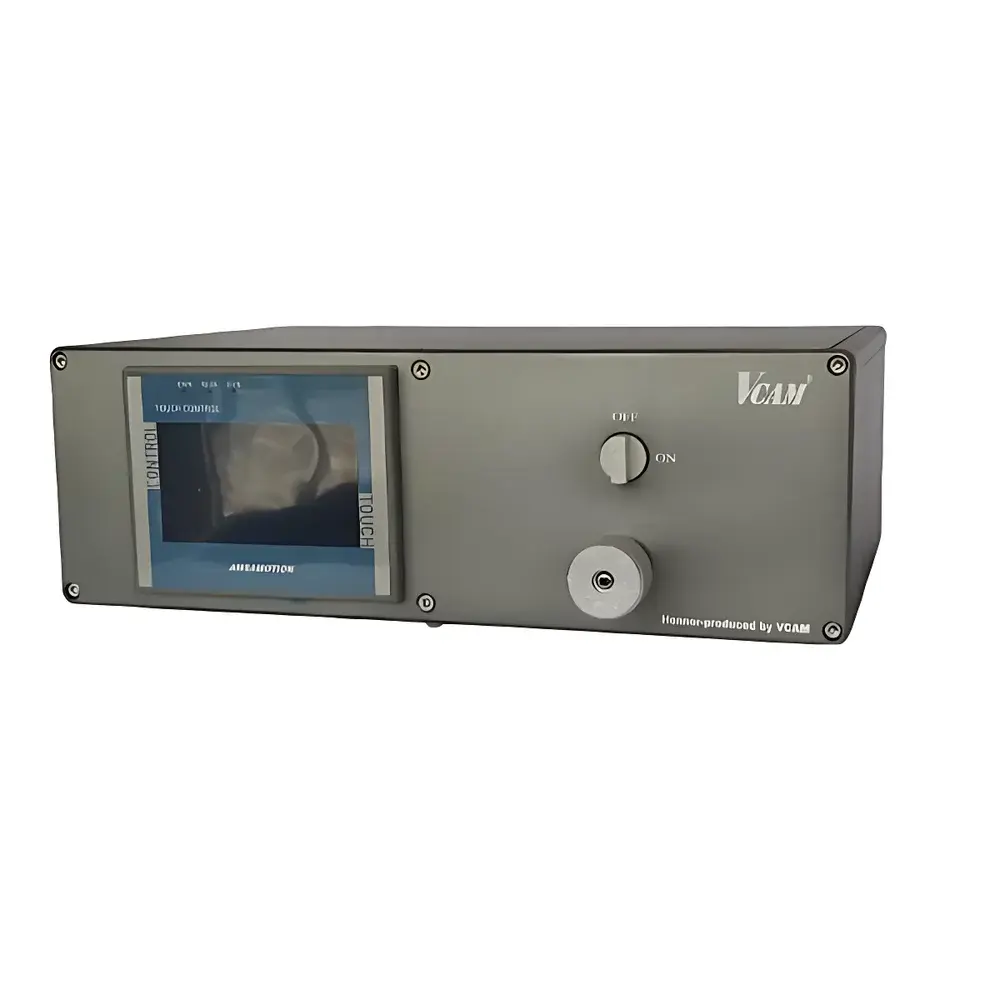
The GreenPrima PM 8202C Online Conductivity Analyzer is a purpose-engineered industrial instrument designed for continuous, high-stability monitoring of electrical conductivity in ultrapure water (UPW) and critical process streams across semiconductor fabrication, pharmaceutical water-for-injection (WFI) systems, power plant boiler feedwater, and laboratory-grade purified water loops. It operates on the principle of two-electrode or four-electrode conductometric measurement—where an alternating current is applied across a sensor cell, and the resulting voltage drop is used to calculate solution conductivity according to Ohm’s law and cell constant calibration. Its dual-range architecture supports seamless transition from sub-µS/cm ultrapure water applications (e.g., 0.01–10 µS/cm) up to aggressive industrial effluent monitoring (up to 2000 mS/cm), eliminating the need for multiple instruments across divergent process stages. The analyzer integrates temperature-compensated conductivity (TCC) algorithms compliant with ASTM D1125 and ISO 7888 standards, ensuring traceable, reproducible measurements under dynamic thermal conditions.
Key Features
- True dual-mode operation: automatic range switching between low-conductivity (ultrapure water) and high-conductivity (process brine, cooling water) modes without manual intervention
- Configurable sensor interface supporting two-electrode, four-electrode, and toroidal (inductive) conductivity sensors—enabling optimal selection for fouling-prone, high-salinity, or ultra-low-conductivity environments
- Backlit graphic LCD with intuitive English/Chinese bilingual menu navigation and password-protected configuration access (three-tier user privilege levels)
- Dual isolated 4–20 mA analog outputs—each independently assignable to conductivity, salinity, TDS, or temperature—with full span and zero adjustment and NIST-traceable linearity (±0.1% F.S.)
- RS485 Modbus RTU serial interface as standard; optional HART 7 protocol support for integration into legacy DCS/SCADA systems requiring analog-plus-digital redundancy
- Programmable relay module with two SPDT outputs for alarm actuation, pump control, or valve triggering—configurable with adjustable hysteresis and fail-safe logic
- Onboard data logger storing up to 600,000 timestamped records (conductivity, temperature, TDS, salinity, system status) with cyclic overwrite and USB export capability
Sample Compatibility & Compliance
The PM 8202C is validated for use with deionized water, reverse osmosis permeate, distilled water, WFI, pure steam condensate, and low-ionic-strength process solvents. Its measurement architecture meets ISO 9001-certified manufacturing requirements and supports regulatory compliance frameworks including FDA 21 CFR Part 11 (with optional audit trail firmware), EU GMP Annex 11 (for electronic records integrity), and USP for purified water conductivity testing. Sensor compatibility includes sanitary tri-clamp, NPT-threaded, and immersion-style configurations rated to IP68. The analyzer itself carries CE, RoHS, and UKCA markings, and its enclosure meets IP65 ingress protection for wall-mounted or panel-integrated deployment in humid or washdown environments.
Software & Data Management
Configuration and diagnostics are managed via the embedded web interface (HTTP/HTTPS) or GreenPrima’s PC-based ConfiTool™ software (Windows/macOS), enabling remote parameter setup, calibration history review, and real-time trend visualization. All configuration changes are logged with user ID, timestamp, and pre-/post-value snapshots—fulfilling ALCOA+ data integrity principles. Data export supports CSV and XML formats compatible with LIMS, MES, and historian platforms (e.g., OSIsoft PI, Ignition SCADA). Optional firmware upgrades provide enhanced cybersecurity features: TLS 1.2 encryption, role-based API access control, and secure boot verification.
Applications
- Real-time UPW quality assurance in semiconductor fab ultrapure water distribution loops (ASTM F631-compliant monitoring)
- In-line verification of conductivity excursions during pharmaceutical purified water (PW) and WFI generation per USP Stage 1–3 testing protocols
- Boiler feedwater purity surveillance in thermal power plants to prevent scaling and corrosion
- Continuous salinity and TDS tracking in desalination plant product water and brine concentration streams
- Leak detection in double-containment piping systems via conductivity spike analysis
- Process validation support for cleaning-in-place (CIP) rinse cycle endpoint determination
FAQ
Does the PM 8202C support automatic temperature compensation using both NTC30k and PT1000 sensors?
Yes—it auto-detects and configures for either NTC30k (standard) or PT1000 (optional) temperature probes, with compensation algorithms aligned to IEC 60746-3 and DIN EN 27888.
Can the device store calibration history and generate reports for audit purposes?
Yes—each calibration event (zero, span, cell constant) is permanently recorded with operator ID, date/time, reference values, and deviation metrics; reports are exportable in PDF or CSV.
Is the 4–20 mA output intrinsically safe for hazardous area installation?
The standard output is non-IS; however, an ATEX/IECEx-certified version with galvanically isolated barriers (Zone 1/21) is available upon request.
What is the minimum detectable conductivity in ultrapure water mode?
At 25 °C, the effective resolution is 0.01 µS/cm in the 0.00–10.00 µS/cm range, with repeatability better than ±0.5% of reading under stable flow and temperature conditions.
How frequently does the unit require recalibration in continuous UPW monitoring?
Under GMP-compliant operation, quarterly verification against NIST-traceable KCl standards is recommended; drift typically remains within ±0.3% F.S. over six months with proper sensor maintenance.