
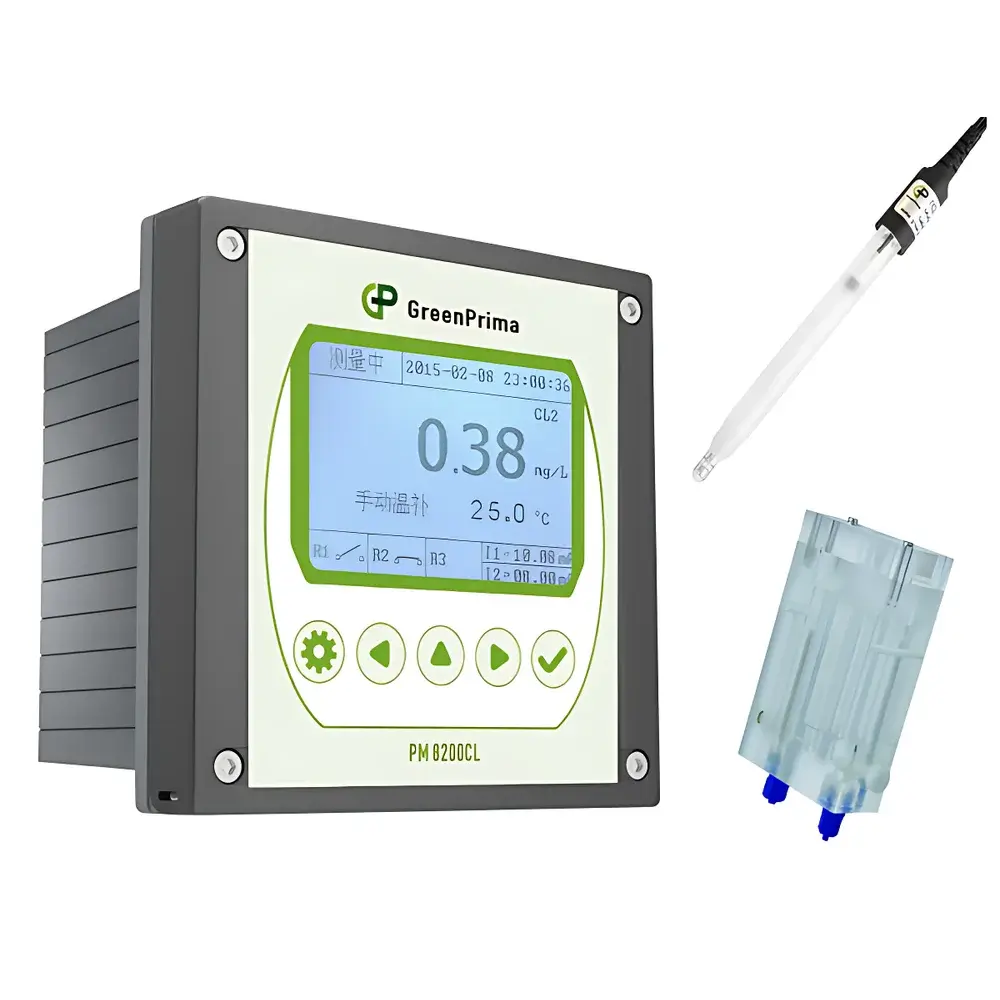
GreenPrima PM8200CL Online Residual Chlorine, Chlorine Dioxide and Ozone Analyzer
| Brand | GreenPrima |
|---|---|
| Origin | UK |
| Manufacturer Type | Original Equipment Manufacturer (OEM) |
| Product Category | Imported Instrument |
| Model | PM8200CL |
| Instrument Type | Online Analyzer |
| Measurement Principle | Amperometric Electrochemical Sensor (Constant Potential Method) |
| Measured Parameters | Free Chlorine, Total Chlorine, Chlorine Dioxide, Ozone |
| Range | 0–2.000 ppm / 0–20.00 ppm (dual-range auto-switching) |
| Accuracy | ±0.001 ppm / ±0.01 ppm (depending on range) |
| Repeatability | ±0.001 ppm / ±0.01 ppm |
| Resolution | 0.001 ppm / 0.01 ppm |
| Detection Limit | 0.001 ppm / 0.01 ppm |
| Temperature Compensation | -10 to 130 °C (NTC10k or PT1000 selectable, manual/automatic) |
| Operating Temperature | 0 to 70.0 °C |
| Storage Temperature | -20 to 70.0 °C |
| Display | Backlit graphical LCD |
| Language | English & Chinese menu |
| Data Storage | 600,000 records |
| Power Supply | 90–260 VAC, 50/60 Hz or optional 24 VDC |
| Enclosure Rating | IP65 |
| Communication | RS485, MODBUS-RTU compliant |
| Analog Outputs | Two isolated 4–20 mA outputs (max. loop resistance 500 Ω, accuracy ±0.1% FS) |
| Cleaning Control | Programmable cleaning interval (0.1–1000 h) and duration (1–1000 s) |
| Mounting Options | Wall-mount, pole-mount, panel-mount |
| Dimensions (H×W×D) | 144 × 144 × 106 mm |
| Panel Cutout | 138 × 138 mm |
| Weight | 0.86 kg |
| Sensor Model | Bsens650 |
| Sensor Electrode Material | Glass body with dual-platinum ring working electrode |
| Max. Pressure Rating | 5 bar |
| Cable Length | 3 m |
| Sensor Operating Temp. | 0–70.0 °C |
| Sensor Accuracy | ±2% FS |
Overview
The GreenPrima PM8200CL is a fully integrated online analyzer engineered for continuous, real-time monitoring of free chlorine, total chlorine, chlorine dioxide, and ozone in potable water distribution systems, municipal drinking water treatment plants, pharmaceutical process water loops, swimming pool sanitation systems, and wastewater disinfection processes. It operates on the amperometric electrochemical principle—specifically the constant-potential (galvanic) method—where a stable polarization voltage is applied between a working electrode (dual-platinum ring) and a reference electrode. Target oxidants undergo selective electrochemical reduction at this fixed potential, generating a diffusion-controlled current proportional to their concentration. This approach eliminates reliance on colorimetric reagents, optical path integrity, or membrane-based electrolyte replenishment—offering inherent stability, low maintenance, and high long-term reproducibility under variable flow and temperature conditions.
Key Features
- True multi-analyte capability: Simultaneous or configurable measurement of residual chlorine (free/total), ClO₂, and O₃ using a single sensor platform (Bsens650) and unified controller architecture.
- Zero-reagent operation: No chemical dosing, no consumable membranes, no liquid electrolyte refills—reducing operational cost and eliminating calibration drift associated with reagent degradation.
- Dual-range auto-scaling: Seamlessly switches between 0–2.000 ppm (high-resolution mode) and 0–20.00 ppm (broad-range mode), ensuring optimal signal-to-noise ratio across diverse application scenarios—from finished drinking water (5 ppm).
- Robust temperature compensation: Integrated NTC10k or PT1000 probe support with programmable compensation algorithms compliant with ISO 7888 and ASTM D1253 standards for residual oxidant measurement.
- Industrial-grade communications: Dual isolated 4–20 mA analog outputs (fully configurable per parameter) and RS485 interface supporting MODBUS-RTU protocol for seamless integration into SCADA, DCS, or PLC-based water management systems.
- Intelligent maintenance scheduling: Programmable automatic cleaning cycles (interval: 0.1–1000 hours; duration: 1–1000 seconds) to mitigate biofilm accumulation and particulate fouling without manual intervention.
- Flexible deployment: IP65-rated enclosure supports wall-mount, pole-mount, and panel-mount configurations; compact 144 mm square form factor enables retrofit installation in space-constrained control rooms or inline sampling cabinets.
Sample Compatibility & Compliance
The PM8200CL is validated for use with clarified, filtered, and disinfected aqueous streams meeting typical municipal and industrial water quality specifications (turbidity <5 NTU, suspended solids <10 mg/L, pH 4.0–8.5). It complies with key regulatory frameworks governing water safety and instrument validation, including EPA Method 334.0 (amperometric chlorine detection), ISO 7393-2 (electrochemical determination of free chlorine), and EN ISO 20647 (chlorine dioxide in drinking water). When deployed in GMP-regulated environments (e.g., pharmaceutical purified water systems), the device supports audit-ready data logging (600,000 timestamped records), user-access controls, and optional 21 CFR Part 11-compliant software extensions for electronic signature and change tracking.
Software & Data Management
Data acquisition and system configuration are managed via an embedded firmware interface accessible through the front-panel LCD or remote terminal. All measurements—including raw current signals, compensated concentration values, temperature readings, and diagnostic flags—are time-stamped and stored locally with millisecond precision. Export is supported via USB or MODBUS polling to external historian databases (e.g., Ignition, Siemens Desigo, or OSIsoft PI). Optional GreenPrima Insight™ desktop software provides trend visualization, alarm threshold management (high/low, rate-of-change), calibration history archiving, and PDF report generation aligned with GLP documentation requirements.
Applications
- Municipal drinking water treatment: Real-time monitoring at clearwell outlets, booster station inlets, and distribution network endpoints to ensure regulatory compliance with WHO and local residual disinfectant mandates (e.g., US EPA minimum 0.2 ppm free chlorine).
- Hospital and healthcare facility water systems: Continuous surveillance of hot water recirculation loops to prevent Legionella proliferation while maintaining safe biocide levels.
- Pharmaceutical purified water (PW) and water-for-injection (WFI) distribution: Validation-grade measurement for chlorine removal verification post-carbon filtration and pre-membrane polishing stages.
- Recreational water facilities: Automated feedback control of chlorine dioxide dosing in indoor swimming pools and spas, minimizing THM formation and user irritation.
- Wastewater reuse applications: Monitoring of ozone residual post-tertiary disinfection to confirm pathogen inactivation efficacy prior to environmental discharge or irrigation reuse.
- Chemical feed system integration: Closed-loop control input for chlorine, ClO₂, or ozone generators via 4–20 mA setpoint modulation.
FAQ
Does the PM8200CL require daily calibration?
No. The Bsens650 sensor exhibits excellent zero stability and minimal drift due to its solid-state electrode design and constant-potential operation. Field verification using NIST-traceable standard solutions is recommended every 30–90 days depending on water matrix complexity.
Can the same sensor measure chlorine, chlorine dioxide, and ozone interchangeably?
Yes—via software-selectable measurement modes. Each oxidant has a distinct reduction potential; the controller applies the appropriate polarization voltage and applies analyte-specific calibration coefficients stored in non-volatile memory.
Is the system compatible with existing SCADA infrastructure?
Yes. RS485 communication with MODBUS-RTU protocol ensures plug-and-play interoperability with major industrial automation platforms, including Rockwell Automation, Schneider Electric EcoStruxure, and Honeywell Experion.
What maintenance does the BAF615 flow cell require?
The BAF615 is a passive, no-moving-parts flow-through chamber designed for laminar, bubble-free sample presentation. Periodic visual inspection and gentle mechanical cleaning with deionized water are sufficient; no gasket replacement or internal recalibration is needed.
How is temperature compensation implemented?
Compensation uses either built-in NTC10k thermistor or external PT1000 probe input. Algorithms follow the Arrhenius-type temperature dependence defined in ISO 7393-2, dynamically adjusting sensitivity across the full operating range (-10 to 130 °C).







