
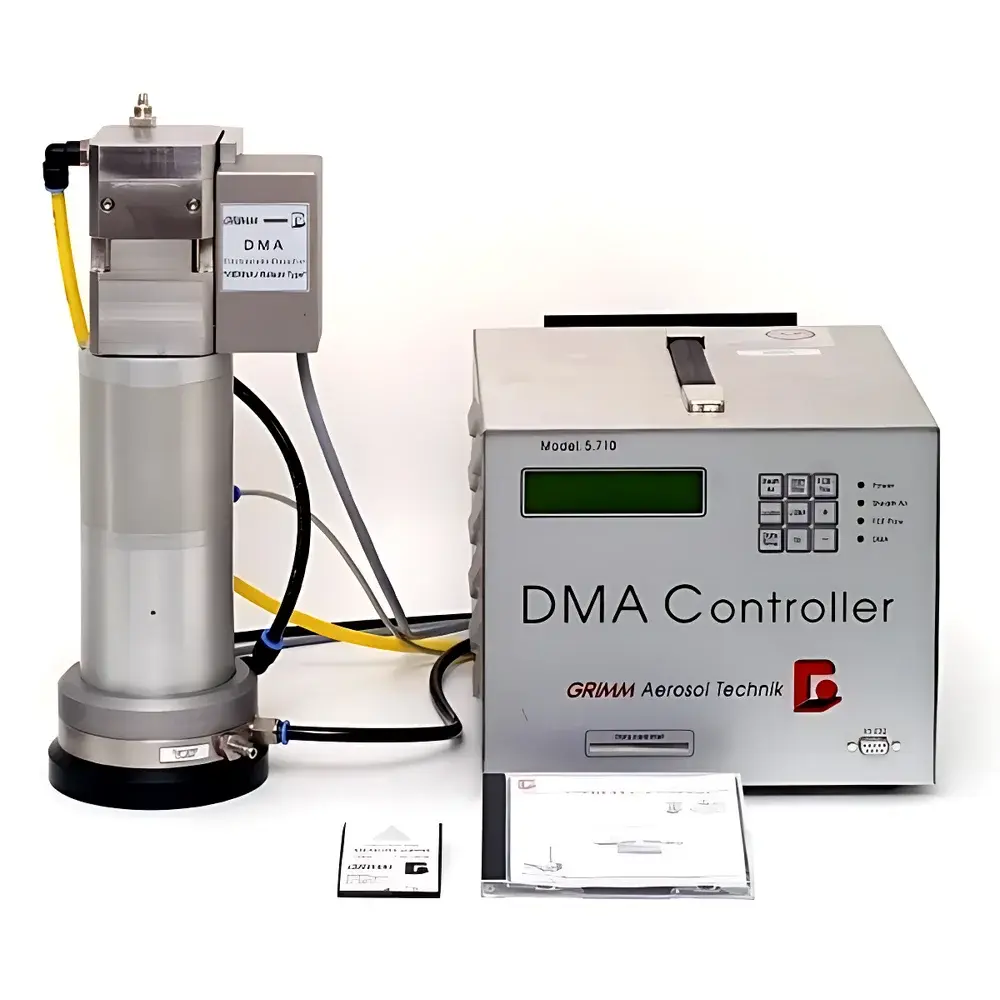
GRIMM SMPS+E Scanning Mobility Particle Sizer
| Brand | GRIMM |
|---|---|
| Origin | Germany |
| Model | SMPS+E |
| Principle | Scanning Mobility Particle Sizing (SMPS) |
| Sample Flow Rate | 1–5 L/min |
| Particle Size Range | 0.8 nm – 1100 nm |
| Number Concentration Range | 1–3,000,000 particles/L |
| Size Channels | 255 |
| Particle Mass Concentration Range | up to ~10⁸ particles/cm³ |
| Sheath Flow Rate | 3–20 L/min |
| Maximum Scan Frequency | 16 Hz |
| FCE Response Time (T₉₀) | 200 ms |
| FCE Sensitivity | 0.1 fA at 1 Hz |
| FCE Noise Level | 0.35 fA (τ = 0.25 s, 90% confidence) |
| DMA Voltage Range | 5–10,000 V |
| Operating Pressure Range | 400–1100 mbar |
| Power Supply | 230 VAC / 120 VAC, 50–60 Hz or 12 VDC ±10% |
| Compliance | ISO 15900:2020 (Determination of particle size distribution by electrical mobility analysis) |
Overview
The GRIMM SMPS+E Scanning Mobility Particle Sizer is a high-precision, laboratory-grade aerosol sizing system engineered for quantitative measurement of nanoparticle size distributions in the critical range of 0.8 nm to 1100 nm. It operates on the principle of scanning electrical mobility analysis—a technique standardized under ISO 15900:2020—where charged aerosol particles are classified by their electrical mobility ratio (Zp = n·e / 3πηdp) in a differential mobility analyzer (DMA), and subsequently counted with sub-femtoampere sensitivity using a Faraday Cup Electrometer (FCE). The system integrates a Vienna-type DMA design optimized for minimal diffusion losses and maximal resolution at sub-3 nm diameters, paired with an actively flushed, vibration-damped FCE that serves as both a primary detector and a metrological reference for condensation particle counters (CPCs). Unlike optical or inertial methods, SMPS+E delivers traceable, charge-state-resolved number-based size distributions without assumptions about particle refractive index or density—making it indispensable for fundamental aerosol science, nanomaterial synthesis validation, and regulatory reference measurements.
Key Features
- Three interchangeable DMA configurations (S-DMA, M-DMA, L-DMA) enabling seamless coverage across the full 0.8 nm–1100 nm range with optimized resolution per sub-range
- Vacuum-compatible, electrostatically neutralized sampling path incorporating a dielectric barrier discharge (DBD) neutralizer compliant with Boltzmann equilibrium charging standards
- U-shaped top inlet and laminar flow conditioner minimizing particle deposition losses during transport into the DMA classification zone
- FCE with integrated purge gas flow (0.3–0.6 L/min) preventing surface contamination and ensuring long-term signal stability under variable pressure and humidity conditions
- DMA high-voltage module (5–10,000 V) with active feedback control, coupled to real-time pressure and temperature compensation algorithms
- Full automation via embedded DMA controller supporting programmable scan protocols, auto-zeroing, and hardware-level diagnostics including thermal limit switch monitoring and differential pressure sensing across critical orifices
- Compact, maintenance-free architecture—no consumables, no moving parts, no optical components requiring alignment or recalibration
Sample Compatibility & Compliance
The SMPS+E accepts aerosols carried in dry, filtered air or inert gases (N₂, Ar) and is compatible with both ambient atmospheric sampling and controlled process streams (e.g., reactor exhausts, cleanroom effluents, combustion ducts). Its robust mechanical design tolerates operating pressures from 400 to 1100 mbar and relative humidity up to 95% non-condensing—enabling field-deployable operation when paired with appropriate inlet conditioning (e.g., Nafion dryers, cyclone pre-separators). All core algorithms—including mobility-to-diameter inversion, charge distribution deconvolution, and multi-modal fitting—are derived from peer-reviewed implementations developed by Prof. Reischl (University of Vienna) and fully aligned with ISO 15900:2020 Annex B. The system supports audit-ready data logging with timestamped metadata (flow rates, voltage ramps, environmental sensors), satisfying GLP and GMP documentation requirements where instrument qualification and traceability are mandated.
Software & Data Management
GRIMM’s proprietary SMPS Control Software provides real-time visualization of number, surface area, and volume-weighted size distributions, alongside statistical metrics (geometric mean diameter, standard deviation, modal counts). Raw mobility scans are stored in ASCII-compatible format with full parameter annotation (sheath/sample flow setpoints, ramp duration, voltage steps, FCE gain settings), enabling third-party post-processing in MATLAB, Python (PySMPS), or R. The software implements ISO 15900-compliant inversion routines and supports batch processing of time-series datasets for diurnal or process-monitoring studies. Optional analog inputs accommodate meteorological or gas-phase sensor integration (e.g., CO, NOx, RH/T), while RS-232 and PCMCIA SRAM (4 MB) interfaces ensure compatibility with legacy DAQ systems and offline deployment scenarios. All firmware updates and calibration constants are digitally signed and version-controlled to support FDA 21 CFR Part 11 compliance when configured with user access controls and electronic signature modules.
Applications
- Primary aerosol research: nucleation, coagulation, and growth kinetics in atmospheric simulation chambers
- Cloud condensation nuclei (CCN) activation studies requiring accurate sub-10 nm size-resolved number concentrations
- In-process monitoring of nanoparticle synthesis (e.g., flame spray pyrolysis, laser ablation, chemical vapor condensation)
- Combustion aerosol characterization in engine test cells and biomass burners
- Validation and calibration of CPCs, optical particle counters (OPCs), and aerodynamic particle sizers (APS)
- Occupational hygiene assessments in semiconductor fabrication, pharmaceutical powder handling, and battery material production
- Regulatory reference measurements supporting EU REACH, US EPA Method PS-1, and ISO/TC 229 nanomaterial characterization guidelines
FAQ
What distinguishes the GRIMM SMPS+E from conventional optical particle sizers?
Unlike light-scattering instruments, SMPS+E measures particle size based on electrical mobility—providing absolute, charge-resolved size distributions independent of optical properties, morphology, or refractive index assumptions.
Can the SMPS+E operate unattended for extended periods?
Yes—the system includes automated self-diagnostics, scheduled zero checks, and non-volatile memory for scan parameters and calibration history, supporting multi-day autonomous operation in fixed-site monitoring networks.
Is the FCE sensitive enough to detect single-digit particle concentrations at sub-2 nm?
At optimal sheath-to-sample flow ratios and with DBD neutralization, the FCE achieves detection limits of ~65 elementary charges/cm³ at 2 L/min, corresponding to reliable quantification down to ~100 particles/cm³ for monodisperse 1.2 nm particles.
Does the system require external vacuum pumps or high-voltage supplies?
No—all high-voltage generation, flow control, and signal amplification are fully integrated; only mains power (or 12 VDC) and conditioned sample/sheath gas supplies are required.
How is traceability maintained across instrument lifetime?
Each DMA unit is factory-characterized against NIST-traceable mobility standards, and the FCE undergoes annual electrostatic calibration using certified reference currents; all calibration certificates and uncertainty budgets are archived within the software metadata framework.







