
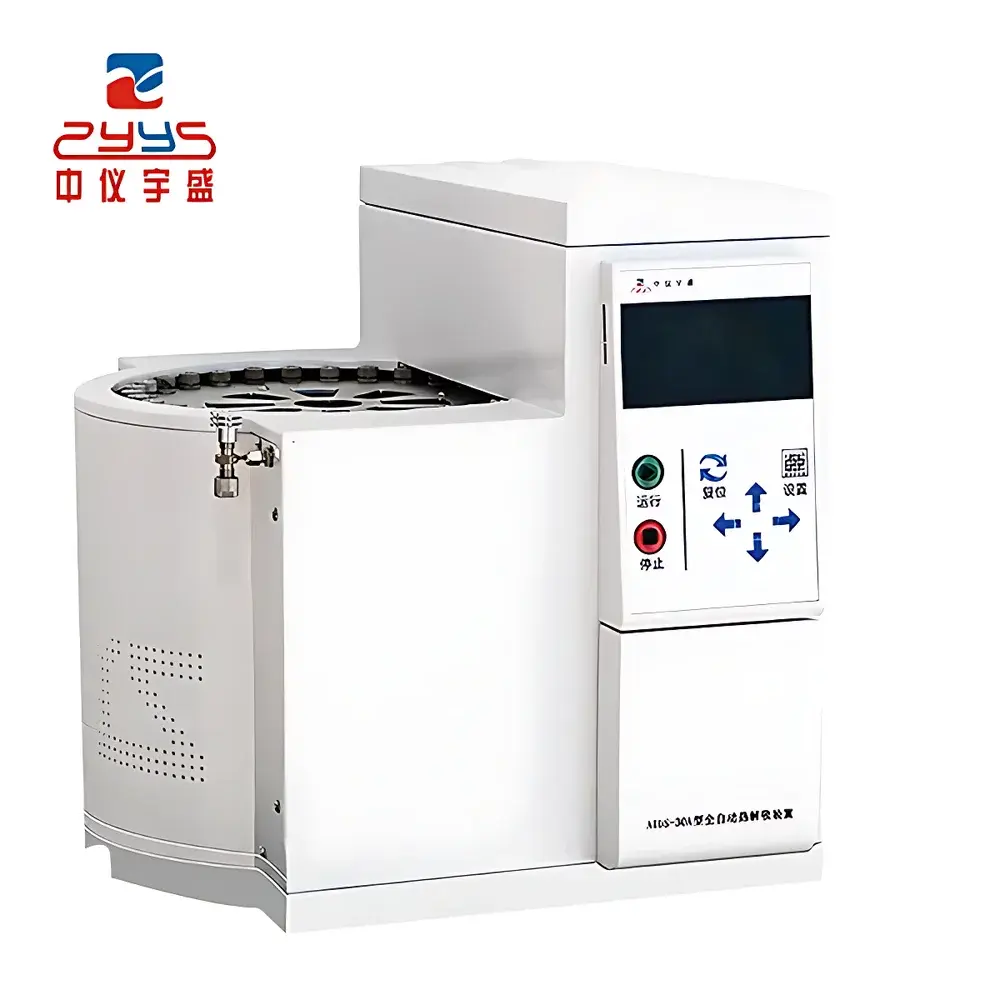
Zhongyi Yusheng ATDS-30A Single-Stage Automated Thermal Desorber
| Brand | Zhongyi Yusheng |
|---|---|
| Origin | Beijing, China |
| Manufacturer Type | Direct Manufacturer |
| Product Category | Domestic |
| Model | ATDS-30A (Single-Stage) |
| Instrument Type | Single-Stage Thermal Desorber |
| Automation Level | Fully Automated |
| Sample Capacity | 30 positions |
| Compliance Standards | GBZ/T 300–2017, HJ 583–2010, GB 50325–2020 |
Overview
The Zhongyi Yusheng ATDS-30A Single-Stage Automated Thermal Desorber is a benchtop sample introduction system engineered for high-throughput, unattended thermal desorption of volatile and semi-volatile organic compounds (VOCs and SVOCs) from sorbent tubes prior to gas chromatographic analysis. Operating on the principle of controlled resistive heating and carrier gas-assisted desorption, the ATDS-30A transfers analytes quantitatively from thermally stable sorbent media (e.g., Tenax TA, Carbopack B/C, or multi-bed traps) into the injection stream of a coupled gas chromatograph (GC). Designed specifically for single-stage (primary) desorption workflows, it eliminates manual tube handling and ensures consistent thermal profiles across all 30 sample positions—making it suitable for routine environmental air monitoring, occupational hygiene testing, and indoor air quality (IAQ) compliance laboratories.
Key Features
- Fully automated batch processing of up to 30 sorbent tubes without operator intervention, supporting overnight and unattended operation.
- Integrated self-diagnostic startup sequence with real-time fault detection, automatic sample tray homing, and positional calibration.
- Independent PID temperature control for three critical zones: desorption oven (up to 400 °C), transfer line (up to 300 °C), and six-port switching valve (up to 250 °C), ensuring minimal thermal degradation and optimal analyte transfer efficiency.
- Programmable time-based method sequencing—including desorption, GC trigger synchronization, back-flush of transfer line and valve, and post-run tube conditioning—enabling full method reproducibility per ICH Q2(R2) and ISO/IEC 17025 requirements.
- Onboard tube activation function: automated thermal conditioning of used or new sorbent tubes under inert gas flow, eliminating carryover and extending tube service life.
- Standardized mechanical and electrical interfaces compatible with major GC platforms (Agilent, Thermo Fisher, Shimadzu, PerkinElmer, and domestic GC systems), including dedicated valve timing and TTL-level GC start signals.
- Optional quartz-lined transfer lines available for enhanced inertness when analyzing reactive or polar compounds (e.g., aldehydes, amines, organic acids).
- Front-panel 7-inch capacitive touchscreen with intuitive icon-driven navigation, real-time status animation, and method storage capacity for ≥100 user-defined protocols.
Sample Compatibility & Compliance
The ATDS-30A accepts standard 6 mm OD × 89 mm or 1/4″ OD stainless steel or glass sorbent tubes. It supports both single-bed and multi-bed configurations and is validated for use with ASTM D6196-22 (selection of sorbents), EPA TO-17 (determination of VOCs in ambient air), and Chinese national standards including GBZ/T 300.1–2017 (workplace air toxicants), HJ 583–2010 (benzene homologues in ambient air), and GB 50325–2020 (indoor air contaminants in civil construction projects). All thermal ramp rates, hold times, and gas flow parameters are fully traceable and auditable—supporting GLP and GMP-aligned laboratory practices where electronic records must comply with FDA 21 CFR Part 11 requirements via external LIMS integration.
Software & Data Management
The ATDS-30A operates via embedded firmware with no external PC dependency. Method files (.atd format) store complete thermal and pneumatic parameters—including desorption temperature ramps, valve actuation timings, carrier gas flows (He or N₂), and GC synchronization logic. Exportable CSV logs record timestamps, actual zone temperatures, pressure events, and error codes for each run. When integrated with chromatography data systems (CDS), the unit can accept external start commands and emit hardware handshake signals, enabling synchronized acquisition and audit-ready workflow documentation. Optional RS-232 or Ethernet connectivity allows remote monitoring and centralized instrument management in multi-desorber lab environments.
Applications
- Quantitative analysis of benzene, toluene, ethylbenzene, xylenes (BTEX), styrene, and C2–C12 aliphatic/aromatic hydrocarbons in ambient, workplace, and indoor air matrices.
- Compliance testing for formaldehyde, acetaldehyde, and other carbonyls using derivatization-compatible sorbents (e.g., DNPH-coated tubes).
- Method development and validation studies requiring precise thermal desorption reproducibility (RSD < 3% for peak area across 30-tube batches).
- Reference material preparation and calibration curve generation via built-in standard spiking simulation mode.
- High-volume screening in environmental contract laboratories performing EPA Method TO-17–aligned analyses under ISO/IEC 17025 accreditation.
FAQ
Is the ATDS-30A compatible with cryogenic focusing or cold trap systems?
No—the ATDS-30A is designed exclusively for single-stage thermal desorption and does not incorporate cryofocusing capability. For applications requiring analyte refocusing (e.g., ultra-trace VOCs), a separate cold trap interface or a two-stage desorber is required.
Can the instrument perform tube aging or reconditioning automatically?
Yes—built-in tube activation protocols enable programmable thermal purging under inert gas flow, restoring sorbent integrity between uses.
Does it support audit trails and electronic signatures for regulated environments?
While the standalone unit does not host 21 CFR Part 11–compliant user authentication, its timestamped event logs and method versioning support integration with validated LIMS or CDS platforms that provide full electronic record governance.
What maintenance intervals are recommended for long-term reliability?
Valve seals and O-rings should be inspected every 500 runs; transfer line frits replaced every 1,000 runs; and temperature sensor calibration verified annually using NIST-traceable reference sources.
Is remote software update capability available?
Firmware updates are performed locally via USB flash drive; no cloud-based or over-the-air update functionality is implemented for security and regulatory stability reasons.
Related Products





