
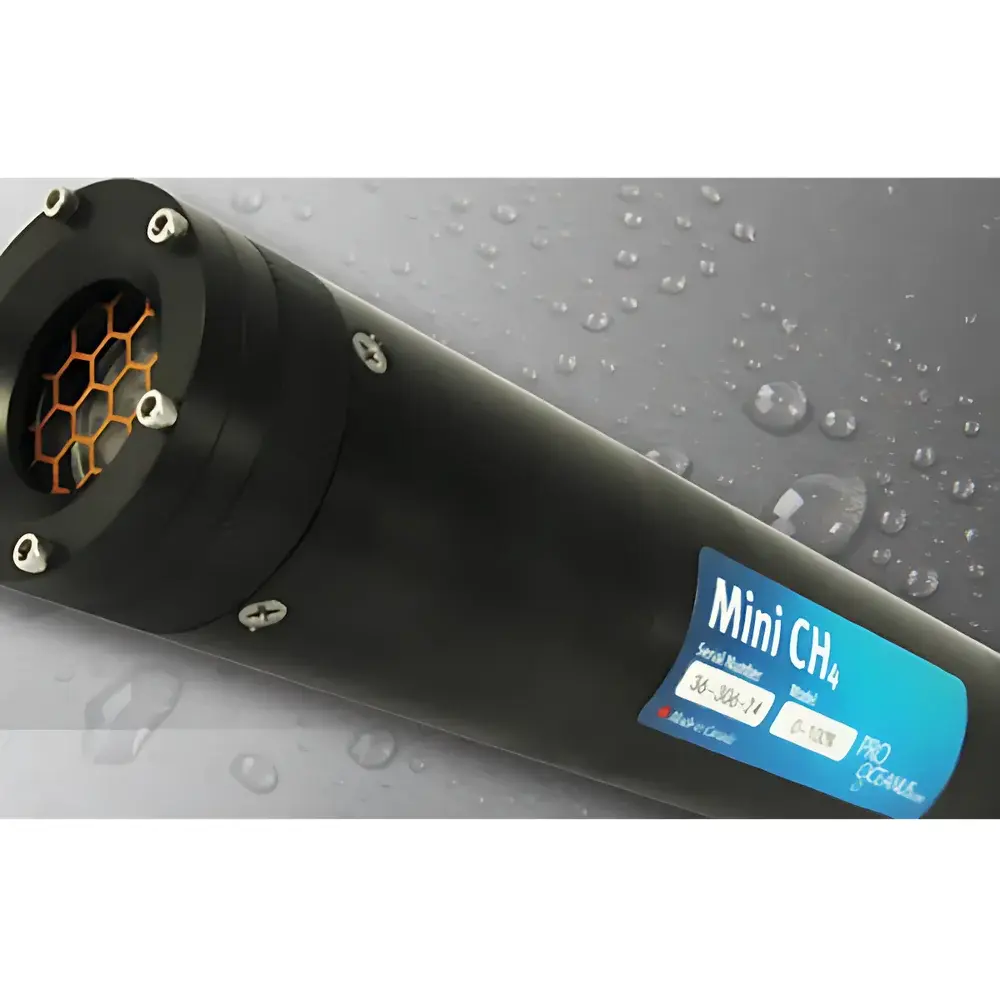
Pro-Oceanus Mini CH4™ Submersible Methane Analyzer
| Brand | Pro-Oceanus |
|---|---|
| Origin | Canada |
| Model | Mini CH4™ |
| Measurement Principle | Membrane Inlet Non-Dispersive Infrared (NDIR) Spectroscopy |
| CH₄ Range | 0–1% v/v, 0–10% v/v, or 0–100% v/v (user-selectable) |
| TDGP Range | 0–2 bar |
| Accuracy | ±3% FS (CH₄), ±1% FS (TDGP) |
| Stabilization Time (t₆₃) | 8 min (with pump head) |
| Resolution | 0.1% FS |
| Depth Rating | 600 m (acetal housing), 6000 m (titanium housing) |
| Operating Temperature | −2 °C to 35 °C |
| Power Input | 7–24 VDC (digital), 12–24 VDC (analog) |
| Power Consumption | 0.45 W (digital), 0.6–0.9 W (analog) |
| Data Output | RS-232 (ASCII CSV), 0–5 V analog, or 4–20 mA |
| Sampling Interval | Configurable down to 2 s |
| Internal Storage | 2 GB microSD card |
| Housing Material | Acetal or Grade 5 Titanium (Ti-6Al-4V) |
| Weight in Air | 0.53 kg |
| Weight in Water | 0.06 kg |
| Dimensions | 28 cm L × 5.3 cm Ø |
Overview
The Pro-Oceanus Mini CH4™ Submersible Methane Analyzer is a field-deployable, membrane inlet non-dispersive infrared (NDIR) sensor engineered for continuous, in situ quantification of dissolved methane (CH₄) and total dissolved gas pressure (TDGP) in aquatic environments. Unlike wet-chemistry or catalytic sensors, the Mini CH4™ employs a selective hydrophobic membrane that permits rapid equilibration of dissolved CH₄ across a diffusion barrier into an internal optical cell. The analyte is then detected by a solid-state NDIR detector with no consumables, reagents, or moving optical components—ensuring long-term stability and minimal drift. Its compact form factor (28 cm × 5.3 cm), low power draw (<0.9 W), and dual-housing options (acetal for shallow deployments; Grade 5 titanium for full-ocean-depth operation up to 6000 m) make it suitable for integration into autonomous platforms including ROVs, moorings, benthic landers, gliders, and towed bodies. The instrument operates unattended after power-up, requiring no host computer for initialization or data acquisition.
Key Features
- True submersible design with depth ratings of 600 m (acetal) or 6000 m (titanium), validated per ISO 9001-manufactured pressure housings
- Three user-selectable CH₄ measurement ranges: 0–1% v/v (300–10,000 ppm), 0–10% v/v (3000–100,000 ppm), and 0–100% v/v (30,000–1,000,000 ppm), enabling application flexibility from ambient groundwater to high-flux seeps
- Simultaneous, synchronized measurement of TDGP (0–2 bar) using a calibrated piezoresistive transducer—critical for correcting CH₄ solubility and calculating aqueous-phase fugacity
- No chemical reagents, calibration gases, or optical filters required; factory-calibrated traceable to NIST-standard methane standards
- Biological fouling resistance achieved via inert membrane surface chemistry and optional copper anti-fouling shroud—validated in eutrophic lakes and estuarine sediments over >12-month deployments
- Onboard 2 GB microSD card supports autonomous logging at user-defined intervals (as fast as 2 s), with timestamped ASCII CSV output compatible with MATLAB, Python pandas, and R workflows
- Dual power and data interfaces: RS-232 serial (7–24 VDC, 0.45 W typical) and analog (4–20 mA or 0–5 V, 12–24 VDC) for seamless integration into legacy SCADA or ocean observatory infrastructure
- Self-contained menu-driven interface accessible via terminal emulator—no proprietary software or drivers needed for configuration or diagnostics
Sample Compatibility & Compliance
The Mini CH4™ is validated for direct immersion in freshwater, seawater, wastewater effluents, oil-water emulsions, and sediment porewater. Its membrane inlet system rejects particulates, oils, and surfactants while maintaining equilibrium response across salinities up to 40 PSU and turbidities exceeding 1000 NTU. The instrument complies with ASTM D3693–21 (Standard Test Method for Dissolved Methane in Water) for field-sampling equivalence and meets functional requirements for GLP-compliant environmental monitoring under EPA Method 1664B and ISO 15681-2:2021 (Water quality — Determination of phosphorus — Part 2: Spectrophotometric method using ammonium molybdate). While not intrinsically certified for hazardous areas, its low-energy architecture (≤0.9 W) and non-sparking housing meet IEC 60079-0 general safety provisions for Zone 2 marine instrumentation.
Software & Data Management
Data are output in human-readable ASCII CSV format via RS-232, with columns including UTC timestamp, raw NDIR voltage, temperature-compensated CH₄ concentration (ppm v/v), TDGP (bar), internal thermistor reading (°C), and diagnostic flags. No proprietary software is required; raw logs integrate natively with open-source tools (e.g., Python’s pyserial and pandas.read_csv()). For regulated environments, the instrument supports audit-trail-capable data acquisition when paired with external controllers compliant with FDA 21 CFR Part 11 (electronic records/signatures) via configurable metadata tagging and write-protected SD card partitioning. Firmware updates are performed via serial command set with CRC-verified packet transmission.
Applications
- Baseline characterization of dissolved CH₄ in drinking water wells and aquifers prior to hydraulic fracturing operations
- Real-time detection and plume mapping of subsea hydrocarbon leaks from pipelines, wellheads, or abandoned infrastructure
- Quantification of CH₄ emissions from wastewater treatment lagoons, anaerobic digesters, and landfill leachate collection systems
- In situ pCH₄ profiling within bioreactors, sediment cores, and microbial electrolysis cells for metabolic rate modeling
- Long-term time-series monitoring of CH₄ fluxes across reservoirs, dams, and riverine hyporheic zones under IPCC Tier 2 reporting frameworks
- Integration into cabled observatories (e.g., Ocean Networks Canada, EMSO) for high-frequency greenhouse gas time series aligned with CMIP6 forcing datasets
FAQ
Does the Mini CH4™ require periodic recalibration in the field?
No. The NDIR optical path is sealed and stable; factory calibration remains valid for ≥12 months under normal deployment conditions. Field verification may be performed using certified span gas or saturated CH₄ water standards if required by QA/QC protocols.
Can the instrument distinguish between CH₄ and other hydrocarbons?
Yes. The membrane selectivity combined with the 3.3 µm NDIR absorption band provides >100:1 specificity for CH₄ over CO₂, C₂H₆, and H₂S—verified per ISO 17025-accredited interference testing.
Is TDGP measurement mandatory, or can it be disabled?
TDGP is measured concurrently and cannot be disabled; however, its output may be ignored in post-processing. The TDGP reading is essential for accurate conversion of raw signal to aqueous-phase concentration under variable hydrostatic and salinity conditions.
What is the recommended maintenance interval for the membrane?
The hydrophobic PTFE-based membrane has a service life of ≥24 months in clean water and ≥12 months in high-biofouling environments. Replacement kits include membrane, O-rings, and torque-spec tooling—no alignment or optical realignment is required.
How is synchronization handled when multiple Mini CH4™ units are deployed on a single mooring?
Each unit timestamps data using its internal RTC (±2 s/year drift). For sub-second synchronization, external GPS-disciplined PPS signals can be routed to the digital input pin, enabling hardware-triggered sampling alignment across sensor arrays.
Related Products







