
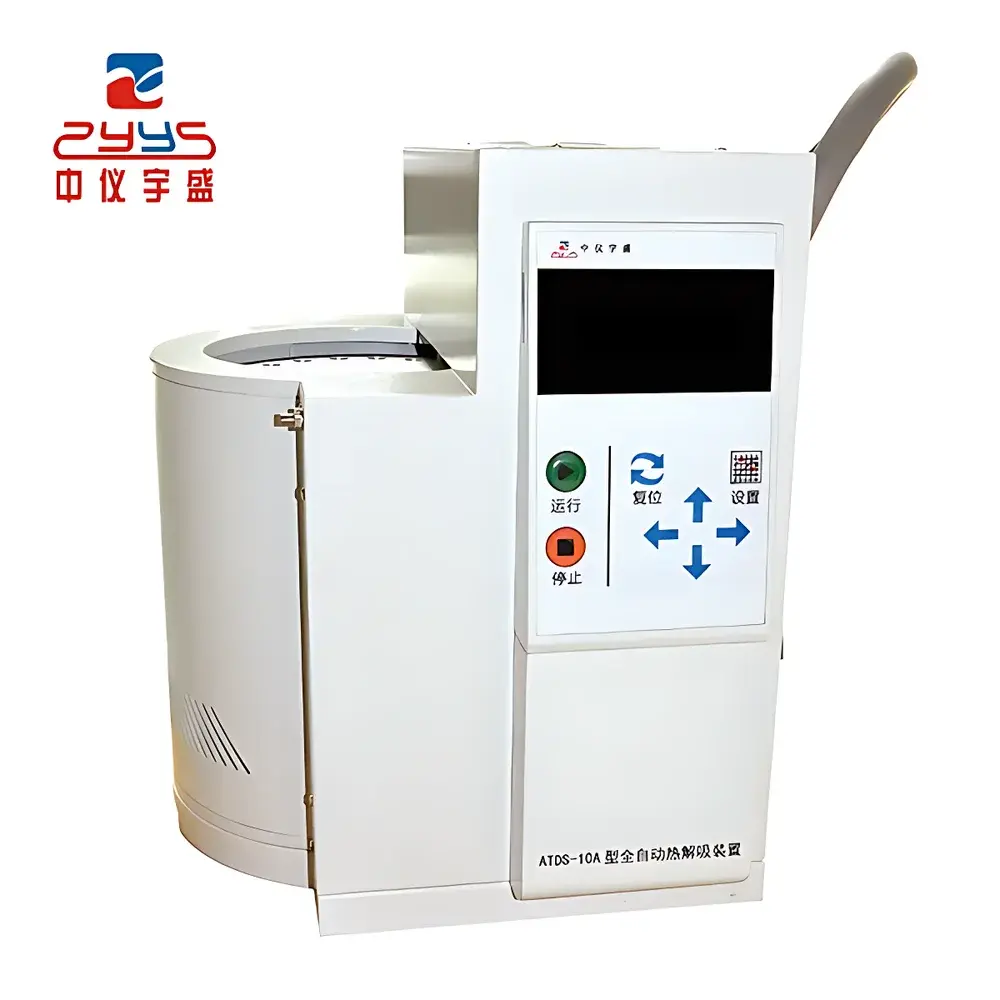
Zhongyi Yusheng ATDS-10A Automated Single-Stage Thermal Desorber
| Brand | Zhongyi Yusheng |
|---|---|
| Origin | Beijing, China |
| Manufacturer Type | Direct Manufacturer |
| Instrument Type | Single-Stage Thermal Desorber |
| Automation Level | Fully Automated |
| Sample Capacity | 10 positions |
| Compatible With | All domestic and imported gas chromatographs (GC) |
| Regulatory Compliance | HJ 583–2010, GB 50325–2020, GBZ/T 300–2017 |
Overview
The Zhongyi Yusheng ATDS-10A Automated Single-Stage Thermal Desorber is a benchtop analytical accessory engineered for precise, unattended thermal desorption of volatile and semi-volatile organic compounds (VOCs and SVOCs) from sorbent tubes prior to gas chromatographic analysis. Operating on the principle of controlled resistive heating and carrier-gas-assisted volatilization, the ATDS-10A performs quantitative release of analytes trapped on Tenax®, Carbopack™, or other standard sorbent media under programmable temperature ramps and inert gas flow conditions. Designed specifically for single-stage (primary) desorption workflows, it eliminates manual tube handling and ensures high reproducibility in environmental, occupational hygiene, and indoor air quality laboratories where regulatory compliance with standardized methods is mandatory.
Key Features
- Fully automated batch processing of up to 10 sorbent tubes per run—no operator intervention required during sequence execution.
- Integrated self-diagnostic system: automatic power-on calibration, positional validation of sample tray, real-time fault detection with on-screen error codes and audible alerts.
- Independent PID temperature control for three critical zones: desorption oven (up to 400 °C), transfer line (up to 350 °C), and GC inlet interface valve (up to 300 °C), minimizing cold spots and analyte condensation.
- Time-segmented method programming supporting desorption, focusing trap bypass (if equipped), carrier gas purge, back-flush cleaning of transfer line and valve, and post-run tube reactivation—all executed sequentially without external triggers.
- Built-in tube activation mode: programmable heating under continuous helium or nitrogen flow to thermally clean used sorbent tubes, extending tube lifetime and reducing blank interference.
- Standardized GC synchronization: TTL-level trigger output to initiate GC oven ramp and data acquisition; also accepts external start signals from chromatography data systems (CDS) or LIMS interfaces.
- Dual-interface hardware design: pre-configured mechanical and pneumatic adapters for seamless integration with Agilent, Thermo Fisher, Shimadzu, PerkinElmer, and major domestic GC platforms—including adjustable needle depth and septum-piercing alignment.
- Optional quartz-lined transfer tubing available for enhanced inertness when analyzing reactive species such as aldehydes, organic acids, or sulfur-containing compounds.
Sample Compatibility & Compliance
The ATDS-10A accommodates standard 6 mm OD × 89 mm length stainless steel or glass sorbent tubes (e.g., SKC, Markes, Entech formats) and supports both direct desorption into split/splitless GC inlets and optional cold trap coupling for enhanced sensitivity. Its operational parameters and validation protocols align with internationally recognized environmental and occupational health standards, including but not limited to:
- HJ 583–2010: “Determination of Aromatic Hydrocarbons in Ambient Air — Solid Sorbent Thermal Desorption/Gas Chromatography”
- GB 50325–2020: “Control Standard for Indoor Environmental Pollution in Civil Building Engineering”
- GBZ/T 300–2017: “Determination of Toxic Substances in Workplace Air” (Parts 1–162)
All system functions—including method storage, run logs, temperature profiles, and user access—are timestamped and traceable, supporting GLP-compliant documentation requirements and internal audit readiness.
Software & Data Management
The ATDS-10A operates via an embedded 7-inch capacitive touchscreen interface running a deterministic real-time OS. Method files (.tdm) store complete thermal and timing parameters—including ramp rates, hold times, gas flow setpoints, and GC sync logic—and support password-protected user levels (Operator, Supervisor, Administrator). Audit trail functionality records all parameter modifications, run starts/stops, and system alerts with immutable timestamps. Export options include CSV-formatted run reports and PDF certificates of operation—compatible with laboratory information management systems (LIMS) via USB or optional RS-232/Ethernet modules. While the instrument does not natively enforce FDA 21 CFR Part 11 requirements, its logging architecture provides foundational elements (electronic signatures, event history, data integrity safeguards) suitable for validation under ISO/IEC 17025 or GMP-aligned quality systems.
Applications
- Regulatory monitoring of benzene, toluene, ethylbenzene, xylenes (BTEX), styrene, and C2–C12 aliphatic/aromatic hydrocarbons in ambient and indoor air.
- Occupational exposure assessment per OSHA and NIOSH methodologies using charcoal or silica gel tubes.
- Material emission testing (e.g., carpets, adhesives, furniture composites) per ISO 16000 series protocols.
- Quality control of activated carbon filters, air purification devices, and HVAC system performance verification.
- Method development and calibration curve generation via integrated standard vapor generation—enabling bracketed quantitation without external spiking equipment.
FAQ
Is the ATDS-10A compatible with cryogenic focusing traps?
No—the ATDS-10A is configured exclusively for single-stage thermal desorption. Integration with cryofocusing units requires retrofitting or use of a dedicated two-stage desorber platform.
Can I validate this instrument according to ISO/IEC 17025?
Yes—its programmable temperature uniformity, repeatability of retention time and peak area (<3% RSD over 10 injections), and full operational logging enable formal method validation and uncertainty estimation per ISO/IEC 17025 Clause 7.7.
Does it support multi-bed sorbent tubes (e.g., Tenax TA + Carbograph 1TD)?
Yes—temperature ramp profiles can be optimized to accommodate staged desorption behavior across composite beds, though full resolution of co-eluting analytes remains dependent on downstream GC column selectivity.
What maintenance intervals are recommended for long-term reliability?
Valve actuation cycles should be logged; OEM recommends inspection of O-rings and ferrules every 500 runs, and annual calibration verification of all three heated zones using NIST-traceable thermocouples.
Is remote monitoring or network control available?
Basic Ethernet connectivity is optional; full SCADA or OPC UA integration requires custom firmware extension and is subject to site-specific validation protocols.






