
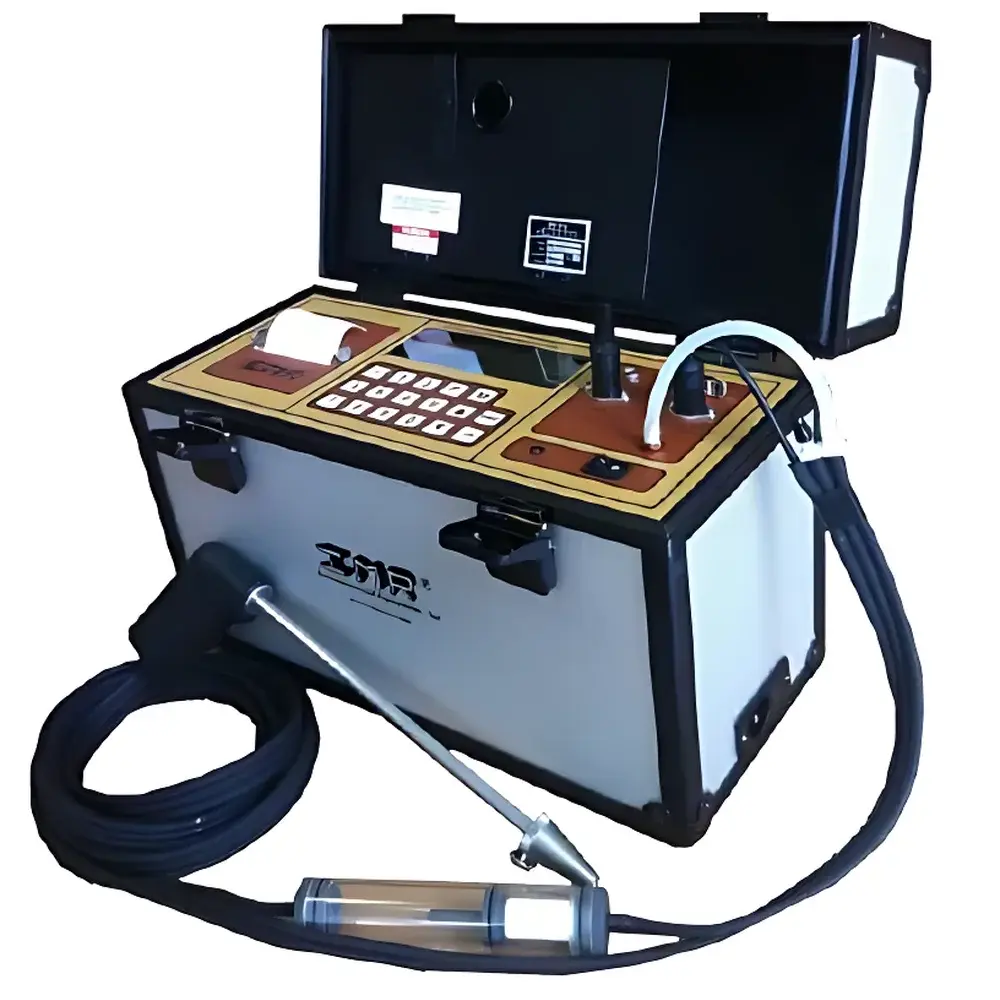
IMR 2800P Portable Flue Gas Analyzer
| Brand | IMR |
|---|---|
| Origin | USA |
| Model | 2800P |
| Instrument Type | Portable Flue Gas Analyzer |
| Measurement Accuracy | ±2% FS |
| Response Time | <90 s |
| Drift Stability | <5% over 1 h |
| Measured Parameters | O₂, NO, NO₂, CO, SO₂, HC/CH₄, Flue Gas Temperature (TG), Ambient Temperature (TA) |
| Sensor Technology | Electrochemical (O₂, NO, NO₂, CO, SO₂, HC/CH₄) |
| Operating Temperature Range (Probe) | Up to 1200 °C (1600 °C optional) |
| Battery Life | 6 h (rechargeable Li-ion) |
| Compliance | Certified for official emission monitoring per German TA Luft and EU Directive 2010/75/EU (IED), supports ASTM D6522, EN 15267-3, and VDI 3862 |
| Data Output | RS232, USB |
| Display | Backlit LCD showing up to 8 parameters simultaneously |
| Built-in Printer | Yes (programmable, on-site thermal printout) |
| Fuel Database | 23 preloaded fuel types + 4 user-definable |
| Calculated Parameters | λ (excess air ratio), qA (dry flue gas loss), CO₂ (by ASME PTC 4.1 equation), NOₓ (as NO₂-equivalent) |
Overview
The IMR 2800P Portable Flue Gas Analyzer is an engineered field instrument designed for precise, real-time quantification of combustion exhaust gases in industrial boilers, furnaces, incinerators, and stationary engines. Based on electrochemical sensor technology with calibrated cross-sensitivity compensation, it delivers trace-level detection and high reproducibility for regulatory-grade emission verification. Its architecture adheres to the physical principles of diffusion-limited amperometric sensing—ensuring stable baseline response and minimal drift during extended deployment. The analyzer operates under ISO 12039 and EN 14181 requirements for continuous emission monitoring system (CEMS) validation and periodic stack testing. All internal signal conditioning, temperature compensation, and pressure normalization are performed in real time using embedded microprocessor control, enabling direct compliance with EPA Method 7E and EN 15267-3 certification criteria.
Key Features
- Simultaneous real-time measurement and display of eight critical parameters: O₂, NO, NO₂, CO, SO₂, HC/CH₄, flue gas temperature (TG), and ambient temperature (TA)
- Electrochemical sensor array with factory-calibrated span and zero stability; each sensor undergoes individual linearity verification per IEC 60779
- Integrated thermal management system ensuring sensor operation within optimal temperature range (10–40 °C) despite ambient extremes
- Aluminum alloy housing rated IP54 for dust and splash resistance, tested per MIL-STD-810G for shock and vibration durability
- Onboard calculation engine implementing ASME PTC 4.1 equations for λ (excess air ratio), qA (dry flue gas heat loss), and CO₂ concentration based on selected fuel type
- Programmable thermal printer supporting customizable report headers, timestamping, and unit selection (ppm, mg/m³, mg/m³ @ 3% O₂, mg/kWh)
- Dual power architecture: rechargeable lithium-ion battery (6 h continuous operation) with hot-swappable capability and AC adapter for lab-based calibration or extended field use
- Self-diagnostic firmware with automated zero-point verification, sensor health monitoring, and fault logging compliant with GLP audit trail requirements
Sample Compatibility & Compliance
The IMR 2800P is validated for use across solid, liquid, and gaseous fuel-fired systems—including coal, biomass, heavy oil, natural gas, and biogas combustion. Its high-temperature sampling probes (250 mm, 750 mm, and 1500 mm lengths) feature ceramic-insulated stainless-steel construction, rated for continuous exposure up to 1200 °C (1600 °C variant available upon request). The instrument meets the metrological and functional requirements of German TA Luft (Technical Instructions on Air Quality Control), EU Industrial Emissions Directive (2010/75/EU), and U.S. EPA Performance Specification 2 (PS-2) for portable analyzers. It supports traceability through NIST-traceable calibration certificates and includes built-in support for ISO/IEC 17025-compliant calibration record storage. Optional sensors for HCl, N₂O, Cl₂, NH₃, H₂S, and CO₂ extend applicability to waste-to-energy and chemical process stacks.
Software & Data Management
Data acquisition and reporting are managed via the integrated firmware and optional PC software suite compatible with Windows 10/11. All measurements are time-stamped with UTC synchronization and stored internally (up to 10,000 records) with full metadata: probe ID, fuel type, operator code, location tag, and environmental conditions. Export formats include CSV and PDF for integration into LIMS or ERP platforms. The USB and RS232 interfaces support bidirectional communication, enabling remote configuration, firmware updates, and batch calibration upload. Audit logs record all user actions—including parameter changes, calibration events, and printer activation—in accordance with FDA 21 CFR Part 11 requirements for electronic records and signatures when used in regulated environments.
Applications
The IMR 2800P serves as a primary tool for combustion efficiency optimization, regulatory compliance verification, and preventive maintenance diagnostics. Typical use cases include: annual stack testing per EN 14181, boiler tune-up and excess air adjustment, NOₓ and SO₂ abatement system performance evaluation, waste incinerator emissions auditing, co-generation plant CHP efficiency analysis, and academic research on low-emission combustion technologies. Its portability and rapid deployment make it suitable for multi-point surveys across large facilities, while its robustness ensures reliable operation in harsh industrial settings—from steel mill reheating furnaces to municipal wastewater sludge dryers.
FAQ
What standards does the IMR 2800P comply with for official emission reporting?
It is certified per German TA Luft Annex 3 and EU EN 15267-3 for portable reference analyzers, and supports EPA Method 7E, ASTM D6522, and VDI 3862 for field validation.
Can the instrument calculate CO₂ without a dedicated CO₂ sensor?
Yes—CO₂ is calculated stoichiometrically using the ASME PTC 4.1 equation based on measured O₂, fuel composition, and combustion stoichiometry.
Is the built-in printer capable of generating legally admissible reports?
Yes—the thermal printer produces timestamped, tamper-evident hard copies with configurable header fields, meeting documentation requirements for regulatory inspections under IED and local permitting authorities.
How often does the unit require calibration verification?
Per EN 14181 QAL2, initial calibration verification is recommended every 3 months; field zero checks should be performed before each measurement campaign using certified span gas.
Are sensor replacements user-serviceable?
Electrochemical sensors are field-replaceable modules with plug-and-play connectors; replacement requires no soldering or firmware reconfiguration—only post-installation two-point calibration.
Related Products







