
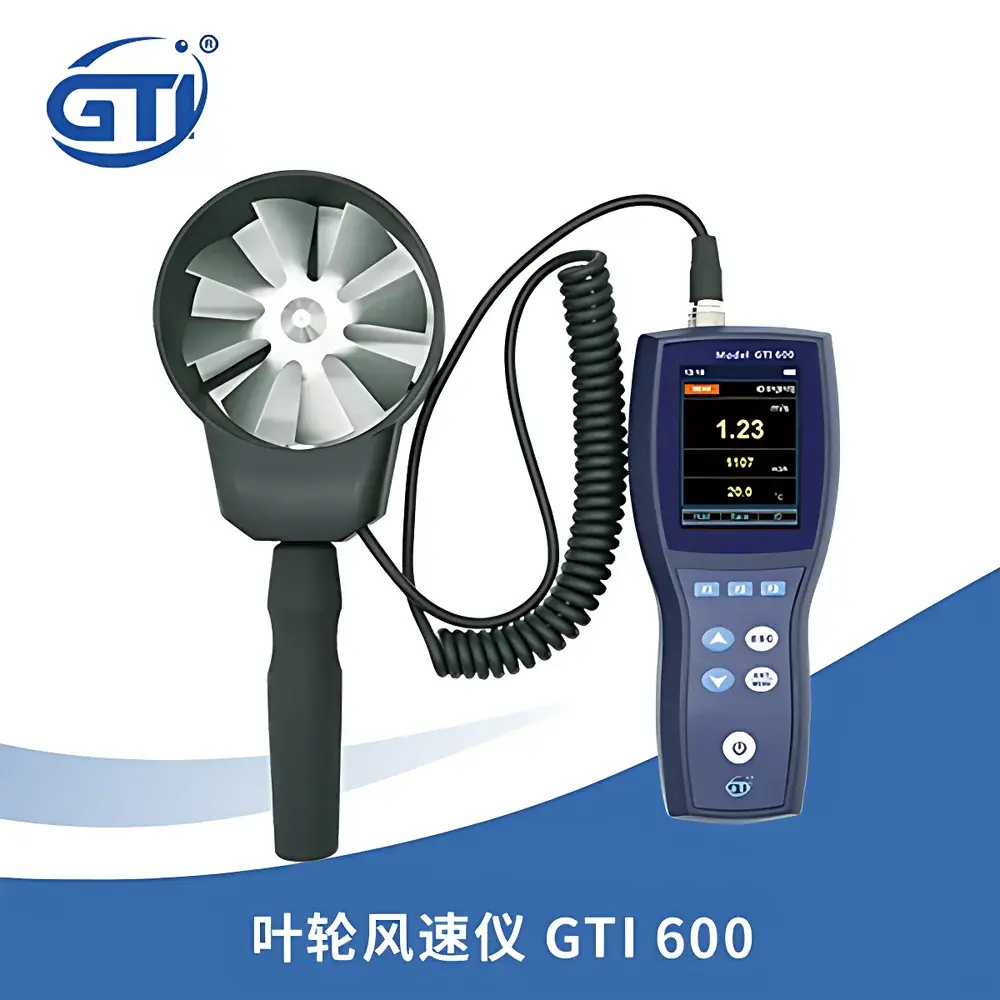
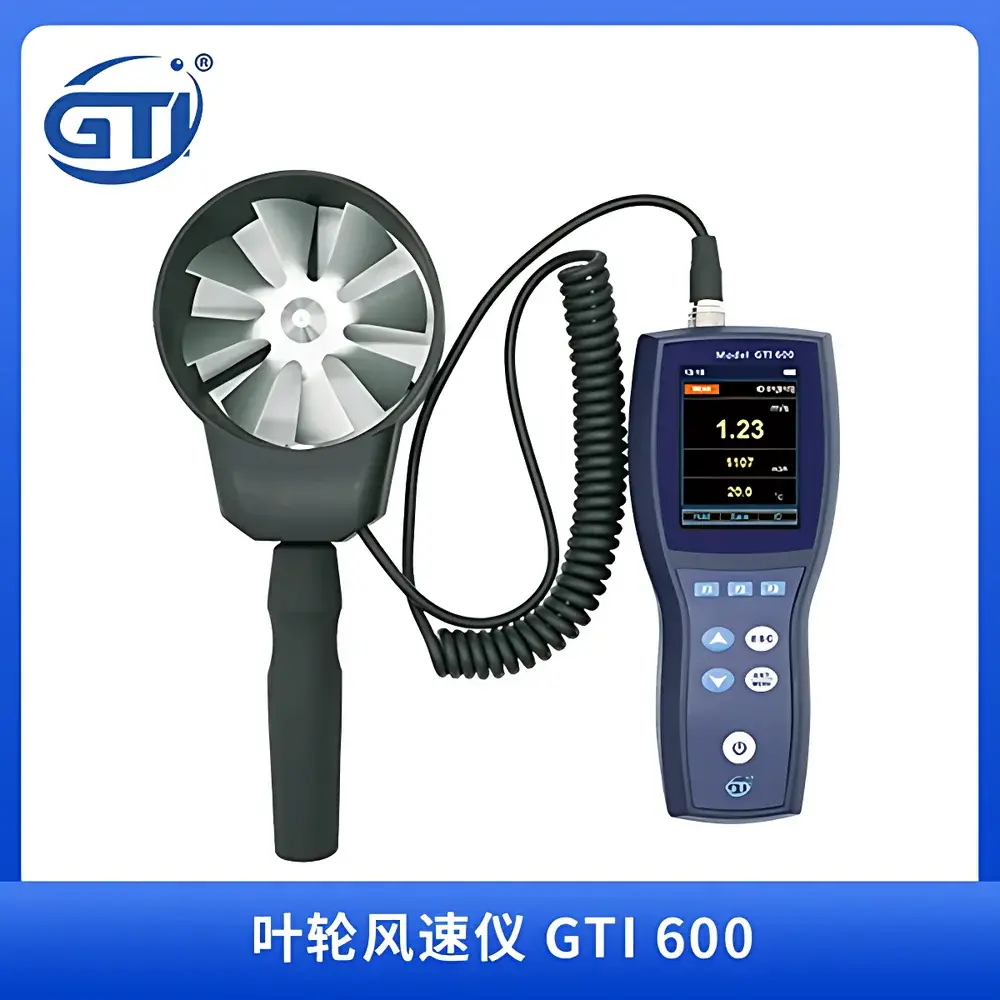
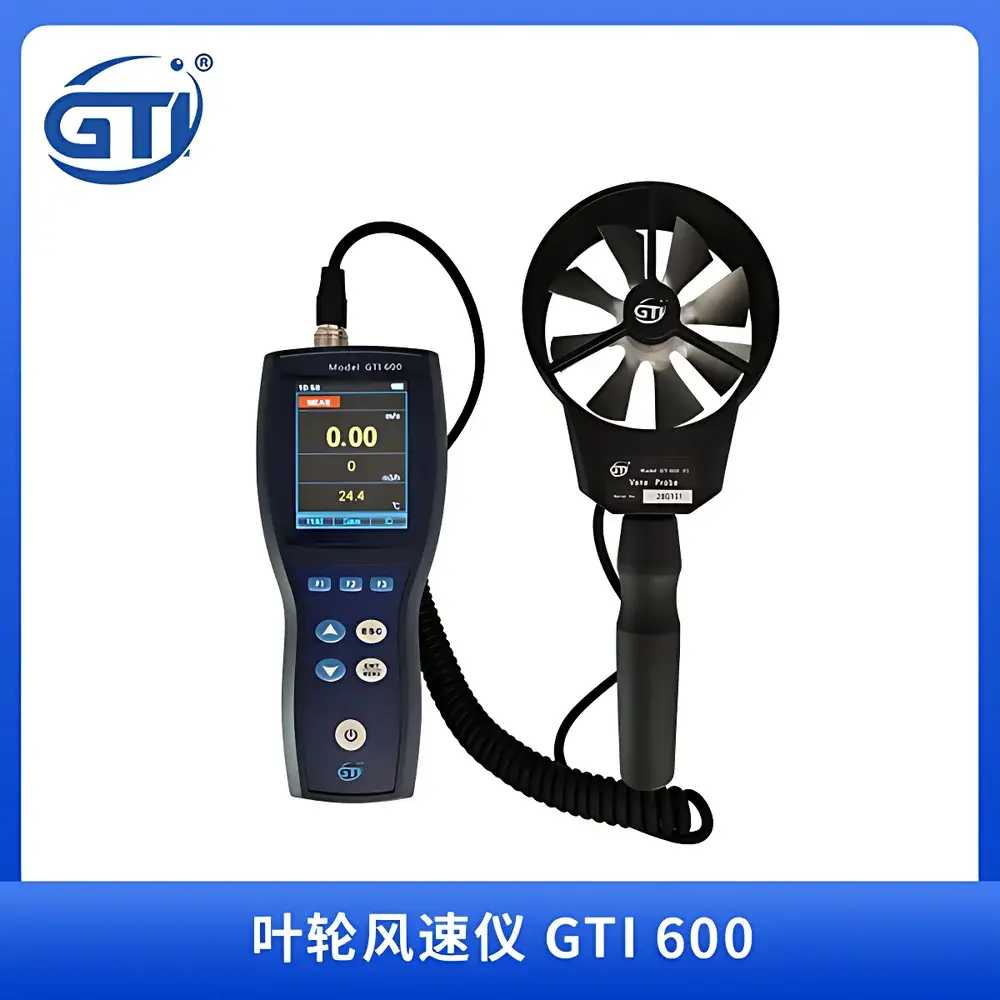
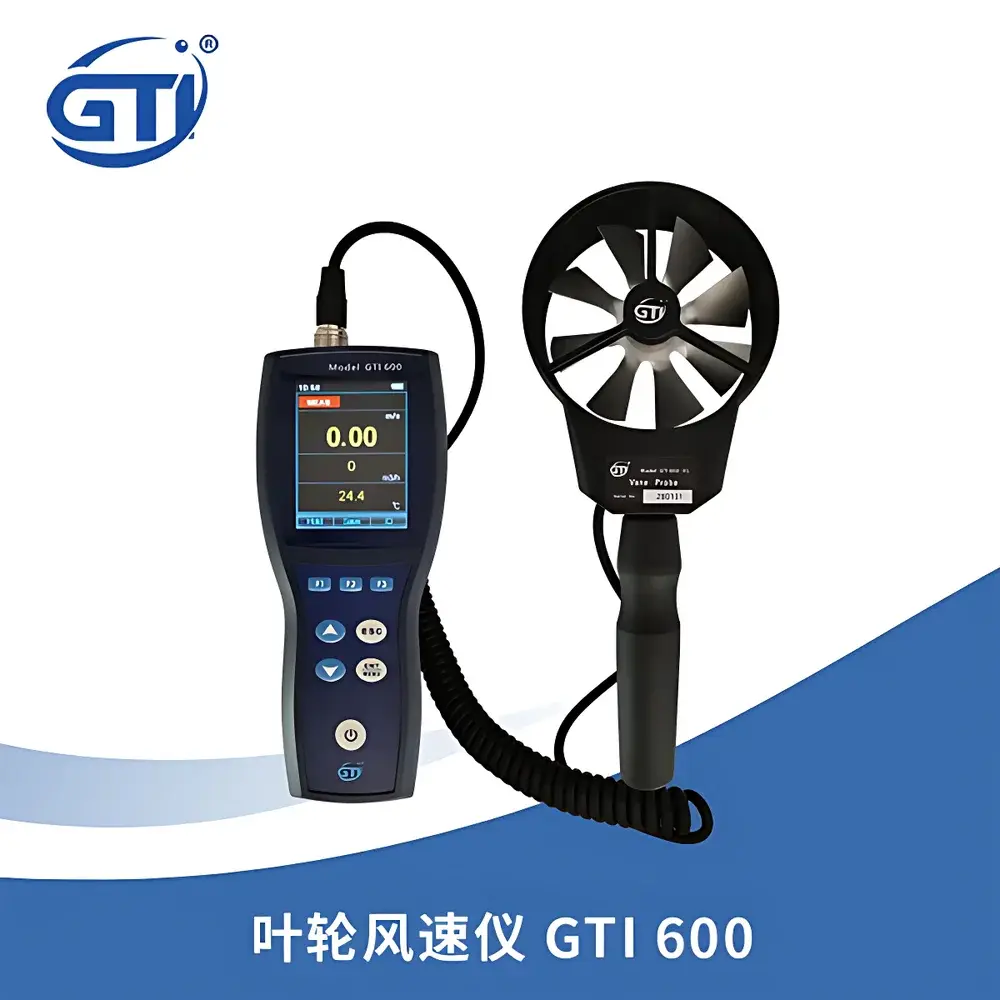
GTI GTI600 Propeller Anemometer with Simultaneous Air Velocity and Temperature Measurement
| Brand | GTI |
|---|---|
| Origin | Liaoning, China |
| Instrument Type | Propeller Anemometer |
| Model | GTI600 |
| Wind Speed Range (FV100) | 0.30–35 m/s |
| Wind Speed Range (FV70) | 0.10–35 m/s |
| Wind Speed Range (FV14) | 0.80–25 m/s |
| Velocity Accuracy | ±3% of reading ±0.1 m/s (low range), ±1% of reading ±0.3 m/s (high range) |
| Velocity Resolution | 0.01 m/s |
| Temperature Range | 0–60 °C |
| Temperature Accuracy | ±0.5 °C |
| Temperature Resolution | 0.1 °C |
| Data Storage Capacity | 10,000 readings |
| Power Supply | 4 × AA batteries or optional AC adapter |
| Operating Temperature | 0–60 °C |
| Storage Temperature | −20–60 °C |
| Weight | ~600 g |
Overview
The GTI GTI600 Propeller Anemometer is a precision-engineered handheld environmental measurement instrument designed for simultaneous, real-time acquisition of air velocity and ambient temperature in HVAC, cleanroom validation, ventilation commissioning, and indoor air quality (IAQ) assessment applications. Built upon proven propeller-based airflow sensing technology, the GTI600 operates on the principle of rotational torque conversion—where airflow imparts angular velocity to interchangeable turbine sensors, which is then transduced into calibrated linear velocity output (m/s). Its dual-sensor architecture enables concurrent temperature measurement via an integrated NTC thermistor, ensuring synchronized thermal and aerodynamic characterization critical for volumetric flow calculation (m³/h) under varying thermal conditions. The device supports three user-swappable sensor heads (FV14, FV70, FV100), each optimized for distinct flow regimes—from low-velocity laminar flows near diffusers to high-velocity duct streams—thereby extending dynamic range coverage while maintaining metrological traceability across configurations.
Key Features
- Triple-sensor interchangeability: Compatible with FV14 (0.80–25 m/s), FV70 (0.10–35 m/s), and FV100 (0.30–35 m/s) propeller probes—enabling application-specific calibration and extended operational flexibility.
- Real-time dual-parameter display: Simultaneous on-screen readout of air velocity (m/s), temperature (°C), and calculated volumetric flow rate (m³/h).
- Configurable flow geometry input: Supports both rectangular and circular duct profiles; users enter cross-sectional dimensions directly to auto-compute average velocity and total airflow.
- Adaptive sampling modes: Select between instantaneous capture for transient event analysis or moving-average mode (user-definable window: 3–30 seconds) to suppress turbulence-induced variance and improve repeatability.
- Statistical data processing: On-device computation of min/mean/max values across multi-point measurements at identical spatial locations—essential for ISO 14644-3 and ASHRAE 110 compliance testing.
- Robust mechanical design: Sensor shafts support controlled bending and extension via optional telescopic rods, facilitating access to recessed grilles, ceiling-mounted diffusers, and constrained filter banks without compromising alignment integrity.
Sample Compatibility & Compliance
The GTI600 is validated for use across heterogeneous airflow environments including supply/exhaust diffusers, HEPA filter face scanning, fume hood face velocity surveys, and HVAC duct traverses per ANSI/ASHRAE Standard 111 and ISO 16813. Its sensor interchangeability ensures consistent performance across laminar, transitional, and turbulent flow profiles typical in laboratory ventilation systems and pharmaceutical cleanrooms. While not certified to IEC 61000-4 electromagnetic immunity standards out-of-box, its analog signal conditioning and isolated probe interface meet baseline EMC requirements for non-critical environmental monitoring per EN 61326-1 Class B. Calibration certificates traceable to national metrology institutes (e.g., NIM China) are available upon request for GLP/GMP-aligned audit readiness.
Software & Data Management
All measurement data—including timestamps, sensor ID, geometry parameters, and statistical aggregates—are stored internally (10,000 records) with timestamped metadata. Export is supported via USB flash drive in CSV format compatible with Excel, MATLAB, and LIMS platforms. No proprietary software installation is required; files open natively for post-processing, trend analysis, or report generation. Audit trail functionality includes automatic logging of measurement mode, averaging duration, and sensor selection—supporting basic FDA 21 CFR Part 11 compliance when used in conjunction with institutional electronic record policies. Battery-level indicators, active pipe geometry icons, and data-hold status are continuously displayed for unambiguous field operation.
Applications
- HVAC system balancing and commissioning per TAB (Testing, Adjusting, Balancing) protocols.
- Cleanroom airflow uniformity mapping and ISO 14644-3 classification verification.
- Pharmaceutical facility environmental monitoring (EM) programs requiring temperature-compensated velocity validation.
- Industrial hygiene assessments of local exhaust ventilation (LEV) capture efficiency.
- Educational laboratory experiments in fluid mechanics and thermal environmental engineering.
- Building commissioning authority (CxA) field verification of design airflow specifications.
FAQ
What sensor types are included with the standard GTI600 configuration?
The base unit ships with one FV100 sensor; FV70 and FV14 probes are optional accessories ordered separately.
Does the GTI600 support automated duct traverse routines?
No—it does not feature motorized probe positioning or pre-programmed traverse patterns. Multi-point manual measurements must be conducted and statistically aggregated using the built-in min/mean/max calculator.
Is calibration documentation provided with shipment?
A factory calibration report listing as-tested accuracy against reference standards is included. NIST-traceable recalibration services are available through authorized GTI service centers.
Can the device operate continuously on AC power during long-duration tests?
Yes—the optional AC adapter enables uninterrupted operation without battery depletion, ideal for extended commissioning sessions or continuous monitoring setups.
How is temperature compensation applied to velocity calculations?
Temperature readings are used solely for environmental context and volumetric correction (via ideal gas law assumptions); no active thermal compensation is applied to the propeller sensor’s raw rotational signal.







