
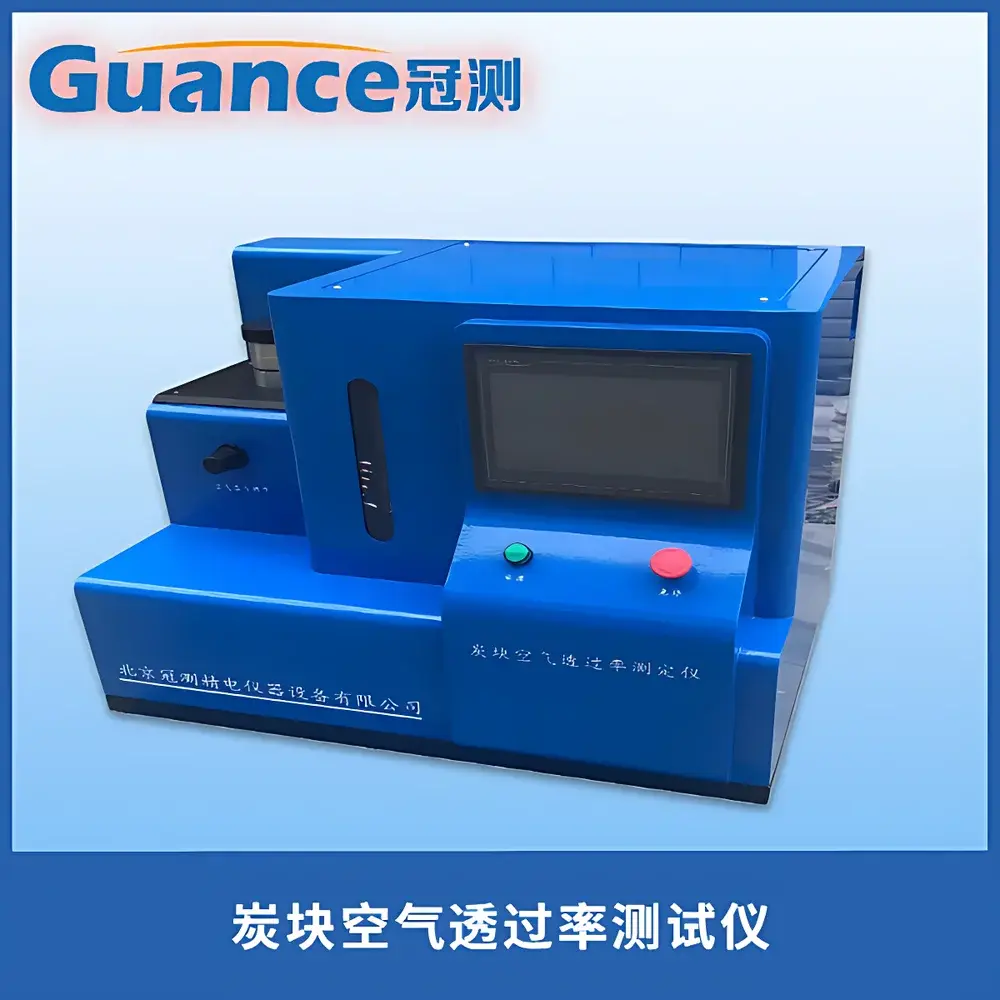

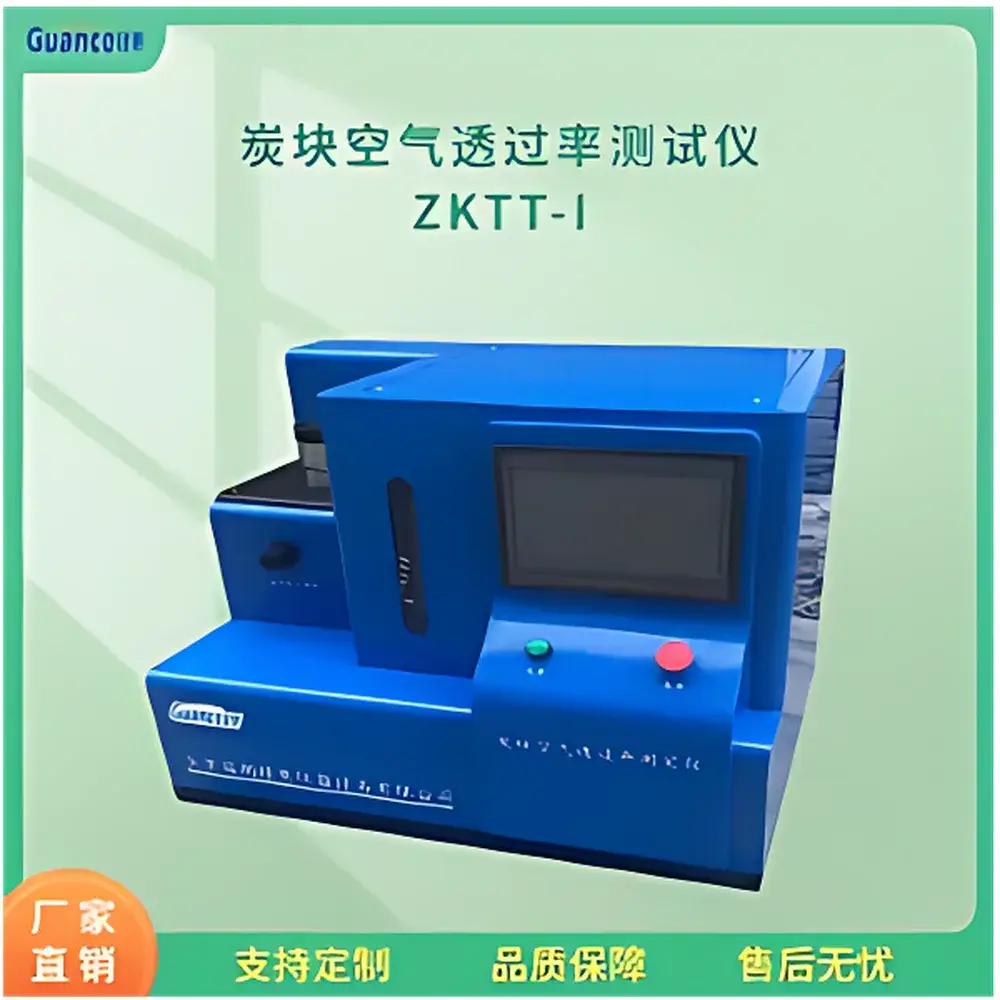
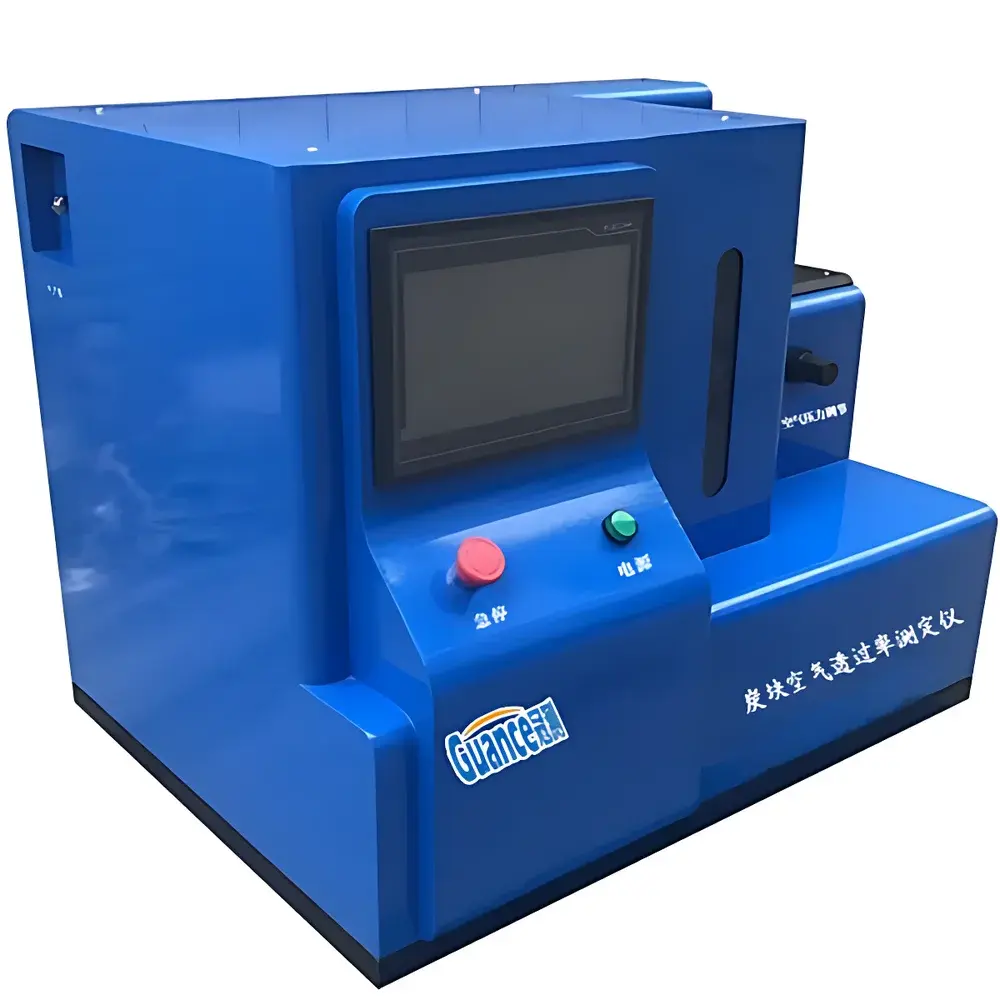
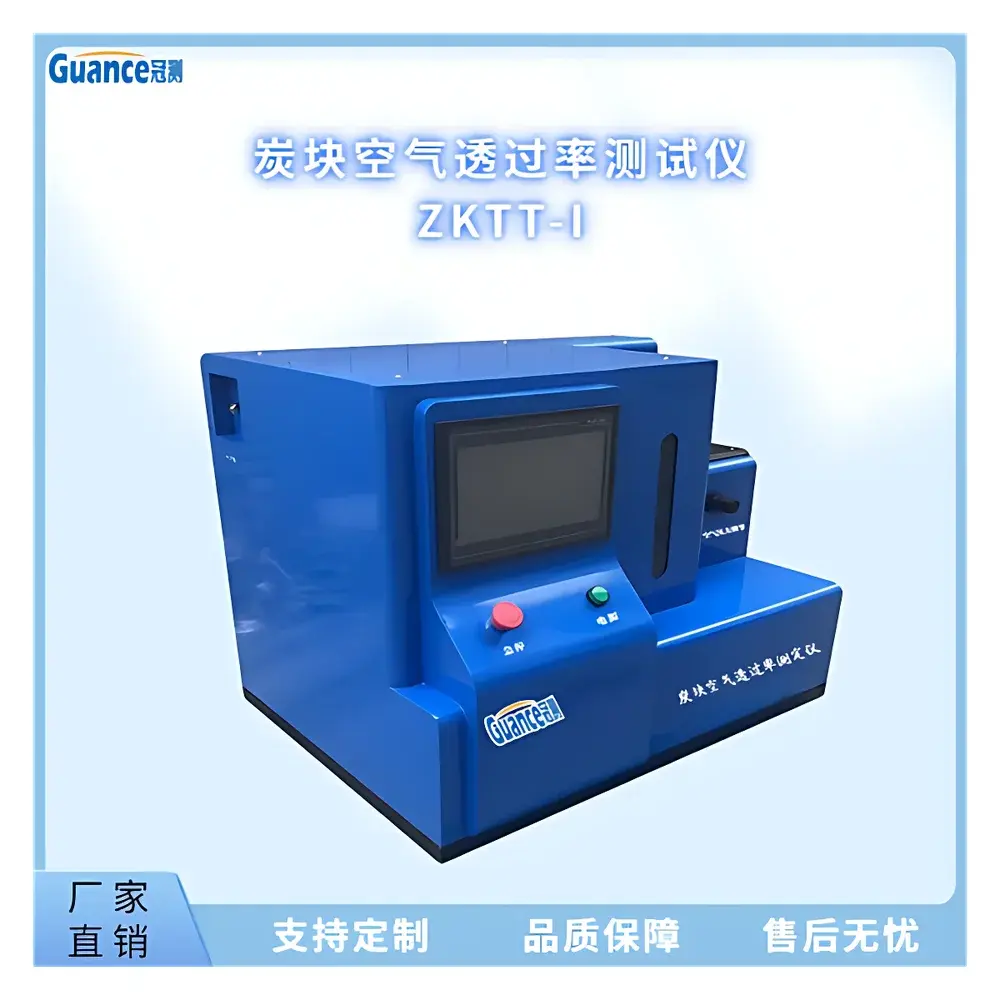
GuanCe Instruments ZKTT-Id Carbon Block Air Permeability Tester
| Brand | GuanCe Instruments |
|---|---|
| Origin | Beijing, China |
| Manufacturer Type | Authorized Distributor |
| Country of Origin | China |
| Model | ZKTT-Id |
| Rated Power | 1 kW |
| Rated Voltage | 220 V / 50 Hz |
| Pressure Sensor Range | 0–1 MPa and −100 kPa to 0 |
| Sample Dimensions | Ø50 mm × 20 mm |
| Measurement Range | 0.01 × 10⁻⁹ m² to 20 × 10⁻⁹ m² |
| Maximum Flow Rate | 25 L/min |
| Equipment Dimensions | 800 mm (L) × 620 mm (W) × 670 mm (H) |
| Net Weight | 100 kg |
| Compliance | YS/T 63.10–2012, ISO 15906:2007 (MOD), GB/T 26297.3 |
Overview
The GuanCe Instruments ZKTT-Id Carbon Block Air Permeability Tester is a precision-engineered instrument designed for the quantitative determination of air permeability in baked carbon anodes used in aluminum electrolysis. It operates on the principle of steady-state gas flow through a cylindrical carbon specimen under controlled differential pressure, conforming to Darcy’s law for laminar gas flow in porous media. The system measures volumetric airflow rate across a known cross-sectional area and thickness under calibrated upstream pressure, enabling direct calculation of intrinsic permeability (k) in m² — a critical quality parameter influencing anode reactivity, energy efficiency, and potline stability. Engineered for laboratory and QC environments in carbon manufacturing facilities, the ZKTT-Id delivers traceable, repeatable results aligned with international standard test methods for prebaked anode qualification.
Key Features
- PLC-based control architecture ensures deterministic sequencing of vacuum evacuation, pressure stabilization, flow measurement, and data logging — eliminating operator-dependent variability.
- Dual-range high-stability pressure transducers (0–1 MPa and −100 kPa to 0) enable accurate differential pressure control across both positive and negative pressure regimes during system conditioning and measurement phases.
- Touchscreen HMI (Human-Machine Interface) provides real-time visualization of test duration, applied pressure, mass flow rate, and calculated permeability value — with configurable alarm thresholds for out-of-spec conditions.
- Compressed-air-driven vacuum generation enables rapid (<60 s) system evacuation without oil-lubricated pumps, reducing maintenance overhead and eliminating hydrocarbon contamination risk to sensitive carbon specimens.
- Modular design supports optional integration of external compressed air dryers and desiccant drying units to maintain consistent inlet air dew point — essential for minimizing moisture-induced measurement drift in low-permeability specimens.
- Robust steel enclosure with electrostatic powder coating ensures long-term corrosion resistance in industrial laboratory settings with ambient humidity and occasional solvent exposure.
Sample Compatibility & Compliance
The ZKTT-Id accepts cylindrical carbon specimens measuring Ø50 mm × 20 mm — dimensionally compliant with YS/T 63.10–2012 and ISO 15906:2007 (Modified). Specimen preparation follows GB/T 26297.3 for representative sampling from prebaked anode blocks. The instrument meets metrological requirements for Type A uncertainty evaluation per ISO/IEC 17025:2017 Annex A, supporting accredited testing laboratories. Its measurement protocol satisfies the technical basis for acceptance criteria defined in IEC 60694 and EN 14384 for carbon material certification. While not FDA-regulated, its audit-ready data structure aligns with GLP principles for traceability, including timestamped raw sensor outputs, operator ID, environmental temperature/humidity logs (when interfaced with external sensors), and electronic signature-capable reporting.
Software & Data Management
The embedded firmware supports USB export of CSV-formatted datasets containing time-stamped pressure, flow, and permeability values. Optional PC software (Windows 10/11 compatible) provides advanced post-processing: automatic outlier detection using Grubbs’ test, statistical summary (mean, SD, CV%), trend analysis across batch sequences, and customizable report generation compliant with internal QA templates. All data files include embedded metadata (test ID, sample ID, calibration certificate ID, operator login, instrument serial number), satisfying 21 CFR Part 11 readiness when deployed with Windows domain authentication and write-protected storage policies. Audit trails record all configuration changes, user logins, and report exports — retained for ≥36 months per standard lab retention protocols.
Applications
- Quality control of prebaked anodes prior to furnace impregnation or potline installation.
- Process validation of carbon baking cycles — correlating permeability shifts with soak time, peak temperature, and cooling rate.
- R&D screening of binder formulations (pitch vs. resin-based) and filler particle size distributions affecting pore network geometry.
- Root cause analysis of excessive anode consumption or uneven current distribution in smelting cells.
- Supplier qualification testing against contractual permeability limits (e.g., ≤5 × 10⁻⁹ m² for high-efficiency anodes).
- Interlaboratory comparison studies under ISO 5725-2 proficiency testing frameworks.
FAQ
What standards does the ZKTT-Id explicitly support?
It is fully configured to execute test procedures per YS/T 63.10–2012 and ISO 15906:2007 (MOD), with hardware calibration traceable to NIM (National Institute of Metrology, China) certified pressure and flow standards.
Is vacuum pump oil required for operation?
No — the system uses compressed air-driven vacuum ejectors, eliminating oil contamination risk and associated maintenance intervals.
Can the instrument measure specimens other than Ø50 mm × 20 mm?
Only with custom fixture adaptation; standard compliance and accuracy claims apply exclusively to the specified geometry per referenced standards.
How is measurement repeatability verified?
Each unit undergoes factory verification using NIST-traceable stainless-steel reference permeability discs with certified k-values (±2.5% expanded uncertainty), documented in the included calibration certificate.
Is remote diagnostics supported?
Yes — optional Ethernet module enables secure SSH access for firmware updates and diagnostic log retrieval, subject to local network security policy approval.




