
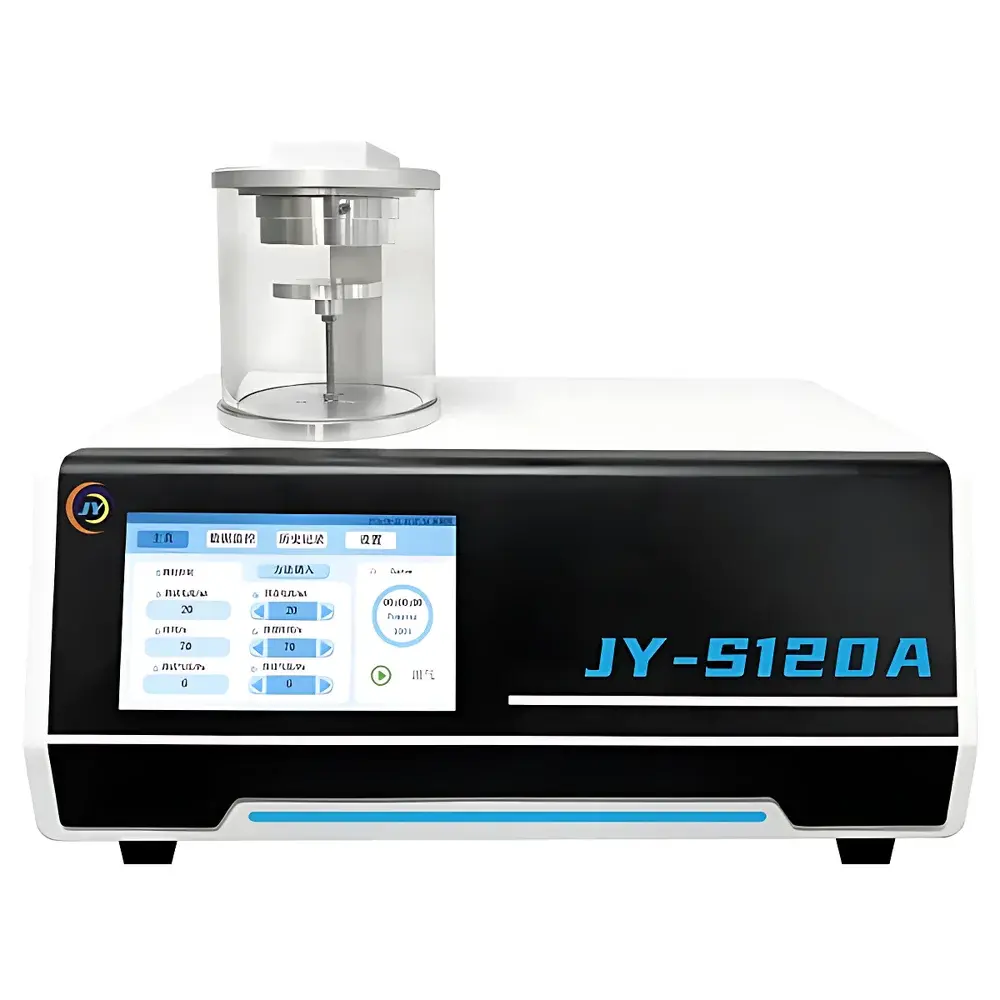
Guangzhou Jingying JY-S120A Automatic Ion Sputter Coater
| Brand | Guangzhou Jingying |
|---|---|
| Origin | Guangdong, China |
| Manufacturer Type | Direct Manufacturer |
| Country of Origin | China |
| Model | JY-S120A |
| Target Materials | Au, Pt, Au/Pd, Pd, Ag, Pt/Pd |
| Target Diameter | 57 mm |
| Control Method | Fully Automatic Digital Control |
| Sample Stage Diameter | 63 mm |
| Sputtering Gases | Argon (Ar) and Air |
| Operating Vacuum Range | 3–15 Pa (1 Pa step) |
| Sputtering Current | 3–40 mA (1 mA step) |
| Sputtering Time | 1–999 s (1 s step) |
| Chamber Material | Borosilicate Glass (Ø120 × 120 mm) |
| Pumping Speed | 2.2 L/s |
| Ultimate Vacuum | 5 × 10⁻² Pa |
| Power Consumption | 80 W (coater), 400 W (pump) |
| Noise Level | 56 dB(A) |
| Display | Touch-enabled IPS LCD with Chinese/English UI |
| Preset Programs | 6 user-configurable protocols |
| Vacuum Gauge | Digital Pirani sensor |
| Data Logging | Real-time current & pressure curves |
Overview
The Guangzhou Jingying JY-S120A Automatic Ion Sputter Coater is a compact, benchtop-grade magnetron sputtering system engineered for high-fidelity conductive coating of non-conductive specimens prior to scanning electron microscopy (SEM) analysis. It employs low-pressure DC magnetron sputtering—a physically vapor deposition (PVD) technique—where energetic argon ions bombard a metallic target (e.g., Pt or Au), ejecting atoms that condense uniformly onto sample surfaces under controlled vacuum conditions. Unlike thermal evaporation, this process minimizes localized heating and preserves delicate microstructures, making it suitable for biological tissues, polymers, ceramics, and fragile geological sections. The JY-S120A operates within a stable 3–15 Pa working pressure range, ensuring reproducible film nucleation and sub-5 nm grain size distribution across diverse substrates. Its borosilicate glass chamber (Ø120 × 120 mm) provides full optical access for real-time visual monitoring during deposition, while the integrated digital Pirani vacuum gauge delivers continuous, calibrated pressure feedback essential for method transfer and inter-laboratory consistency.
Key Features
- Fully automated workflow: Sequential execution of chamber evacuation, gas purging, parameter ramp-up, sputtering, and venting—all programmable and repeatable without manual intervention.
- Digital current regulation: Independent of chamber pressure fluctuations, enabling precise control over sputtering rate (typically 0.1–0.8 nm/s for Pt at 20 mA, 8 Pa Ar) and layer thickness reproducibility (±3% RSD across 10 consecutive runs).
- Intuitive human-machine interface: 7-inch capacitive IPS touchscreen with bilingual (English/Chinese) firmware, real-time graphical display of sputtering current and chamber pressure, and touch-responsive audio feedback (configurable on/off).
- Modular target compatibility: Accepts standard 57 mm diameter targets—including Pt, Au, Au/Pd (80/20), Pd, Ag, and Pt/Pd—with tool-free mounting and alignment verification via built-in mechanical stops.
- Comprehensive data traceability: Onboard memory logs timestamped records of all operational parameters per run—including start/end time, final pressure, average current, total sputtering duration, and cumulative target usage hours—supporting GLP-compliant documentation requirements.
- Compact footprint and safety integration: Dimensions of 450 × 310 × 340 mm accommodate standard fume hoods or SEM prep rooms; includes overpressure interlock, current limit protection, and audible/visual end-of-process alerts.
Sample Compatibility & Compliance
The JY-S120A accommodates up to twelve 12.7 mm pin-mount SEM stubs on its Ø63 mm rotating sample stage, with vertical adjustment (25–65 mm) to optimize target-to-substrate distance for uniformity. It supports flat, irregular, and height-varied specimens—including freeze-fractured cryo-sections, electrospun nanofibers, and fractured metallographic cross-sections—without requiring conductive adhesives or carbon tabs in most cases. The system meets IEC 61000-6-3 (EMC emission) and IEC 61000-6-2 (immunity) standards. While not certified to ISO 13485 or FDA 21 CFR Part 11 out-of-the-box, its audit-ready data logging architecture—retaining raw sensor values and operator actions—facilitates validation for regulated environments when paired with documented SOPs and periodic performance qualification (PQ) per ASTM E2937-21 (Standard Guide for SEM Sample Preparation).
Software & Data Management
No external PC or proprietary software is required: all configuration, execution, and review occur locally via the embedded Linux-based controller. Six programmable protocols can be saved with descriptive names (e.g., “Pt_15s_25mA”), each storing vacuum setpoint, current, duration, gas type, and stage position. Historical logs are exportable via USB flash drive in CSV format, containing columns for Run_ID, Timestamp, Target_Type, Pressure_Pa, Avg_Current_mA, Duration_s, and Target_Hours_Used. Session curves (current vs. time, pressure vs. time) render in real time and persist in memory for post-run analysis—enabling correlation between arcing events, pressure instability, and film quality anomalies.
Applications
- Routine SEM sample preparation for insulating materials: ceramics, oxides, biological tissues, polymers, and composites.
- High-resolution backscattered electron (BSE) imaging requiring topographic contrast enhancement without edge charging artifacts.
- Energy-dispersive X-ray spectroscopy (EDS) mapping where ultra-thin, homogeneous coatings minimize beam penetration and secondary fluorescence interference.
- Serial block-face SEM (SBF-SEM) and focused ion beam–SEM (FIB-SEM) workflows demanding consistent conductivity across hundreds of sequential sections.
- Teaching laboratories: Demonstrating thin-film growth kinetics, plasma physics fundamentals, and vacuum science principles with visual process transparency.
FAQ
What vacuum pump is compatible with the JY-S120A?
The system integrates a dedicated 400 W two-stage rotary vane pump with 2.2 L/s pumping speed and ultimate vacuum ≤5 × 10⁻² Pa. External turbomolecular or dry scroll pumps are not supported due to interface and control protocol constraints.
Can the JY-S120A perform glow discharge cleaning?
No. This unit is configured exclusively for DC magnetron sputtering. Glow discharge functionality requires separate RF or AC power supplies and electrode geometry not present in this design.
Is remote operation or network connectivity available?
No Ethernet, Wi-Fi, or RS-232 interfaces are provided. All operation and data retrieval occur locally via touchscreen or USB.
How often does the vacuum oil require replacement?
Under typical usage (≤5 runs/day), pump oil should be replaced every 6 months or after 1,000 operating hours, per manufacturer specifications for the integrated rotary vane pump.
Does the system support thickness monitoring via quartz crystal microbalance (QCM)?
No. Film thickness estimation relies on empirical calibration (e.g., 20 mA × 30 s ≈ 3–5 nm Pt under standard conditions); optional QCM integration is not offered in this model tier.



