
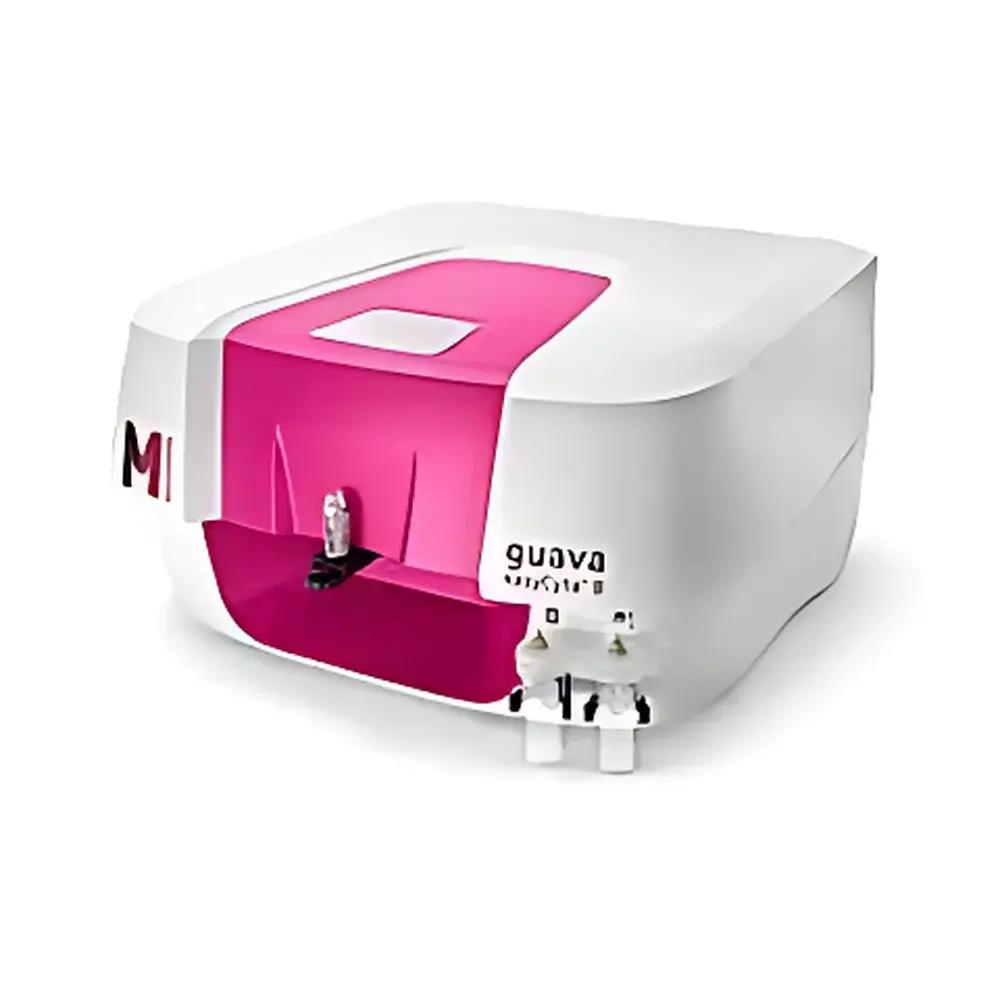
Guava easyCyte 8 Microflow Cytometer
| Brand | Merck |
|---|---|
| Origin | USA |
| Manufacturer Type | Original Equipment Manufacturer (OEM) |
| Import Status | Imported |
| Model | easyCyte 8 |
| Product Category | Flow Cytometer |
| Laser Configuration | Dual-laser (488 nm blue + 635 nm red) |
| Fluorescence Channels | 6 (Green, Yellow, Red1, Red2, NIR1, NIR2) + 2 Scatter (FSC, SSC) |
| Sample Format | 1.2 mL or 1.5 mL microtubes |
| Software Platform | guava InCyte v3.x |
Overview
The Guava easyCyte 8 Microflow Cytometer is a compact, benchtop flow cytometry system engineered for precision cell analysis in resource-constrained or high-throughput laboratory environments. Unlike conventional flow cytometers requiring sheath fluid, hydrodynamic focusing, and complex alignment, the easyCyte 8 employs proprietary microfluidic sample delivery—integrating capillary-based aspiration, laminar flow focusing, and real-time impedance-based volumetric counting. This architecture eliminates reliance on calibrated sheath flow rates, enabling direct absolute cell concentration measurement (cells/µL) without reference beads or secondary standards. The dual-laser excitation platform (488 nm blue diode laser and 635 nm red diode laser) supports simultaneous detection across eight optical parameters: forward scatter (FSC), side scatter (SSC), and six spectrally resolved fluorescence channels—Green (525/30 nm), Yellow (583/26 nm), Red1 (690/50 nm), Red2 (661/19 nm), NIR1 (785/70 nm), and NIR2 (785/70 nm). All emission filters are high-transmission, narrow-band interference filters with optimized optical isolation to minimize spillover between adjacent channels—critical for multicolor panel design and quantitative compensation accuracy.
Key Features
- Microfluidic volumetric sampling: Delivers absolute cell counts without calibration beads or volumetric pipetting errors.
- Dual-laser excitation (488 nm + 635 nm): Enables broad fluorophore compatibility—including FITC, PE, PerCP-Cy5.5, APC, APC-Cy7, and near-infrared dyes (e.g., Cy7, IRDye 800CW).
- Eight-parameter detection capability: Two light scatter channels plus six fluorescence detectors with >3-decade dynamic range per channel.
- Integrated thermal control: Maintains sample integrity at 4–30 °C during acquisition to preserve viability and signaling kinetics.
- Low sample consumption: Requires only 20–100 µL per assay; compatible with standard 1.2 mL or 1.5 mL microcentrifuge tubes—no specialized cartridges or flow cells.
- Self-aligning optical path: Factory-optimized laser-to-detector coupling reduces user maintenance and ensures long-term signal stability.
Sample Compatibility & Compliance
The easyCyte 8 accepts suspension cells from diverse sources—including primary human PBMCs, murine splenocytes, cultured mammalian lines (HEK293, Jurkat, THP-1), yeast, and bacteria—without centrifugation or filtration steps. Its microfluidic chip accommodates particles ranging from 1 µm to 30 µm in diameter. The system complies with IEC 61010-1:2010 safety standards for laboratory equipment and meets electromagnetic compatibility (EMC) requirements per EN 61326-1:2013. Data acquisition and analysis workflows support GLP/GMP-aligned documentation practices, including audit-trail-enabled software logging (via guava InCyte), electronic signature readiness, and export formats compliant with ISO/IEC 17025 reporting guidelines. While not FDA 21 CFR Part 11–certified out-of-the-box, the platform supports configuration controls and procedural documentation required for regulated QC environments.
Software & Data Management
guava InCyte software (v3.x) provides a unified interface for instrument control, real-time data acquisition, and advanced analysis. Key capabilities include drag-and-drop gating with hierarchical gate logic, on-the-fly compensation matrix calculation using single-stained controls, and offline recompensation without raw FCS file regeneration. Visualization tools encompass dot plots, histograms, contour plots, heatmaps (for population frequency mapping across multi-condition experiments), and dose–response curve fitting (IC50/EC50) using nonlinear regression (four-parameter logistic model). Data exports support FCS 3.0/3.1, CSV, PDF, and PNG formats. All analysis sessions are timestamped and logged with operator ID, instrument serial number, and acquisition parameters—ensuring traceability for method validation and regulatory submissions.
Applications
- Leukocyte immunophenotyping: Simultaneous identification of T-cell subsets (CD3/CD4/CD8), B cells (CD19), monocytes (CD14), and activation markers (CD25, CD69, HLA-DR).
- Intracellular cytokine staining: Quantification of IFN-γ, IL-2, TNF-α, and IL-17A in stimulated PBMCs or isolated T-cell populations.
- Apoptosis and viability assessment: Dual staining with Annexin V–FITC and propidium iodide or 7-AAD.
- Cell signaling analysis: Phospho-flow detection of p-ERK, p-AKT, p-STAT5 using fluorescently conjugated antibodies.
- High-content compound screening: Multiplexed readouts of cytotoxicity, oxidative stress (DCFDA), mitochondrial membrane potential (TMRE), and calcium flux (Fluo-4).
- Viral transduction efficiency: Co-detection of reporter expression (GFP/RFP) and surface marker modulation post-transduction.
FAQ
Does the easyCyte 8 require sheath fluid or daily alignment?
No—its microfluidic cartridge uses passive hydrodynamic focusing and requires no sheath fluid, tubing, or daily optical alignment.
Can I use third-party antibodies and fluorophores with this system?
Yes—the 488 nm and 635 nm lasers support most commercially available conjugates; spectral overlap must be assessed using the provided filter transmission profiles.
Is absolute counting traceable to NIST standards?
Absolute counts are derived from microfluidic volume displacement calibrated against gravimetric standards during manufacturing; NIST-traceable verification kits are available separately.
What file format does it generate for downstream analysis in FlowJo or FCS Express?
Exports native FCS 3.1 files with complete metadata, including instrument settings, compensation matrices, and gate definitions.
How is temperature controlled during acquisition?
The sample port includes Peltier-based cooling/heating with closed-loop feedback, maintaining ±0.5 °C stability across the 4–30 °C operating range.




