
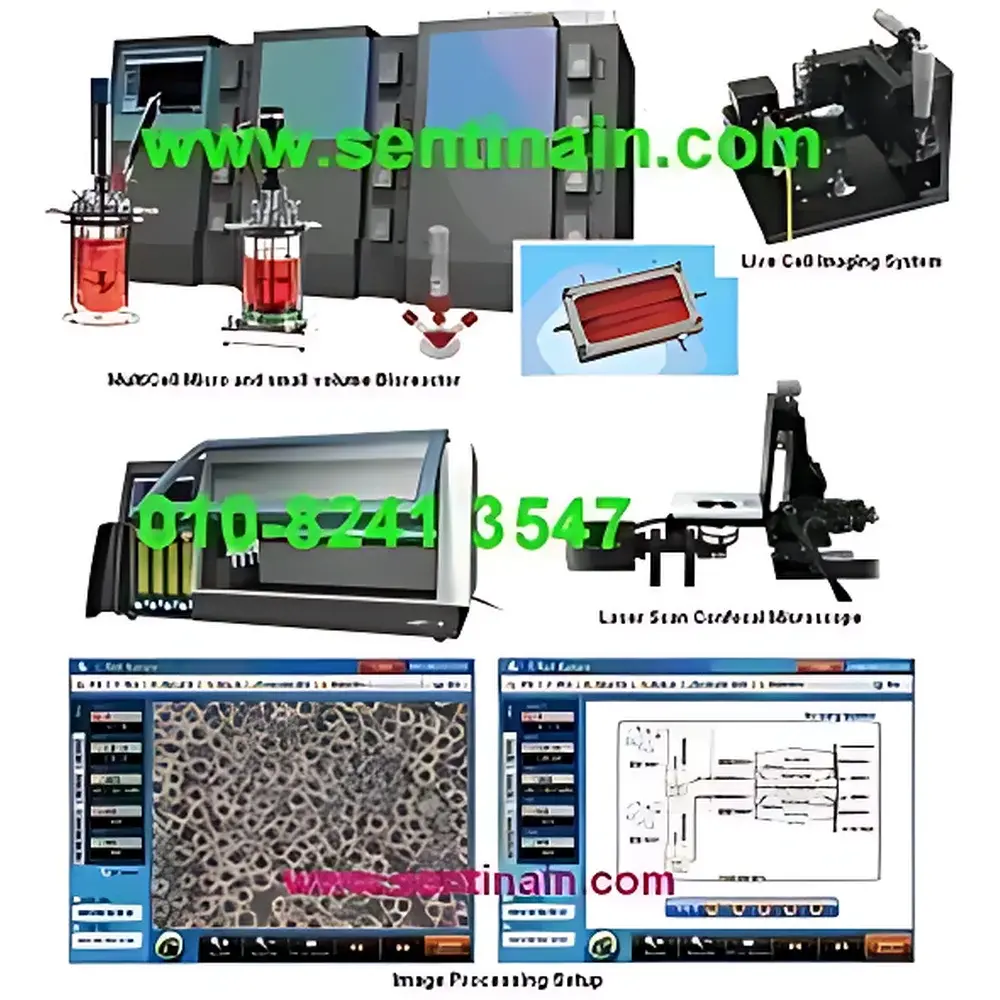
GX Bioreactor – Modular Animal Cell Culture Observation System with Integrated Semiconductor Biosensors
| Origin | South Korea |
|---|---|
| Supplier Type | Authorized Distributor |
| Origin Category | Imported |
| Model | GX Bioreactor |
| Pricing | Upon Request |
Overview
The GX Bioreactor is a modular, scalable animal cell culture observation system engineered for high-fidelity monitoring and controlled microenvironmental modulation during adherent and suspension mammalian cell cultivation—particularly critical for stem cell expansion, 3D organoid development, and therapeutic protein production. Unlike conventional stirred-tank bioreactors relying on mechanical agitation, the GX platform employs a magnetically coupled impeller design with ultra-low-shear hydrodynamics to minimize mechanical stress on sensitive primary and pluripotent cells. Its core innovation lies in the integration of proprietary lateral- and backside-isolated semiconductor biosensors (patent-pending), enabling simultaneous, real-time, non-invasive measurement of pH, dissolved oxygen (DO), and temperature directly at the cellular interface—not merely in bulk medium. This architecture supports physiologically relevant spatial resolution for metabolic profiling, essential for process understanding under dynamic perfusion or differentiation-inducing stimuli.
Key Features
- Modular multi-vessel configuration: Supports up to 24 serially connected bioreactors (10–100 mL working volume per vessel), enabling parallel parameter screening and scale-down modeling compliant with QbD principles.
- Integrated all-in-one semiconductor sensor array: ISFET-based pH, thermistor-integrated DO, and junctionless temperature sensing—all embedded within a sub-millimeter footprint, eliminating conventional probe fouling and calibration drift.
- Low-shear agitation: Smooth-profile magnetic impellers and optimized flow path geometry reduce turbulent kinetic energy, preserving viability in shear-sensitive applications such as neural progenitor expansion or cardiomyocyte differentiation.
- Flexible perfusion architecture: Controller supports up to 16 variable-speed and 24 fixed-speed peristaltic pumps for precise feed control of glucose, glutamine, FBS, antibiotics, and growth factors—enabling fed-batch, continuous perfusion, and gradient-based cytokine delivery.
- Dual-display control interface: Optional LCD-mounted master module (for standalone operation) or headless distributed node configuration (for centralized PC-based supervision of up to 256 vessels via daisy-chained modules).
- Stimulus-integrated culture chamber: Customizable single-use bioreactor cartridges compatible with ultrasonic stimulation, programmable electrical pulse delivery (electroporation-grade waveform control), and wavelength-specific optical actuation—designed to replicate in vivo biophysical cues.
Sample Compatibility & Compliance
The GX Bioreactor accommodates diverse cell culture modalities: microcarrier-based adherent cultures (e.g., Cytodex™, Cultispher®), encapsulated systems (alginate, chitosan microcapsules), U-shaped carriers, soft agar overlays, and suspension lines (CHO, HEK293, CAP-T). Its single-use cartridge design eliminates cross-contamination risk and satisfies ISO 13485 requirements for medical device manufacturing environments. Sensor firmware and data acquisition software are designed with audit trail capability, electronic signature support, and configurable user access levels—aligning with FDA 21 CFR Part 11 and EU Annex 11 expectations for GMP-compliant cell therapy process development. All hardware components comply with IEC 61000-6-2/6-4 EMC standards and UL/CSA safety certifications.
Software & Data Management
The GX Control Suite provides integrated PID loop management for pH, DO, temperature, agitation speed, gas blending ratios (O₂/CO₂/N₂/air), and perfusion rate. Calibration workflows include automated two-point pH standardization, dynamic DO re-calibration under defined nitrogen purge conditions, and thermal offset compensation across operating ranges. Image processing functionality supports time-lapse acquisition (JPEG, TIFF, AVI), ROI-based intensity quantification, and overlay of sensor-derived metabolic trends onto phase-contrast or fluorescence sequences. Raw sensor data, event logs, and image metadata are timestamped and stored locally (onboard 128 MB flash) or exported to external NAS/SQL databases. Data export formats include CSV, HDF5, and MIAME-compliant XML for downstream analysis in MATLAB, Python (Pandas/Plotly), or commercial bioprocess analytics platforms.
Applications
- Stem cell bioprocessing: Scalable expansion of MSCs, iPSCs, and hematopoietic progenitors under low-shear, stimulus-responsive conditions—supporting clinical-grade manufacturing aligned with ISCT guidelines.
- 3D tissue model development: Real-time monitoring of metabolic gradients in spheroid and organoid cultures during vascularization or drug-induced maturation.
- Therapeutic protein optimization: High-throughput evaluation of clone performance, media formulation, and feeding strategies in miniature bioreactors—reducing reliance on large-scale pilot runs.
- Regulatory filing support: Generation of robust process characterization data (PCD) and design space maps required for IND/IMPD submissions, including demonstration of control strategy effectiveness for critical quality attributes (CQAs).
- Academic translational research: Enabling mechanistic studies on electrophysiological priming, acoustic bioeffects, or photobiomodulation in controlled bioreactor environments.
FAQ
Does the GX Bioreactor support FDA submission-ready documentation packages?
Yes—system validation templates, IQ/OQ protocols, sensor calibration records, and audit trail reports are provided as part of the GxP Support Package.
Can the semiconductor sensors be recalibrated in situ without removing the cartridge?
Yes—pH and DO sensors feature built-in reference electrode compensation and auto-zero routines executable during operation using standardized buffer solutions and nitrogen sparging.
Is the controller compatible with third-party SCADA or MES systems?
Yes—the GX Control Suite exposes OPC UA and Modbus TCP interfaces for seamless integration into existing industrial automation infrastructures.
What is the minimum viable culture volume per vessel?
The system supports operational volumes from 10 mL to 100 mL, validated for consistent mixing, mass transfer, and sensor response across the range.
Are custom cartridge geometries available for specialized cell types?
Yes—Kyocera’s 3D ceramic platform enables rapid prototyping of substrate topographies, microfluidic channeling, and integrated electrode layouts per client specification.
Related Products



