
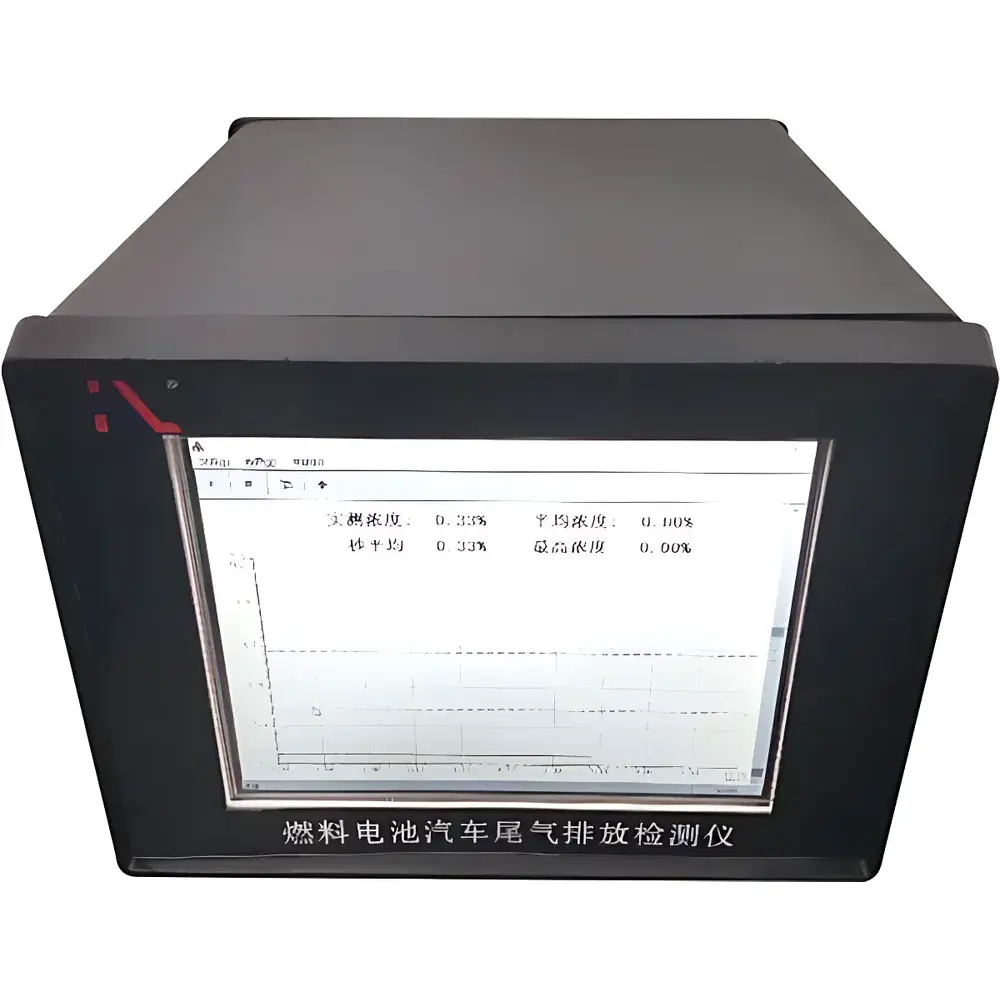
HA-Ai HA-H2 Portable Hydrogen Emission Analyzer for Fuel Cell Electric Vehicles
| Brand | HA-Ai |
|---|---|
| Model | HA-H2 |
| Origin | Shanghai, China |
| Manufacturer Type | Direct Manufacturer |
| Instrument Type | Portable |
| Detection Principle | Thermal Conductivity Detection (TCD) |
| Maximum Permissible Error | ±1%–±10% FS |
| Zero Drift | ≤1% FS/24h |
| Span Drift | ≤3% FS/24h |
| Repeatability | ≤2% RSD |
| Compliance | GB/T 37154–2018, GB/T 24549–2009 |
Overview
The HA-Ai HA-H2 Portable Hydrogen Emission Analyzer is a purpose-built instrument engineered for quantitative measurement of hydrogen (H₂) concentration in exhaust streams from fuel cell electric vehicles (FCEVs). It operates on the principle of thermal conductivity detection (TCD), a robust and well-established physical method for binary or quasi-binary gas mixtures where H₂ exhibits significantly higher thermal conductivity (~7–8×) than common background gases such as nitrogen, carbon dioxide, and water vapor. The analyzer draws sample gas via an integrated diaphragm pump (pump-suction sampling), delivering consistent flow to a dual-element TCD sensor cell—one element exposed to the sample stream, the other sealed with reference gas (typically air or N₂). Differential thermal resistance changes between the two elements generate a measurable voltage output proportional to H₂ concentration. This analog signal is conditioned by a high-stability precision amplifier and regulated power supply circuitry, ensuring low-noise acquisition and minimal baseline fluctuation—critical for trace-level monitoring in dynamic vehicle exhaust environments.
Key Features
- Portable, battery-operated design with ergonomic carrying handle and integrated rechargeable Li-ion pack (≥6 h continuous operation)
- Real-time H₂ measurement range: 0–10%, 0–50%, or 0–100% vol (user-selectable full-scale spans)
- Thermal conductivity sensor with temperature-compensated bridge circuitry for improved stability across ambient conditions (5–40 °C)
- Dual-stage particulate and moisture filtration system to protect sensor integrity during field use
- Auto-zero function with programmable zero interval (1–24 h) and span-check capability using certified H₂/N₂ standard gas
- IP65-rated enclosure for dust and water resistance; designed for under-hood and roadside testing scenarios
- Internal data logger with timestamped storage (up to 10,000 records); USB-C interface for CSV export and firmware updates
Sample Compatibility & Compliance
The HA-H2 is validated for use with humid, warm, and particulate-laden exhaust effluents typical of FCEV tailpipe emissions—provided gas temperature remains below 80 °C and condensate is removed upstream. It is not intended for direct installation in high-pressure or cryogenic hydrogen delivery lines. The instrument conforms to key national standards governing hydrogen safety and emission verification in China: GB/T 37154–2018 specifies test procedures for whole-vehicle hydrogen emission quantification—including idle, acceleration, and deceleration phases—and mandates instrumentation with documented linearity, repeatability, and drift performance matching HA-H2’s published specifications. GB/T 24549–2009 defines functional safety requirements for FCEV systems, including hydrogen leak detection thresholds and response time criteria; while the HA-H2 is not a safety shutdown device, its measurement accuracy and stability support compliance auditing and type-approval documentation per this standard.
Software & Data Management
The HA-H2 includes embedded firmware supporting real-time display (OLED screen), configurable alarm thresholds (visual + audible), and manual/automatic calibration logging. Optional PC software (HA-Ai DataLink v2.1) enables advanced post-processing: time-series overlay, statistical summary (mean, SD, max/min), and report generation compliant with GLP-aligned lab notebooks. All calibration events—including date, operator ID, standard gas lot number, and before/after span verification—are immutably recorded with electronic signatures. Audit trail functionality satisfies basic data integrity requirements aligned with ISO/IEC 17025 and supports traceability for regulatory submissions. Exported datasets include UTC timestamps, instrument serial number, and environmental metadata (ambient T/P), facilitating correlation with vehicle CAN bus logs during on-road testing.
Applications
- On-vehicle hydrogen emission verification during certification testing (e.g., CNAS-accredited labs conducting GB/T 37154–2018 protocols)
- Development-phase validation of fuel cell stack sealing integrity and purge valve performance
- Field diagnostics of unintended H₂ leakage at refueling interfaces, coolant loops, or cathode exhaust manifolds
- Comparative benchmarking of aftertreatment strategies for residual H₂ oxidation efficiency
- Educational use in automotive engineering programs focusing on zero-emission powertrain emissions science
FAQ
What is the recommended calibration frequency for routine FCEV testing?
Calibration is advised before each test session using certified H₂/N₂ standard gas (e.g., 10.0 ± 0.1% vol); zero check should be performed every 2 hours during extended field campaigns.
Can the HA-H2 measure hydrogen in the presence of CO₂ or water vapor?
Yes—the TCD sensor is inherently selective for H₂ vs. CO₂ and tolerates up to 95% RH when used with the included hydrophobic filter; however, liquid water ingress must be prevented via proper sample conditioning.
Does the instrument meet any international standards beyond Chinese GB specifications?
While not certified to ISO 15055 or SAE J2529, its metrological performance aligns with the technical requirements of those frameworks for portable H₂ analyzers used in light-duty vehicle applications.
Is remote data transmission supported?
No built-in cellular or Wi-Fi module is provided; however, USB-C–connected laptops or industrial tablets can run HA-Ai DataLink for live telemetry and automated report drafting.
How is sensor contamination mitigated during long-term use?
The dual-stage filter assembly (PTFE membrane + activated carbon sorbent) reduces oil mist, sulfur compounds, and particulates; sensor cleaning is recommended annually or after exposure to >100 ppm total hydrocarbons.
Related Products







