
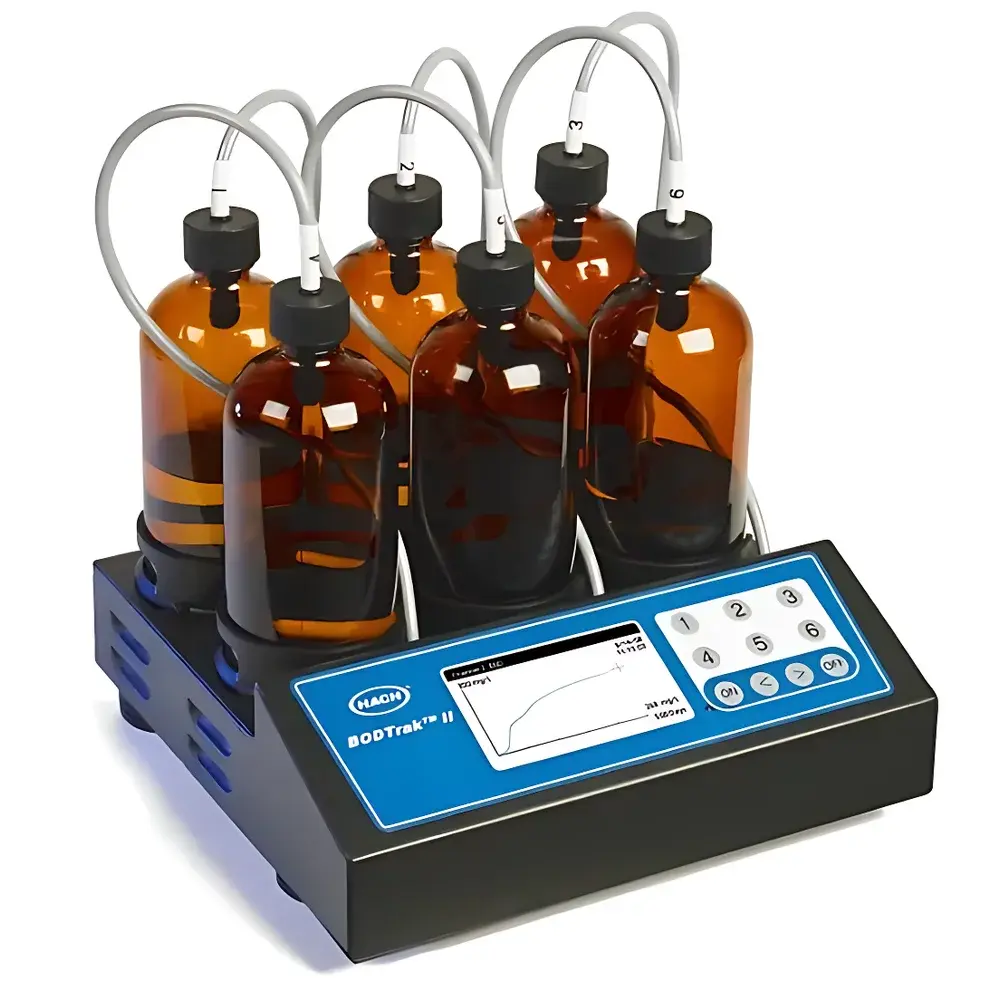
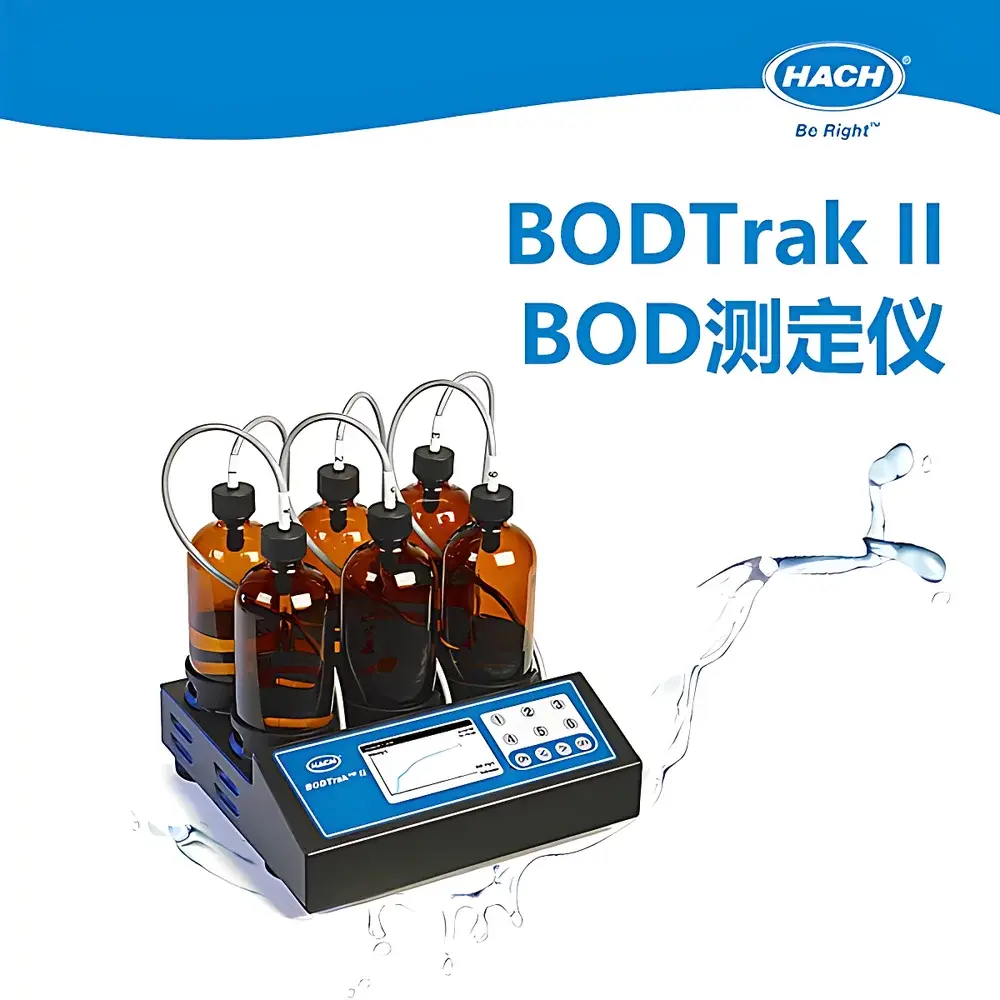
Hach BODTrak II Biochemical Oxygen Demand Analyzer
| Brand | Hach |
|---|---|
| Origin | Imported |
| Manufacturer Type | Original Equipment Manufacturer (OEM) |
| Instrument Type | Laboratory BOD Analyzer |
| Model | BODTrak II |
| Measurement Principle | Manometric (Pressure-Difference) Method |
| Measurement Range | 0–700 mg/L O₂ |
| Accuracy | ±5% of reading |
| Sample Throughput | 6 samples per run (473 mL bottles) |
| Incubation Temperature | 20 °C (±0.5 °C) |
| Data Storage | Up to 480 data points per sample |
| Display | Graphical LCD with real-time BOD curve visualization |
| Sensor | Integrated microprocessor-controlled pressure transducer |
| Power Supply | AC-powered magnetic stirrer base |
| Dimensions | 28.9 × 26.0 × 9.8 cm |
| Compliance | Designed to meet ASTM D5210, ISO 5815-1, and EPA 405-B-16-001 requirements for BOD₅ testing |
Overview
The Hach BODTrak II Biochemical Oxygen Demand Analyzer is a dedicated laboratory instrument engineered for precise, standardized determination of five-day biochemical oxygen demand (BOD₅) in water and wastewater samples. It operates on the manometric (pressure-difference) principle—a gravimetrically traceable, non-depleting measurement method that quantifies oxygen consumption indirectly by monitoring pressure changes within a sealed incubation vessel. As microorganisms metabolize biodegradable organic matter under controlled aerobic conditions at 20 °C, dissolved oxygen is consumed and replenished from the headspace; simultaneously, CO₂ generated during respiration is chemically absorbed by potassium hydroxide (KOH) pellets integrated into the bottle cap. This absorption prevents CO₂ buildup and ensures that observed pressure decline correlates linearly with O₂ uptake—enabling direct calculation of BOD in mg/L O₂ without titration or dilution corrections. The system complies with internationally recognized protocols including ASTM D5210 (Standard Test Method for Determining Anaerobic Biodegradation of Plastic Materials Under Accelerated Conditions), ISO 5815-1:2019 (Water quality — Determination of biochemical oxygen demand after n days — Part 1: Dilution method), and U.S. EPA Method 405-B-16-001.
Key Features
- Manometric measurement architecture eliminates need for frequent calibration standards or reagent-based titrations.
- Integrated microprocessor-controlled pressure transducer provides continuous, high-resolution monitoring of headspace pressure with <0.1 kPa resolution.
- Real-time graphical LCD display shows dynamic BOD curves for all six samples simultaneously, supporting visual assessment of microbial activity onset and stabilization.
- Onboard data storage retains up to 480 time-stamped data points per sample, facilitating full audit trails compatible with GLP and GMP documentation workflows.
- Dual-mode operation: supports both standard 5-day BOD₅ assays and extended incubation periods for low-BOD or recalcitrant samples.
- AC-powered magnetic stirrer base maintains consistent, gentle agitation across all six 473 mL BOD bottles to ensure uniform oxygen transfer and prevent sedimentation-related bias.
- Thermally stabilized incubation chamber maintains 20 °C ±0.5 °C throughout the test duration—critical for reproducibility per regulatory temperature specifications.
Sample Compatibility & Compliance
The BODTrak II accommodates standard 473 mL glass BOD bottles fitted with KOH-absorbing caps, making it fully compatible with existing laboratory infrastructure and sample preservation practices. It accepts raw influent, treated effluent, surface water, groundwater, and industrial process streams—provided samples are seeded appropriately where endogenous microbial populations are insufficient. The analyzer meets functional equivalence requirements outlined in ISO/IEC 17025 for testing laboratories and supports compliance with U.S. Clean Water Act reporting mandates. Its pressure-based methodology avoids interference from colored, turbid, or high-suspended-solids matrices that often compromise dilution-method accuracy. All firmware and data handling routines adhere to ALCOA+ principles (Attributable, Legible, Contemporaneous, Original, Accurate, Complete, Consistent, Enduring, Available), enabling traceability for FDA 21 CFR Part 11–aligned environments when paired with validated LIMS integration.
Software & Data Management
Data export is supported via USB interface to standard CSV format, preserving timestamps, pressure readings, calculated BOD values, and derivative metrics (e.g., rate-of-consumption slope). No proprietary software installation is required—raw files are natively readable in Excel, MATLAB, or statistical analysis platforms. Each stored dataset includes metadata fields for operator ID, sample ID, collection date, incubation start time, and bottle-specific KOH lot number—ensuring full chain-of-custody integrity. Optional Hach Lab Software Suite (v3.2+) enables automated report generation compliant with EPA Form 3320-1 and ISO 14001 environmental management system documentation templates.
Applications
- Regulatory compliance monitoring of municipal and industrial wastewater discharge permits (NPDES, ISO 14001).
- Performance evaluation of biological treatment units (activated sludge, trickling filters, MBRs).
- Assessment of biodegradability of new chemical formulations, pharmaceutical intermediates, and agrochemical runoff.
- Research-grade kinetic profiling of microbial oxygen uptake rates under varying nutrient or toxicity conditions.
- Educational use in environmental engineering and microbiology laboratories requiring hands-on BOD methodology instruction.
FAQ
Does the BODTrak II require daily calibration?
No—its pressure transducer is factory-calibrated and drift-compensated through internal reference algorithms; only periodic verification using certified zero-pressure and span-gas checks is recommended per ASTM D5210 Annex A3.
Can it measure BOD beyond 5 days?
Yes—users may configure custom incubation durations from 1 to 28 days to characterize slow-degrading compounds or assess ultimate BOD (BODu).
Is seeding required for all samples?
Seeding is mandatory for samples with low indigenous heterotrophic biomass (e.g., chlorinated effluents, oligotrophic surface waters); Hach provides standardized nitrification-inhibited seed suspension kits (Catalog No. 2975100) for reproducible results.
How does it handle high-BOD samples above 700 mg/L?
Samples exceeding the upper detection limit must be diluted prior to analysis using Hach’s certified dilution water (Catalog No. 2974900); the instrument applies automatic dilution factor correction if entered manually pre-run.
What maintenance is required?
Routine maintenance includes quarterly cleaning of stirrer magnets, annual KOH cap replacement, and biannual verification of thermal stability using NIST-traceable thermistors—no field service tools or consumable sensors are needed.







