
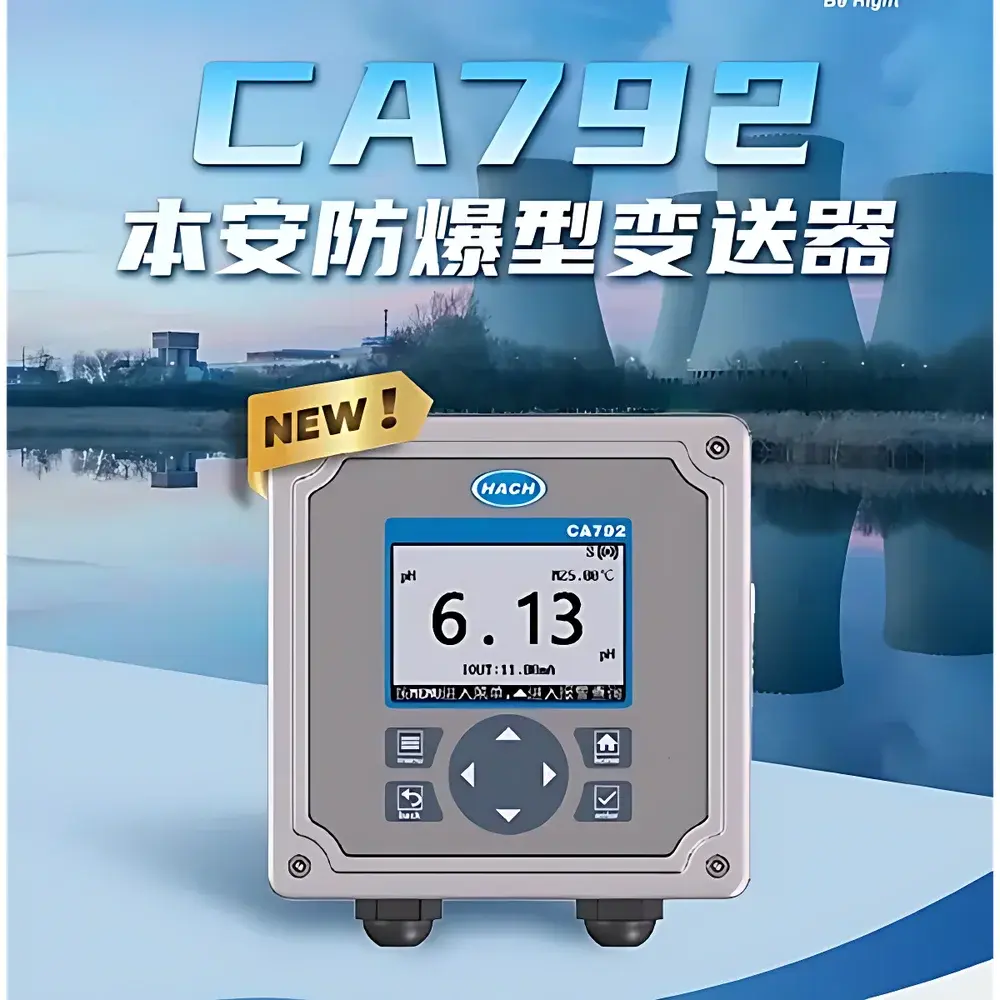
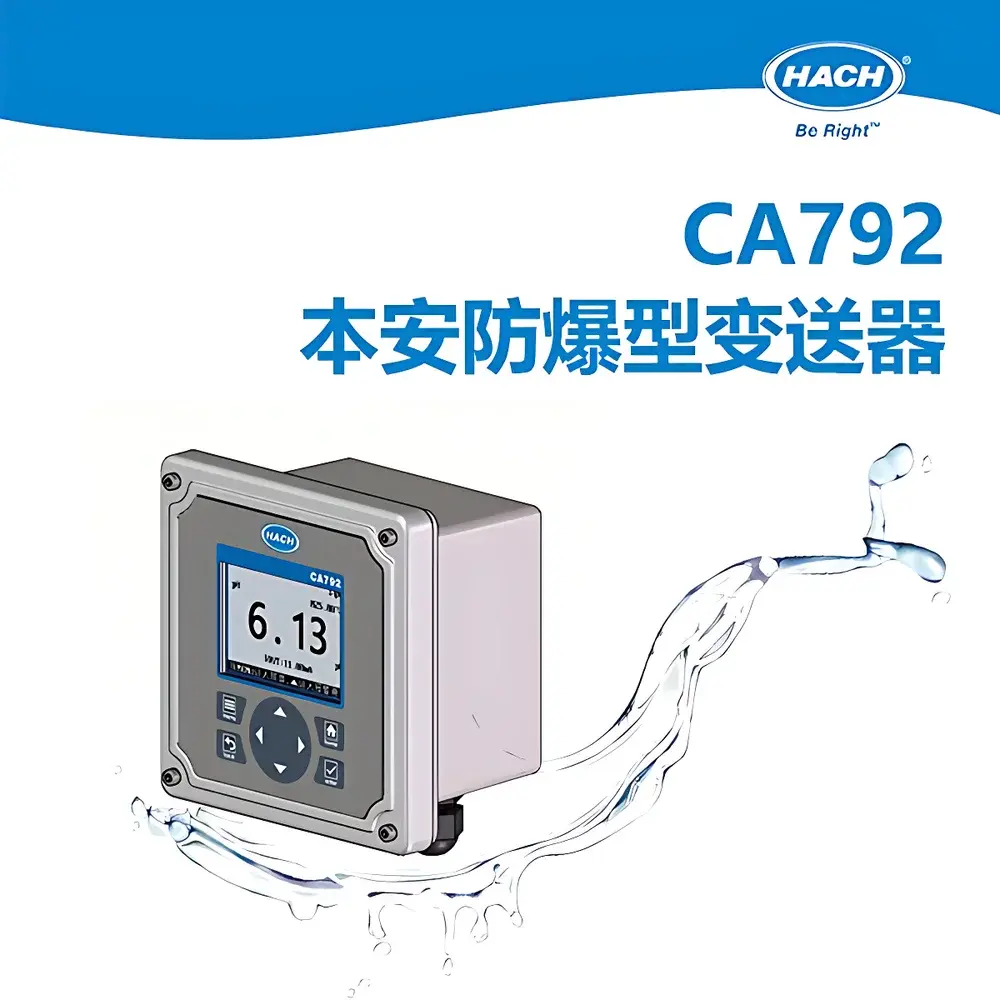
HACH CA792 Intrinsically Safe pH/ORP Transmitter
| Brand | HACH |
|---|---|
| Origin | Imported |
| Manufacturer Type | Manufacturer |
| Instrument Type | Benchtop |
| Parameter Types | Multi-parameter |
| Measurement Range | pH: −2.0 to 16.0 |
| ORP | −2000 mV to +2000 mV |
| Resolution | pH: ±0.01 |
| ORP | ±1 mV |
| Temperature Accuracy | ≤0.2 °C (PT100/PT1000) |
| Enclosure Rating | IP66 |
| Certification | NEPSI Ex ia IIC T4 Ga, compliant with GB/T 3836.x–2021 |
| Communication Protocol | HART 7 |
| Housing Material | 316 Stainless Steel with corrosion-resistant coating |
| Display | 3.5″ graphical LCD with icon-based navigation and status visualization |
Overview
The HACH CA792 Intrinsically Safe pH/ORP Transmitter is an engineered solution for continuous, reliable electrochemical monitoring in hazardous industrial environments where explosion risk mandates strict intrinsic safety compliance. Designed around the fundamental principles of potentiometric measurement—utilizing high-impedance differential amplification to detect voltage potential between a reference and measuring electrode—the CA792 delivers stable, low-drift readings across aggressive chemical matrices. Its dual-parameter capability supports simultaneous pH and oxidation-reduction potential (ORP) quantification, essential for process control in water treatment, chemical manufacturing, pharmaceutical production, and petrochemical refining. The transmitter’s architecture integrates galvanic isolation, digital signal conditioning, and embedded temperature compensation algorithms to mitigate thermal drift and ensure traceable accuracy under dynamic process conditions. As a benchtop-configurable device, it serves both permanent installation and portable verification roles, meeting the functional requirements of ISO/IEC 17025-accredited laboratories and GMP-compliant production lines.
Key Features
- Intrinsically safe design certified to NEPSI Ex ia IIC T4 Ga per GB/T 3836.x–2021, enabling deployment in Zone 0/1 classified areas without additional barrier systems
- 3.5″ high-contrast graphical LCD with intuitive icon-driven menu navigation and real-time status visualization—including sensor health, calibration history, and diagnostic flags
- Dual-parameter measurement engine supporting pH (−2.0 to 16.0) and ORP (−2000 to +2000 mV) with resolution of ±0.01 pH units and ±1 mV, respectively
- Integrated temperature compensation using PT100, PT1000, or NTC300 sensors, with accuracy ≤0.2 °C (RTD) or ≤0.5 °C (thermistor)
- HART 7 protocol support enabling multi-variable transmission—including primary measurement, temperature, sensor diagnostics, and configuration metadata—over standard 4–20 mA loops
- IP66-rated enclosure constructed from 316 stainless steel with proprietary corrosion-resistant coating, validated for extended service life in high-humidity, saline, or acidic atmospheres
- Configurable alarm logic with visual indicators and customizable threshold triggers, aligned with ISA-84 SIL 1 functional safety considerations
Sample Compatibility & Compliance
The CA792 is compatible with a broad range of HACH and third-party pH/ORP sensors featuring BNC, DIN, or M12 connectors, including gel-filled, refillable, and solid-state electrodes. It supports automatic recognition of sensor type and applies appropriate calibration curves—including NIST-traceable 2-, 3-, or 4-point pH calibrations and user-defined ORP offset corrections. For ultra-pure water applications, the transmitter implements low-conductivity pH compensation models aligned with ASTM D1125 and USP . All firmware and calibration data are stored in non-volatile memory with write-protection, ensuring auditability under GLP/GMP and FDA 21 CFR Part 11 requirements. Device configuration logs, calibration records, and diagnostic events are timestamped and accessible via HART interface for regulatory review.
Software & Data Management
Configuration, calibration, and diagnostics are performed locally via the front-panel interface or remotely through HART-compatible handheld communicators (e.g., AMS Device Manager, FieldMate). The transmitter supports secure access control with configurable password protection levels—operator, technician, and administrator—enabling role-based parameter modification. All calibration actions generate immutable entries with operator ID, timestamp, and pre-/post-calibration deviation values. Data export is supported via HART burst mode or manual dump to external logging tools. Firmware updates are delivered as signed binary packages, verified prior to installation to maintain system integrity and regulatory compliance.
Applications
- Real-time pH and ORP monitoring in chlorine dosing control loops for municipal drinking water treatment
- Neutralization process supervision in chemical effluent management systems
- Electroplating bath chemistry control in metal finishing facilities
- Bioreactor redox potential tracking during upstream pharmaceutical fermentation
- Corrosion inhibition monitoring in cooling tower and boiler feedwater circuits
- Wastewater anaerobic digestion optimization via ORP trending and setpoint feedback
FAQ
Does the CA792 support automatic temperature compensation (ATC) with external probes?
Yes—it accepts PT100, PT1000, and NTC300 temperature sensors, applying real-time compensation using built-in Nernst equation correction factors.
Can the CA792 be integrated into a DCS with Foundation Fieldbus or Profibus PA?
No—it is HART 7–only; integration with fieldbus systems requires a HART-to-fieldbus gateway compliant with IEC 61158.
Is the device suitable for use in offshore oil & gas platforms?
Yes—its NEPSI Ex ia IIC T4 Ga certification and IP66 rating meet typical offshore Zone 1 environmental and safety requirements.
What calibration standards are recommended for traceable pH verification?
NIST-traceable buffer solutions at pH 4.01, 7.00, and 10.01 (25 °C), certified to ISO 3696 Grade 2 water purity specifications.
How is sensor diagnostics reported and interpreted?
The transmitter evaluates electrode impedance, asymmetry potential, and slope deviation; alerts appear on-screen and are transmitted via HART as standardized diagnostic codes per HCF Technical Report 13.






