
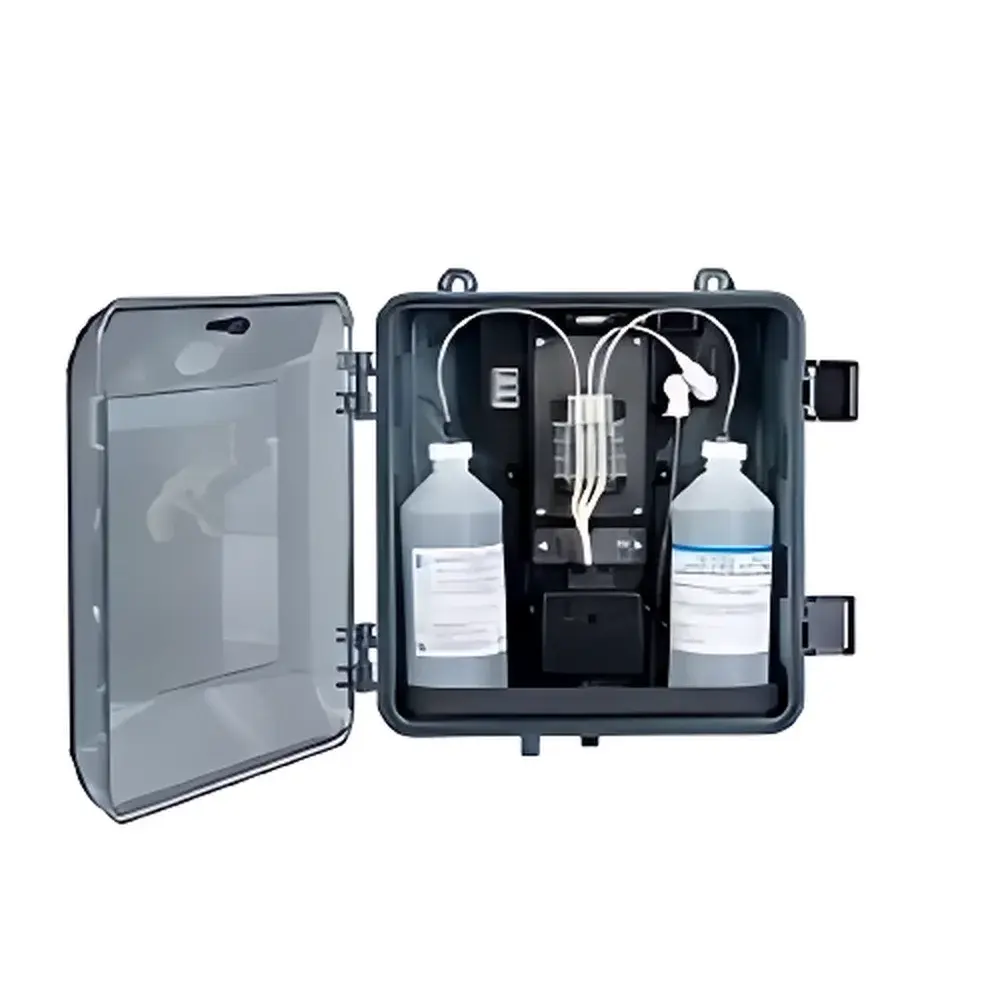
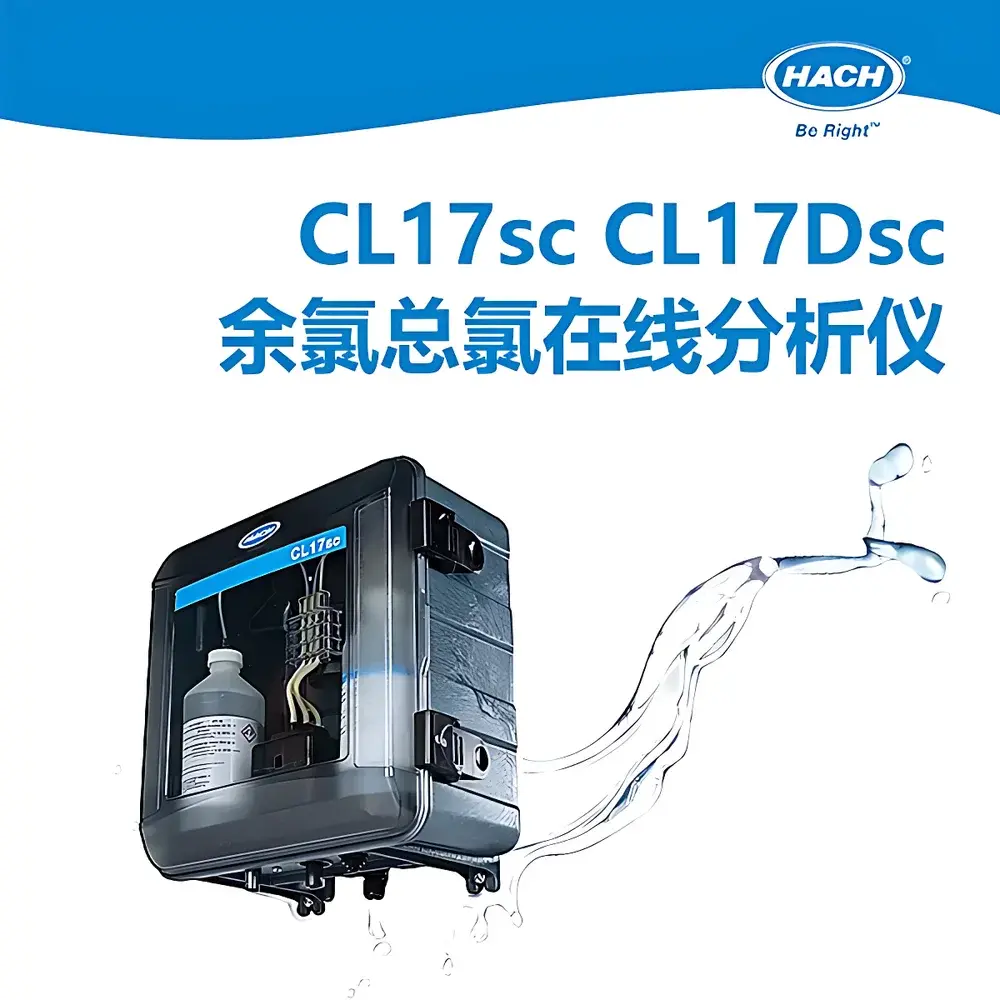
HACH CL17sc / CL17Dsc Online Residual and Total Chlorine Analyzer
| Brand | HACH |
|---|---|
| Origin | USA |
| Manufacturer | HACH Company (a Danaher subsidiary) |
| Product Type | Imported Online Analyzer |
| Model | CL17sc / CL17Dsc |
| Instrument Category | Online Residual & Total Chlorine Analyzer |
| Measurement Principle | DPD Colorimetric Method (ASTM D1253, ISO 7393-2) |
| Measured Parameter | Free Chlorine, Total Chlorine |
| Range | 0–10 mg/L as Cl₂ |
| Accuracy | ±5% or ±0.04 mg/L (whichever is greater) for 0–5 mg/L |
| Detection Limit | 0.03 mg/L as Cl₂ |
| Cycle Time | 2.5 min (standard) or 10 min (extended) per measurement |
| Compliance | Designed to meet EPA 334.0, USP <643>, and WHO Guidelines for drinking water quality monitoring |
Overview
The HACH CL17sc and CL17Dsc are fully automated, online colorimetric analyzers engineered for continuous, real-time monitoring of free residual chlorine and total chlorine in potable water, wastewater effluent, and process streams. These instruments implement the standardized N,N-diethyl-p-phenylenediamine (DPD) method—recognized under ASTM D1253, ISO 7393-2, and EPA Method 334.0—to deliver trace-level quantification with high reproducibility and minimal operator intervention. Unlike amperometric or electrochemical sensors, the CL17sc/Dsc platform relies on photometric detection of stable DPD-chlorine reaction products within a precisely temperature-controlled flow cell. This optical architecture eliminates drift associated with electrode fouling or membrane degradation, ensuring long-term stability across fluctuating sample matrices. The analyzer performs full reagent-based calibration and blank compensation at every cycle—measuring baseline absorbance prior to reagent addition to correct for inherent sample turbidity and color interference—a critical capability for raw surface water, filtered distribution systems, and reclaimed wastewater applications.
Key Features
- Automated dual-point zero and span verification using factory-calibrated standards, supporting GLP-compliant audit trails
- Integrated flow-through cuvette with quartz optical path and built-in LED photometer (515 nm), optimized for DPD oxidation product detection
- Programmable maintenance alerts and guided service routines reduce hands-on time by up to 40% compared to legacy CL17 platforms
- Modular reagent delivery system with quick-connect tubing and pre-filled, shelf-stable DPD reagent cartridges (up to 30 days operation per set)
- Multi-status LED indicator (green/yellow/red) combined with real-time diagnostic dashboard accessible via SC1000/SC200 controller interface
- Onboard flow sensor and pressure monitoring provide early warning of clogging, air entrainment, or pump failure
- Supports both 4–20 mA analog output and Modbus RTU/TCP digital communication for seamless integration into SCADA and DCS environments
Sample Compatibility & Compliance
The CL17sc/Dsc operates reliably across a broad range of water matrices—including low-turbidity finished drinking water (<0.1 NTU), secondary-treated wastewater (up to 10 NTU), and chlorinated process water in pharmaceutical clean utilities. It meets functional requirements outlined in USP for chlorine monitoring in purified water systems and aligns with WHO’s “Guidelines for Drinking-water Quality” (4th ed.) for continuous disinfectant residual surveillance. All firmware and data logging functions comply with FDA 21 CFR Part 11 requirements when deployed with HACH SC controllers featuring electronic signature and audit trail capabilities. The analyzer’s wetted materials—PFA, EPDM, and 316 stainless steel—are compatible with chlorine concentrations up to 10 mg/L and resist degradation from intermittent shock dosing events.
Software & Data Management
When paired with the HACH SC1000 or SC200 universal controller, the CL17sc/Dsc enables comprehensive data governance: internal 30-day timestamped logs (1-minute resolution), configurable alarm thresholds with email/SMS notification via optional cellular gateway, and secure export of CSV or XML datasets for LIMS integration. The embedded diagnostic engine continuously monitors reagent consumption rate, optical path cleanliness, and photometer signal-to-noise ratio—generating predictive alerts before performance deviation exceeds specification limits. All configuration changes, calibration events, and error logs are time-stamped and user-attributed, satisfying GMP documentation expectations for regulated manufacturing facilities.
Applications
- Drinking water treatment plants: Real-time monitoring of chlorine residuals at entry points, clearwells, and distribution system endpoints
- Municipal wastewater reuse facilities: Ensuring regulatory compliance for tertiary disinfection prior to environmental discharge or irrigation reuse
- Pharmaceutical water systems: Continuous verification of sanitizing chlorine levels in purified water (PW) and water-for-injection (WFI) loop sanitization cycles
- Food & beverage production: Monitoring chlorine concentration in CIP rinse water and process contact surfaces
- Power generation: Feedwater and condensate system disinfection control to mitigate biofilm formation in cooling towers and heat exchangers
- Semiconductor ultrapure water (UPW) pretreatment: Guarding against microbial breakthrough in reverse osmosis and electrodeionization stages
FAQ
What chlorine species does the CL17sc measure?
The CL17sc measures free residual chlorine (hypochlorous acid and hypochlorite ion) using the standard DPD Method 1 protocol. The CL17Dsc variant adds iodide catalyst capability to quantify total chlorine (free + combined chloramines) via DPD Method 4.
Can the analyzer distinguish between free and combined chlorine?
Yes—by selecting appropriate reagent sequences and timing protocols through the SC controller interface, users can configure discrete free chlorine, total chlorine, or differential (combined chlorine = total − free) measurements.
Is manual calibration required during routine operation?
No. The system performs automatic zero and span verification using internal reference standards at user-defined intervals (e.g., every 24 hours), eliminating need for field calibration unless validation or troubleshooting is performed.
How often must reagents be replaced?
With typical operation at 2.5-minute cycle time, one set of pre-filled DPD and buffer reagent cartridges lasts approximately 30 days. Reagent life scales inversely with measurement frequency and ambient temperature.
Does the CL17sc support remote diagnostics and firmware updates?
Yes—when connected to an SC controller with Ethernet or cellular connectivity, remote access via HACH Connect enables live parameter viewing, diagnostic review, and over-the-air firmware upgrades compliant with IEC 62443 cybersecurity guidelines.







