
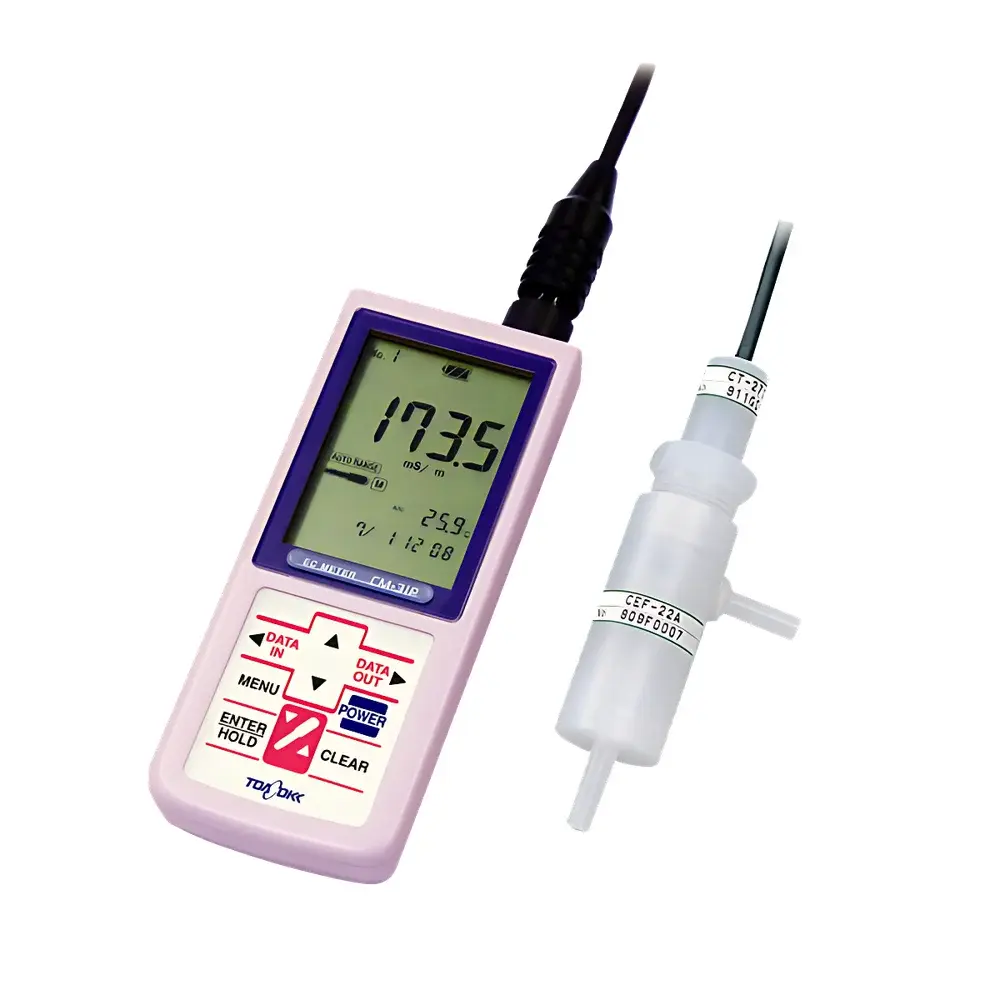
HACH CM31PW-1-1B Portable Ultrapure Water Conductivity Meter
| Brand | HACH |
|---|---|
| Origin | Imported |
| Manufacturer | DKK TOA Corporation |
| Model | CM31PW-1-1B |
| Portability | Portable |
| Conductivity Range | 0.05–200 µS/cm |
| TDS Range | 0–100 mg/L |
| Resistivity Range | 50 Ω·m–182 kΩ·m |
| Salinity Range | 0–100 mg/L |
| Temperature Range | 0–80 °C |
| Accuracy | ±0.5% FS |
| Minimum Resolution | 0.001 µS/cm |
| Electrode Constant | 0.01 cm⁻¹ |
| Repeatability | ±0.5% FS (conductivity/resistivity), ±0.2 °C (temperature) |
| Temperature Compensation | Manual/Automatic (0–100 °C) |
| Calibration | Electrode constant calibration + single-point temperature calibration |
| Data Storage | 1,000 measurement records |
| IP Rating | IP67 |
| Display | LCD |
| Output | Analog signal or RS-232C |
| Power | Two AA alkaline batteries or 100 VAC adapter |
| Dimensions | 35 × 78 × 173 mm (H×W×D) |
| Weight | 0.28 kg |
Overview
The HACH CM31PW-1-1B Portable Ultrapure Water Conductivity Meter is an engineered solution for high-precision, field-deployable measurement of low-conductivity water in critical purity applications. Designed and manufactured by DKK TOA Corporation under HACH’s global quality and support framework, this instrument employs a four-electrode conductivity cell with a certified electrode constant of 0.01 cm⁻¹—optimized specifically for ultrapure water (UPW) monitoring in semiconductor fabrication, pharmaceutical water systems (PW/WFI), power plant condensate loops, and laboratory-grade deionized water validation. Its measurement principle is based on AC-driven two-electrode or four-electrode conductance detection, minimizing polarization effects and enabling stable, drift-free readings across the 0.05–200 µS/cm range. Unlike general-purpose conductivity meters, the CM31PW-1-1B integrates temperature-compensated resistivity calculation (50 Ω·m to 182 kΩ·m) using the industry-standard 25 °C reference, supporting compliance with ASTM D1125, ISO 7888, and pharmacopeial monographs (USP , EP 2.2.38).
Key Features
- IP67-rated rugged housing ensures reliable operation in humid, dusty, or splash-prone environments—including cleanroom gowning areas and outdoor utility corridors.
- Four-digit resolution at 0.001 µS/cm enables detection of minute ionic contamination events—critical for early leak identification in UPW distribution systems.
- Dual power options: long-life AA alkaline batteries (typical 2,000-hour operation) or optional 100 VAC adapter for benchtop continuity during qualification protocols.
- Integrated CT-27111D sensor with 1 m cable and CEF-22A flow-through cell enables real-time inline or grab-sample measurement without air entrapment or thermal lag artifacts.
- Onboard temperature compensation (manual or automatic, 0–100 °C) uses NIST-traceable thermistor response, with ±0.2 °C repeatability for accurate thermal correction of conductivity values.
- 1,000-point internal memory stores timestamped conductivity, resistivity, TDS, salinity, and temperature data—exportable via RS-232C to LIMS or audit-ready spreadsheets.
Sample Compatibility & Compliance
The CM31PW-1-1B is validated for use with ultrapure water (resistivity >1 MΩ·cm), purified water (PW), water for injection (WFI), boiler feedwater, and steam condensate. Its 0.01 cm⁻¹ electrode geometry minimizes capacitive coupling and stray current interference, ensuring metrological integrity per ISO/IEC 17025-accredited calibration practices. The instrument supports GLP/GMP documentation workflows through configurable data logging, user-accessible calibration history, and non-volatile memory retention—even during battery replacement. While not inherently 21 CFR Part 11 compliant out-of-the-box, its RS-232 output and deterministic data structure enable integration with validated electronic lab notebooks (ELNs) and data acquisition platforms that enforce electronic signatures, audit trails, and record retention policies.
Software & Data Management
No proprietary software is required for basic operation; however, HACH-provided terminal emulation tools (e.g., HyperTerminal-compatible ASCII protocol) allow direct serial interrogation of stored datasets and real-time streaming. Each recorded entry includes UTC timestamp (derived from internal RTC), measurement mode identifier, sensor ID, temperature reading, and raw/conversion-corrected values. Data export follows fixed-field ASCII format (comma- or tab-delimited), facilitating ingestion into statistical process control (SPC) dashboards, Excel-based trending, or automated alarm triggers within SCADA environments. Firmware updates are performed via RS-232 using signed binary packages distributed through HACH’s secure customer portal.
Applications
- Real-time verification of point-of-use (POU) resistivity in semiconductor fab UPW loops (per SEMI F63 guidelines).
- Pharmaceutical facility PW/WFI system validation and routine release testing per USP and EU GMP Annex 1.
- Monitoring condensate purity in nuclear and fossil-fuel power plants to detect steam generator tube leaks.
- Field verification of deionizer and EDI module performance during commissioning and preventive maintenance.
- Academic and industrial research requiring trace-level ion quantification in low-ionic-strength aqueous matrices.
FAQ
What electrode constant is used—and why is it critical for ultrapure water?
The CT-27111D sensor features a certified 0.01 cm⁻¹ electrode constant, which extends measurement sensitivity into the sub-0.1 µS/cm range while maintaining linearity and minimizing stray capacitance errors common in high-resistivity media.
Can the instrument perform automatic temperature compensation across the full 0–80 °C range?
Yes—automatic compensation is enabled across 0–100 °C using the built-in thermistor; however, the specified measurement range for conductivity remains valid only up to 80 °C per sensor thermal rating.
Is the 1,000-record memory retained after battery replacement?
Yes—data storage resides in non-volatile flash memory and persists independently of power source status.
Does the device meet any international ingress protection standards?
It carries an IP67 rating per IEC 60529, confirming dust-tightness and resistance to immersion in 1 m of water for up to 30 minutes.
How is calibration traceability maintained?
Electrode constant calibration is performed using certified KCl standard solutions (e.g., 0.01 mol/kg); calibration logs—including date, operator ID, standard lot number, and deviation values—are stored alongside measurement data.





